Is Syracuse University haunted? We ghost hunted so you don’t have to.

Get the latest Syracuse news delivered right to your inbox.
Subscribe to our newsletter here.
Editor’s note: This article includes mention of violence and suicide.
For all of human history, they have been unexplained by science.
Tibetan Buddhists believe that they exist in a liminal space before reincarnation. Islamic tradition holds that the just ones can give hidden knowledge, while the impure ones seek revenge. Jesus’ followers believed he was one of them when he was resurrected.
Ghosts.
“Science is not oriented to proving that things don’t exist, we can only do that by showing other things that do exist,” said Gareth Fisher, a religion professor at Syracuse University who teaches a course on ghosts and belief. “We try to look at what people believe, and we don’t get into the real question of whether it’s true or not.”
Bird Library has a ghost hunting kit in its new “Library of Things” collection. Syracuse has some of the most paranormal activity in the country — a survey from 2023 ranked it as the fourth most likely city to have ghosts. So, I decided to check the kit out and see if SU has ghosts.
Here’s what I found:
How to hunt
I’ve never had a paranormal experience or touched a ghost hunting kit. So, I contacted Monica Kinner, vice president of CNY Ghost Hunters, for clarification on how to use the kit’s tools. Ironically, Kinner said she was scared of ghosts as a kid.
“I’m less afraid now because I know how to talk to them, and I almost feel as though I can turn it on and turn it off when I am investigating,” Kinner said. “But every now and again, it’ll creep up on me.”
The kit includes a digital recorder, an AM/FM radio and an electromagnetic field reader. The kit’s radio and recorder are like any other. You go to the haunted location, start recording and ask the ghost a series of questions (with some pauses in between to allow the ghost to talk back). After you leave, you play back the recording and ideally hear responses to your questions that your naked ear couldn’t catch.
Electromagnetic activity from the EMF reader can indicate the presence of spirits, but make sure you’re not near lights, outlets or anything else that might manipulate the EMF test, Kinner said. When doing your hunt, you’ll want to hold the reader up in the air and find a spot where the EMF reader isn’t reading electromagnetic activity. Then you put the reader on a table and ask the spirit if it can get closer. If there’s a spirit, the reader will light up, Kinner said.
The line of questioning for the ghosts resembles a line of investigation questions on a polygraph exam or, thankfully for this journalist, a reporting interview.
“Sometimes we’ll ask questions that we know aren’t true,” Kinner said. “Because that’s how we know if we’re getting an intelligent spirit or someone who’s messing with us.”
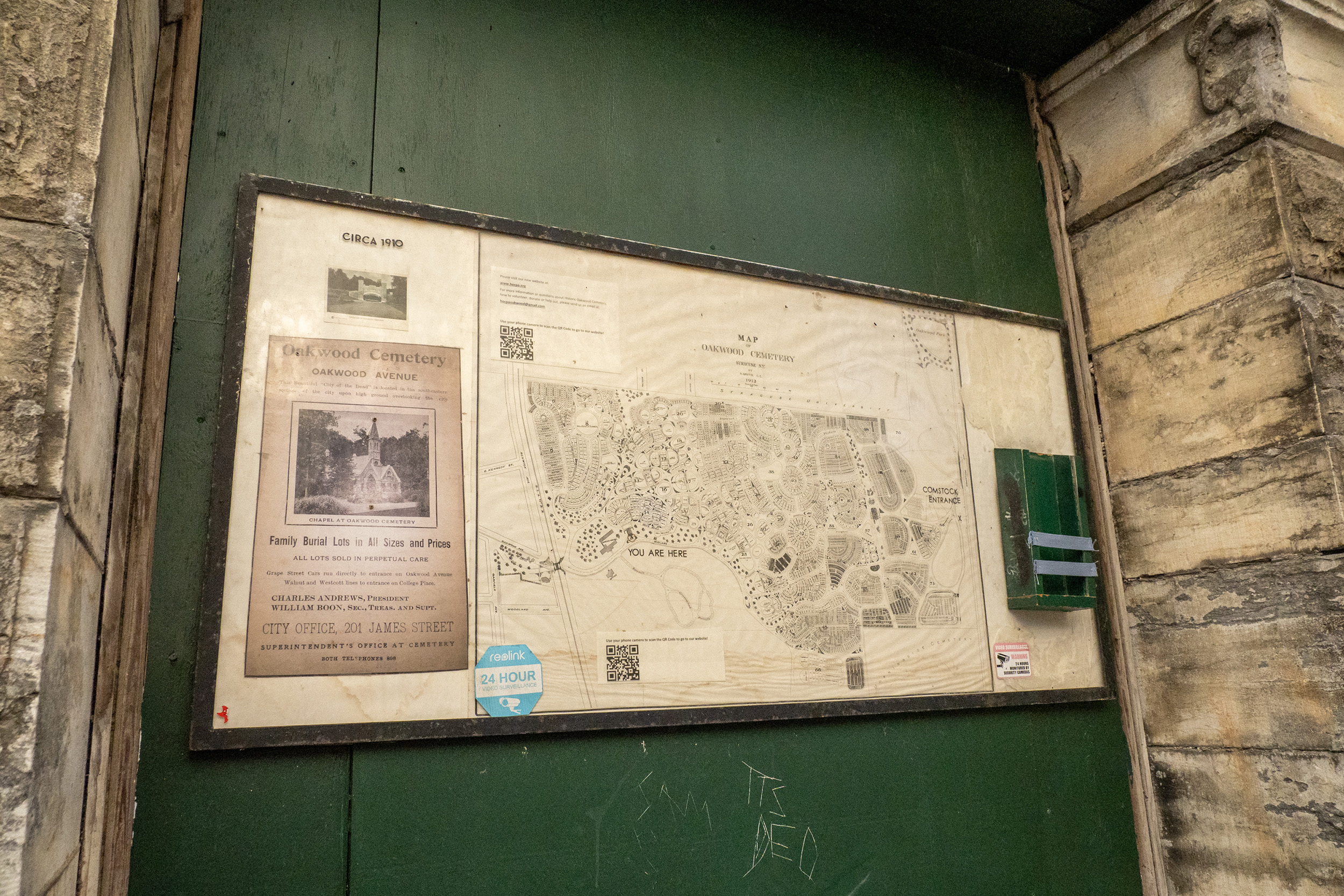
The Daily Orange took Bird Library’s ghost hunting kit to Oakwood Cemetery to communicate with any potential ghosts in the area. Aside from crows cawing and the wind blowing, we didn’t find any ghosts. Lars Jendruschewitz | Senior Staff Photographer
Is Syracuse University haunted?
The short answer? A little haunted. Students shouldn’t expect to see poltergeists flying out of windows or hear banshees shrieking every night, but there’s a handful of documented claims of paranormal activity on and off-campus. Some students living in the university neighborhood even say they have “roommates” who aren’t paying rent and utilities.
An article in New York Folklore from the late ‘90s suggests Slocum Hall is haunted by the victim of a grisly murder-suicide. In 1921, Dean J. Herman Wharton of the College of Business Administration (now Whitman School of Management) was murdered by Holmes Beckwith, a professor who believed Wharton was responsible for firing him. Beckwith committed suicide immediately after.
John Harris, a paranormal investigator who runs Pride Paranormal NY, advised me not to ask Beckwith about the murder immediately — its poor form to bring up death in ghost hunting because ghosts don’t like to talk about it. Generally, Harris said, questions should lead with a genuine interest in the ghost’s life, work and personal history.
“Ghosts don’t haunt a place because they died there, they haunt a place because they have a biological desire to be alive,” Harris said. “It’s life that we’re interested in.”
So I sat in Slocum asking the deceased Beckwith about his life and his Ph.D. dissertation, which focused on German-style vocational education. But he didn’t share his theories about how work studies would help American students. He didn’t say anything at all.
When I started pressing Beckwith about the murder 10 minutes later, some architecture students knocked on the door and asked me if I still needed the room to talk to the air. That was my cue to leave for the night.
I didn’t hear a response from the recorder on playback, leaving me curious about Beckwith’s take on vocational education — and his motives for murdering his boss a century ago.
Harris also pointed me to Oakwood Cemetery next to the Mount, where he’s taken Fisher’s class REL 381: Ghosts and Ghostbusters on tours. Oakwood was planned as a cemetery park, meaning it was intended to be a place where the living would spend time honoring the dead. Because Oakwood was planned to be communal, the ghosts are more talkative there, Harris said.
When I went at twilight, the ghosts weren’t interested in chatting. I walked up to a grave and asked a Civil War veteran who the president was, but when I played the recording back I didn’t hear any ghostly voices whispering Abraham Lincoln’s name or praising the Union Army. All I heard were the crows cawing.
Maybe I just couldn’t hear the voices coming through the speaker. Kinner said that might happen — over time, hunters become more attuned to hearing phenomena through the speaker. Rookies don’t usually succeed.
“Some people can hear them right out of the gate, but for other people it takes years,” Kinner said.
Believe it or not
People believe more in ghosts now than ever. In 2024, four in 10 Americans surveyed said they believe in ghosts. Fisher attributed this to a rise in decentralized information, which allows for fringe ideas to develop. Social media is a hub for this, he said. In addition, the rise in distrust in institutions like the media, government and organized religion, have made people become more conspiratorial, he said.
Fisher doesn’t believe in the science of ghost hunting, but ghosts are about belief, not proof. The point of religion classes is to explore belief and why people believe in things, not prove whether things are true. Beliefs aren’t debunked but explored in his courses, Fisher said.
“In order to understand how society works, or human psychology, it is only important that people believe something is true,” Fisher said. “None of it matters, whether the thing is really true or not.”
But ghost hunters do believe they can develop a methodology to prove the existence of ghosts. Harris compared ghost hunting to other scientific developments like chemistry. Before it was called chemistry, the science of matter was called alchemy and was mostly focused on transmuting metals into gold, he said. Alchemists never had much success, but their techniques were foundational to modern lab experiments.
Most real ghost hunting isn’t sensational, like what you’d see on TV. Kinner and Harris both pointed out that most of their time is spent in dark rooms in dead silence with no one responding.
In the end, it doesn’t really matter if you encounter a ghost while you’re hunting. Fisher said a key learning objective of his class is to challenge what people believe. Students come into class skeptics or doubters, and walk out with their minds open to new ideas — which is the point of every religion course he teaches.
I checked the kit out as a skeptic, and I returned it understanding how subjective belief can be. But maybe I went into the whole thing wrong, and my skepticism held me back.
“(Belief) plays a role as well, because maybe they don’t want to talk to you if you’re trying to debunk them,” Kinner said. “Why would I want to talk to somebody who doesn’t believe in me?”
My advice to any burgeoning ghost hunters: If you want to find something, believe in it. Also, if you go to Slocum Hall to hunt, try to make sure students don’t need the room you’re hunting in. It gets a little awkward.