Whitman launches new Experiential Center dedicated to hands-on learning
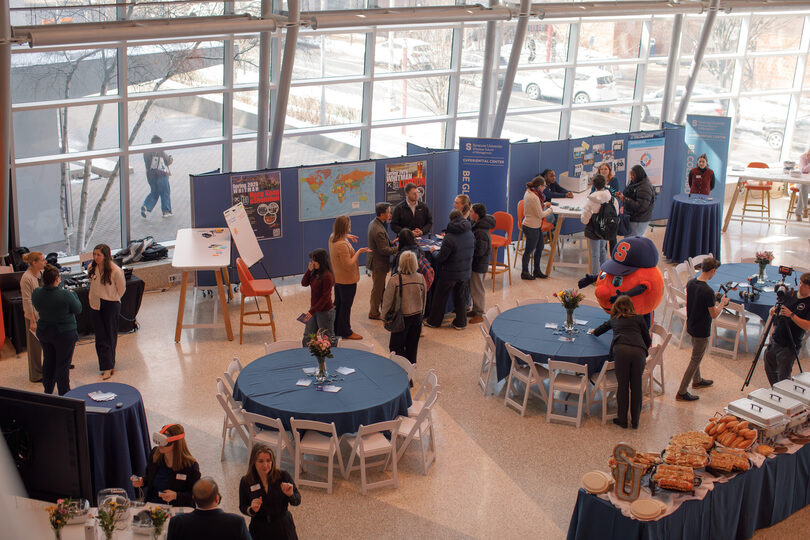
Best business education doesn’t only happen in a classroom.” SU’s Whitman School of Management launched its Experiential Center at a ceremony Wednesday. The center is part of the school’s push to modernize business education. Avery Magee | Photo Editor
Get the latest Syracuse news delivered right to your inbox.
Subscribe to our newsletter here.
Syracuse University’s Whitman School of Management launched its Experiential Center at a public ceremony Wednesday, marking another move to increase its notoriety among national business programs.
A central aspect of Whitman’s “Transformation 2030” push for modernized business education, the center will expand hands-on, experience-based activities already available with enhanced technological, research and professional development opportunities.
Alexander McKelvie, Whitman’s interim dean, spoke to an audience of faculty, students, Otto the Orange and Chancellor-elect Michael Haynie, hailing the program as an “essential centerpiece” of the “Whitman experience.”
“Transformation 2030 is Whitman’s roadmap to become a top 25 undergraduate business program, given that the best business education doesn’t only happen in a classroom,” McKelvie said.
This effort to elevate the school’s reputation is not only a curriculum boost, but a “defining commitment” the school pledges to its students, McKelvie said.
Flaum Grand Hall’s four corners highlighted the four pillars of Whitman: collaboration, innovation, global study and preparation. The “innovation corner” introduced Virtual Speech, a program that combines interactive virtual reality with artificial intelligence to engage users with mock interviews, presentation practice and communication practice in real time.
Lynne Vincent, chair of the management department at Whitman, said the featured program is not meant to just enrich an educational experience but take pedagogical strategies from “theory to practice.”
“We are taking education from the classroom to the real world … taking what you learn in the classroom and figure out, ‘how does this actually apply, and how do I develop my skills there?’” Vincent said.
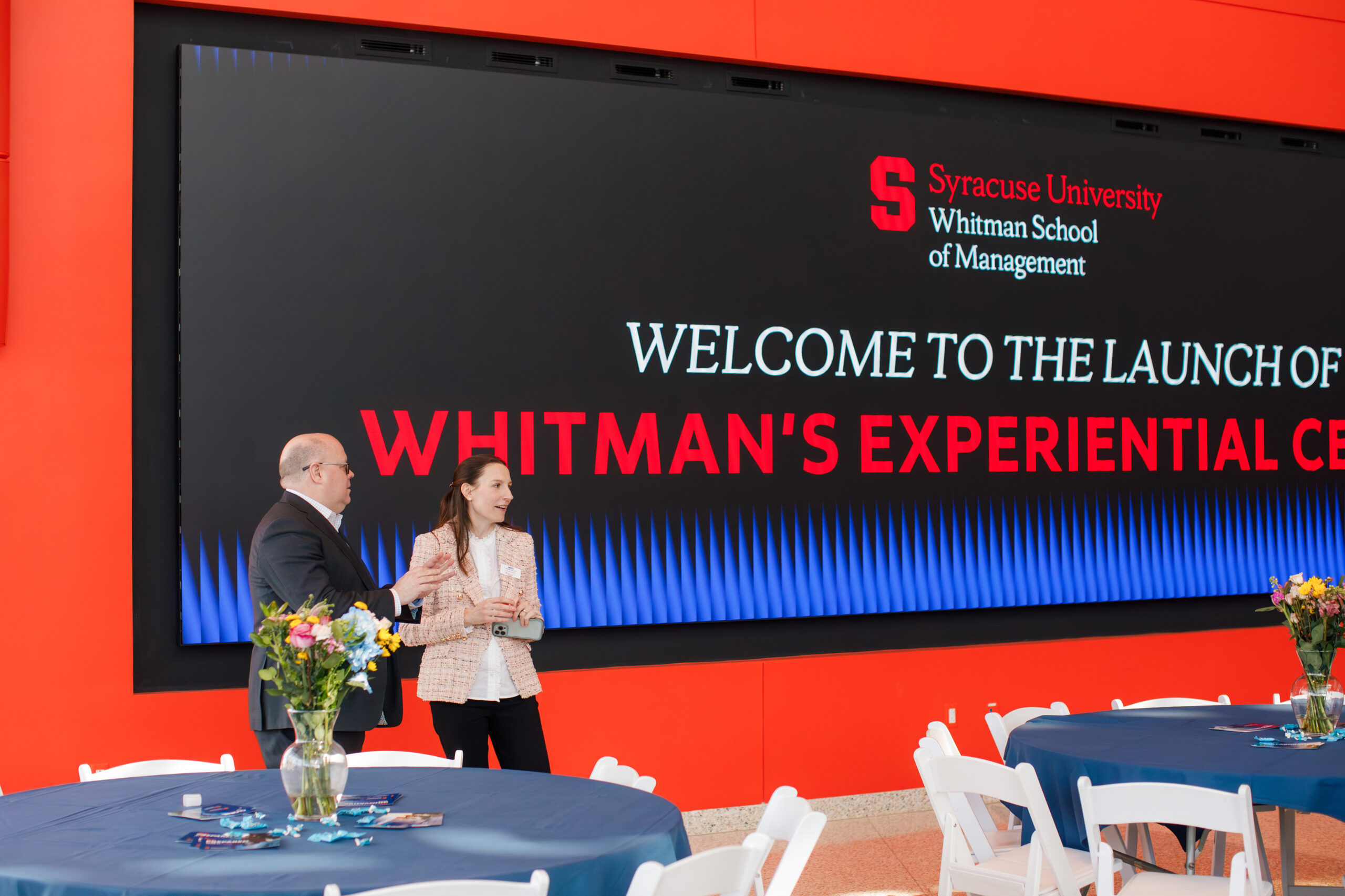
Avery Magee | Photo Editor
As future business leaders are in their collegiate years, Whitman is looking to not only develop its prestige, but also the talents of those earning their degrees.
Vincent added programs like Virtual Speech are truly engaging by being fun but with a purpose, she said.
“All of these centers and everything that they’re doing really can make an impact in their skill development,” Vincent said.
Moreover, programs like Virtual Speech aim to increase accessibility and availability of resources that can improve the concrete skills students need to stand out in the job market, she said. Over 450 students in MGT 248: Managing and Leading People in Organizations, a “core” class, have access to the programs for immediate use.
The new program aims to engage students with the corporate world they seek to enter and connect them with academic skills and professional development.
“Experiential learning happens everywhere at Whitman, and that’s exactly how it should be,” Erin Draper, Whitman’s director of experiential programs, said during remarks at the event.
Practical, job-ready skills are already a focal point of a Whitman education, and students have learned how to foster the opportunities Transformation 2030 presents. Olivia Simons, a Whitman senior, said that even though she is finishing up her time at SU, she sees immense value in the prospect of the program.
“It’s a way for (students) to step outside their comfort zone but have the support they need, and it makes going out and learning about the professional world so much easier,” Simons said.
The programs the Experiential Center provides are “genuinely important,” Experiential Programs Coordinator Melissa McFarlane said while supervising the “collaboration” corner of the forum. Whitman’s leadership seeks to get students out of the classroom, take what they’ve learned there and implement it in the real world, McFarlane said.
As future business leaders are in their collegiate years, Whitman is looking to not only develop its prestige, but also the talents of those earning their degrees who will represent SU at the corporate level.
“Understanding how to communicate with each other and what role you play in the team, it’s really important to make you successful,” McFarlane said.