Action-thriller ‘Normal’ disappoints with predictable, lifeless plot
Get the latest Syracuse news delivered right to your inbox.
Subscribe to our newsletter here.
Action movies can be far more than unnecessary explosions, trivial plots and predictable moments. Some go beyond those stereotypes with meaningful storylines and blood-pumping sequences: the sprawling revenge saga of “Kill Bill: The Whole Bloody Affair,” the Elysian Fields of “Gladiator” and Tom Cruise’s death-defying stunts in the “Mission: Impossible” series to name a few.
Then, there’s “Normal.”
Released on Friday in the United States, the Ben Wheatley-directed action flick is fittingly predictable and lifeless — as the name suggests. Bob Odenkirk’s lead performance is the only aspect that makes the film watchable, and even still, he’s not enough to save “Normal” from its painfully underbaked storyline and cheap thrills.
The film begins in Japan with a ruthless Yakuza (a Japanese organized crime syndicate) boss reprimanding his henchmen, then sending one of them to the fictional town of Normal, Minnesota.
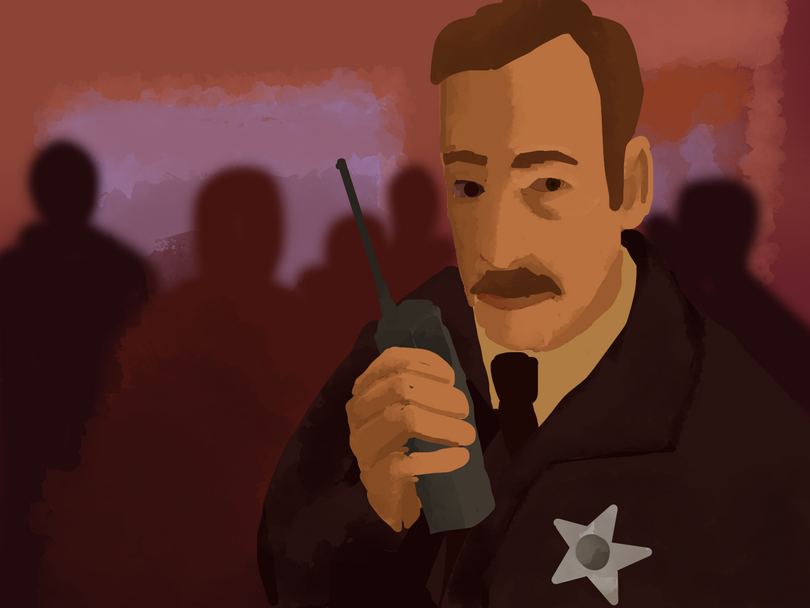
After the death of the town’s sheriff, the mild-mannered Ulysses Richardson (Odenkirk), assumes the role of Normal’s interim sheriff. Ulysses’ interactions with locals hint that the seemingly lowkey town is part of a larger, dark scheme; a yarn store shopkeeper has a police scanner on her desk and another merchant keeps a storage cabinet equipped with too many padlocks.
When Ulysses responds to a bank robbery, his two deputies fire their guns at him, uncovering the town’s corruption. Ulysses survives, discovering gold bars and a weapons cache in the bank’s vault, which are linked to the Yakuza. The henchman that was sent to Normal is disguised as a bank security officer and alerts his higher-ups about the situation.
The rest of “Normal” follows Ulysses and various allies as they battle against the town and the Yakuza.
One scene perfectly encapsulates the film: A deputy extinguishes a dynamite fuse with his hand and calls himself a hero, then immediately — and predictably — gets blown up. Some moments, like this, try to be playful, but they’re just ridiculous.
Derek Kolstad, writer of “John Wick” and “Nobody,” has proven he can craft moments of visceral violence. But in “Normal,” he swaps tight sequences for routine — sometimes cartoonish — action. John Wick (Keanu Reeves) memorably killed two men with a pencil, but Ulysses wields a grenade launcher. Odenkirk’s character in “Nobody” performed a field tracheotomy with a knife and a plastic straw; in “Normal,” we see somebody get knocked out by a falling building sign.
Unfortunately, Kolstad dilutes more than just action with his lazy script. With Ulysses, Odenkirk is playing a watered-down, mustached-silhouette of his character in “Nobody.” Ulysses feels stagnant, even when he’s kicking ass — hopefully Odenkirk isn’t in a typecasting cycle.
Is Odenkirk’s performance good? Yes. But did he bring anything surprising to the table? Absolutely not. But to be fair, Kolstad wrote another familiar action story starring Odenkirk as a supposedly run-of-the-mill guy.
A rare, interesting tidbit about Ulysses is his estranged wife. Although she doesn’t physically appear in the film, Ulysses leaves her voicemails throughout the movie. Because of this separation, Ulysses forms a platonic bond with Alex Gunderson (Jess McLeod), the grieving daughter of the town’s dead sheriff.
In one of the film’s best scenes, Ulysses finds Alex intoxicated behind the wheel of her car. Instead of arresting Alex, Ulysses shares a drink with her.
“Normal” ends with Ulysses taking an interim sheriff job in another place, and Alex becomes his deputy. If a sequel is made, hopefully Wheatley dives deeper into this bond.
Otherwise, Kolstad severely underdeveloped many aspects of “Normal.” For starters, there’s no explanation for why the Yakuza are hiding weapons and currency in the Minnesota town. But the biggest waste are the themes that Kolstad hints at and doesn’t explore.
“Normal” had the opportunity to discuss the corruption of small U.S. towns, but instead used the idea as a backdrop.
This theme came in the form of a recurring moose, adding to the town’s offbeat and abnormal feel. But even the moose, which popped up in multiple scenes, felt surface level. In one scene, Ulysses sees what appears to be a blood trail outside his motel, but really, the moose had gotten into a can of red paint.
While “Normal” contains some entertaining action sequences, its predictability and shallow plot strand a talented Odenkirk in the Minnesota snow.