‘Deeper losses’: A&S faculty, students react as SU sunsets 9 majors
Get the latest Syracuse news delivered right to your inbox.
Subscribe to our newsletter here.
When Alexandra Brownstein chose to major in Middle Eastern studies at Syracuse University, she expected the program would still exist for students who came after her. Now, finishing her final semester, she’s among the last who will be able to declare it.
“When I leave this university and graduate in May, and when people ask, ‘What did you study? Or, for future generations, when my kids ask, ‘What did I study?’” Brownstein said. “That that’s not going to be an option for them … is just highly disappointing.”
Brownstein is one of several students, faculty and alumni affected by the outcomes of SU’s College of Arts and Sciences academic portfolio review, ordered by Vice Chancellor and Provost Lois Agnew in August 2025. As part of the review, 18 Arts and Sciences majors were paused in September, removing them from the Common Application while departments submitted stabilization plans.
The nearly eight-month-long process left many in affected programs “uncertain” and raised concerns about the metrics behind the decisions, the transparency of the review and the future of humanities at SU.
In a March 20 email to department chairs obtained by The Daily Orange, Dean Behzad Mortazavi announced that nine majors will be “sunsetted,” meaning incoming students cannot declare them beginning this fall. Those majors are:
- Classical civilization
- Classics (Greek and Latin)
- Digital humanities
- Fine arts
- German
- Latino-Latin American studies
- Middle Eastern studies
- Modern Jewish studies
- Russian
Three majors — African American studies, religion and music, history and cultures — will be “re-envisioned,” and five others will merge, consolidate or rebrand. Courses in sunsetted majors will continue through “minors, general education and/or interdisciplinary programs,” Mortazavi wrote. Students currently enrolled will be able to complete their degrees.
The nine Arts and Sciences majors are among several SU announced on April 1 that would sunset university-wide. Of the listed majors and programs, 55 had zero enrolled students and many were already closed, inactive or restructured before the review concluded.
For several faculty and students, the word “sunsetting” itself became a point of contention. Karina von Tippelskirch, coordinator of SU’s now-sunsetted German major, said the language used by the university to describe the closures didn’t encompass the full impact of the portfolio review.
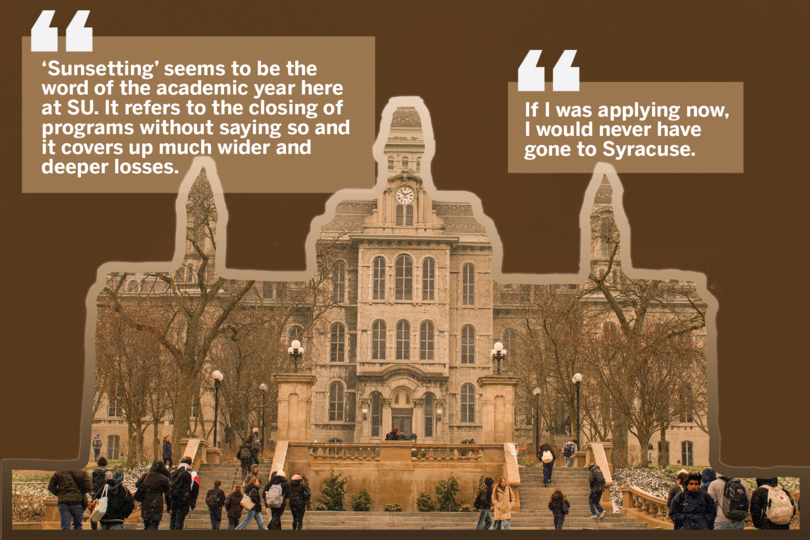
“‘Sunsetting’ seems to be the word of the academic year here at SU,” von Tippelskirch wrote in a statement to The D.O. “It refers to the closing of programs without saying so and it covers up much wider and deeper losses.”
She wrote that the nine closures — all in the humanities — indicate SU is not just changing academic offerings but its “identity,” reflecting what she described as a shift toward valuing “quantity over quality, numbers over people, more of the same over cultural and intellectual diversity, marketability over critical thinking.”
Lucy Lee-Moore, a junior classics and anthropology major, said the language shift from “pausing” to “sunsetting” felt deliberately “secretive,” noting a lack of clear communication from the university.
“The language of sunsetting feels so insidious,” Lee-Moore said. “Okay, you’re canceling our majors, you’re getting rid of them. It’s not a beautiful sunset … If I was applying now, I would never have gone to Syracuse.”
In a previous statement to The D.O., a SU spokesperson said decisions to close programs are not subject to faculty vote within individual colleges or schools because they require a full financial and institutional picture.
“Our approach at Syracuse University is consistent with standard practice across higher education,” the spokesperson said. “Policies vary by institution, but a binding faculty vote on program closures is rare.”
SU’s cuts come as humanities programs face growing pressure nationwide amid a broader crackdown on higher education. Across public and private institutions, departments tied to the humanities and diversity-related fields have been restructured, consolidated or eliminated. The shifts are driven by declining enrollment, budget constraints and intensifying political scrutiny, including from the Trump administration over DEIA efforts and academic priorities.
Classics Chair Jeffrey Carnes said he refused to use the “sunset” term entirely, calling it one of the ways the university softened what was, in his view, a predetermined outcome.
Several faculty also questioned whether the number of declared majors alone could capture the value of what they offered. Carnes said the classics program had seven declared majors across a two-person department — a metric he said the review didn’t fully account for.
Modern Jewish Studies Director Zachary Braiterman concurred, saying he doesn’t believe the university does enough to support the humanities.
“From their perspective, why do you need a major if nobody’s majoring?” Braiterman said. “But, the flip side of it is that the university does nothing to encourage students majoring in the humanities … It’s very anti-intellectual.”
Braiterman and Middle Eastern Studies Director Yael Zeira said they were informed their respective majors were closing in early February — weeks before Mortazavi’s email announcing the nine programs went out. Zeira wrote to affiliated faculty the following day that the dean’s office had decided to “teach out” the program.
“I believe it undermines shared governance and is also quite shortsighted,” Zeira wrote in a statement to The D.O. “At a time when the U.S. is undertaking its largest military operation in over 20 years — again in the Middle East — the University should be expanding opportunities for students to study the region, not cutting them.”
Brownstein, who holds an international relations major with a Middle East and North Africa regional concentration alongside her MES major, said the timing was hard to reconcile with ongoing conflicts in the region. She said low enrollment numbers don’t excuse the university’s “lack of transparency.”
Some are concerned about what will happen to programs, including minors and individual courses, once faculty retire or contracts aren’t renewed.
Russian coordinator Erika Haber is retiring in December and said SU has not hired a replacement. Without faculty to staff upper-level classes, Haber said, sustaining a minor isn’t realistic.
“Considering the world today, we desperately need Americans who know not only the Russian language, but the culture and literature as well,” Haber said. “It’s a critical language and a loss to SU if we lose the opportunity to teach it.”
Jean Jonassaint, a French professor and graduate advisor, said he’s watched the languages department shrink since joining the university in 2005. While the French major will continue as a track in the world languages and cultures major, he said he’s concerned it will be similarly phased out in the future alongside higher-level degrees, such as the Ph.D. in English.
In an email to The D.O., Jonassaint said that faculty bear some responsibility for the program’s closure, though he largely blamed the administration, which he said “doesn’t think that humanities matter.”
“We lost every single possibility to have our say in this university, completely. There is no way for us to be able to move even a stone,” Jonassaint said. “It’s all top down, top down, top down, without transparency, without any discussion.”
Beginning this fall, German and Russian students will be directed toward a new world languages and cultures major. While French and Italian remain standalone concentrations requiring 27 credits, German and Russian will only continue in a combined track where students can take 15 credits of two languages.
Gail Bulman, the chair of SU’s Languages, Literatures and Linguistics (LLL) department, said the administration rejected her department’s proposal to include German as a main concentration in the world languages and cultures major.
Bulman attributed the decision to low enrollment in higher-level courses and a lack of declared majors, despite attempts from faculty to increase student interest. She said the LLL department has not been allowed to search for new faculty to replace those retiring in “quite a few years,” and expressed concern over the longevity of courses if there’s limited faculty.
“Right now, we should be strengthening and supporting the humanities, especially at this time, more than ever,” Bulman said. “So, it’s very disheartening that all of these changes, or most of these changes, are affecting the humanities more than anything.”
When asked about plans for hiring new faculty, an SU spokesperson said hiring proposals are submitted annually by deans and are contingent on “enrollment trends, student demand, program direction, and anticipated retirements.”
“Decisions about future faculty lines in any program will reflect the outcomes of the review and the long-term direction of the program,” the spokesperson said in a statement ahead of the review’s release.
Anna Meehan, a Russian language, literature and culture major, said in an email to The D.O., she wasn’t surprised her major was closing, but questioned why Russian wasn’t made a primary track in the new major alongside French and Italian.
She said she was “deeply appalled” by the word choice in Agnew’s email, suggesting the review would ensure SU offers programs “worthy of (students) time.”
Not every program outcome was met with resistance. Art History and Architecture History Chair Wayne Franits welcomed his programs’ consolidation, saying the two “so obviously complement one another” and are frequently combined at other institutions.
Theo Cateforis, director of undergraduate studies in both fine arts and music history and cultures, said current students will still be able to complete the fine arts major, and that music history and cultures — designated for re-envisioning — will continue its full course offerings under a revised curriculum.
In the mathematics department, geometry professor Steven Diaz said folding statistics into an applied mathematics track was a reasonable response to the department’s difficulty recruiting statisticians, though he raised questions about how voluntary the decision really was.
“I got the impression that while, in the end, it was our initiative, the dean made it clear to us that we better come up with something,” Diaz said.
The religion department — one of three majors designated for “re-envisioning”— had already restructured its major the year before the review began, simplifying requirements and creating more pathways for students to declare, Chair Gareth Fisher said. He added the department was able to demonstrate a “proactive” plan for growth, which he believes influenced the outcome.
“Re-envisioning is not something that was done to us. It was something we were already doing … it was just labeled in a particular way,” he said, noting that the administration has not provided any clear guidelines on what being “re-envisioned” requires going forward.
While Bulman said the announcement to pause majors lacked transparency and collaboration in terms of shared governance, she acknowledged the relationship between faculty has since improved. She added that, since September, there has been more productivity between faculty and administration.
In the African American studies department, professor Horace Campbell raised a different concern about what the “re-envision” label means in practice. He said the department has lost seven or eight faculty over the past seven years without replacements.
“You cannot re-envision something after you’ve destroyed it consciously over the past seven years,” he said. “In other words, they’re predisposing the faculty to failure, and then they blame the faculty.”
He said the review raised broader questions about what kind of institution SU wants to be, adding he believes administrators acted out of political pressure rather than academic judgment.
“There are concerns about the derogation of humanities,” he said. “The philosophical question here is not about African American studies. It’s about a technocratic vision that disarms the citizens from all around thinking.”
Philip Arnold, religion professor of 30 years, whose own department avoided closure, said relief over religion’s outcome was tempered by the loss of programs like classics, which he said had connected faculty across disciplines, including ancient history, language, archaeology and religion.
“I mourn the loss of some of the programs,” Arnold said. “You might save a few bucks on not having a program … but what’s the cost to us being a university?”
Von Tippelskirch, in her statement, addressed the university’s framing directly.
“When the sun is setting, the world becomes darker and less bright,” she wrote. “You may say that the sun is always rising. But for the B.A. in German Language, Literature and Culture and 92 other programs that the university is now closing, this will not be the case.”