At Goldstein checkout, SU student cues human connection with daily questions
Get the latest Syracuse news delivered right to your inbox.
Subscribe to our newsletter here.
Abram Speek has been working in Goldstein Food Hall since his sophomore year. But this semester, when his job tightened regulations on phone usage during shifts, the Syracuse University senior looked for ways to cure his boredom.
So, he started asking questions.
Each shift at the checkout counter, Speek probes the same question to passing customers. The question changes every shift, but Speek aims to keep them “deep but not personal” — just enough to make customers stop in their tracks. Each customer’s answer is recorded on Speek’s sheet of paper, a sea of tally marks representing the various hot takes he hears throughout the shift.
His goal is simple: to spark genuine human interaction between strangers.
“I generally feel like the way that Syracuse campus is, it does not have a lot of interaction,” Speek said. “People don’t have a lot of overall interaction with random people on campus. I wanted to increase that and have those random interactions in your day that brighten your day.”
As a linguistics and international relations major, Speek said he’s always been fascinated by varying human behaviors. Conversation comes easily to Speek. It’s why questions were a no-brainer to cure his boredom during shifts.
“I just have a genuine want to have an understanding for people and how they work and how society works,” Speek said.
Speek’s first-ever question was an arguably controversial one: “What is the best state?”
The seemingly straightforward question invited passionate debates among state loyalists and rivals. Pennsylvanians had a blind support for their home state, even if they admitted they didn’t love living there. New Jerseyans and New Yorkers took the opportunity to hate on each other.
Even Speek himself couldn’t lock down one answer; Vermont is close to home, but Massachusetts is where he’s from. He couldn’t choose between the two.
At the time, Speek was conducting a research project on politeness in the Northeast. He decided to use his customers as a population sample to gauge the makeup of the student body and what states they like the best. It’s not the most scientific research method, but enough for him.
Now, the questions come naturally. He rarely thinks of them ahead of time, instead brainstorming as his shift begins.
The first 10 customers are Speek’s test sample; he asks different types of questions, field testing with the first few customers who come through. By the 10th person, he usually finds one that sticks. That’s when he brings out his paper and pencil to keep track of the results for the rest of the shift. Answers are written down on whatever Speek finds underneath the checkout desk, on the back of leftover papers or shipping labels.
After his third or fourth shift of asking questions, Speek said someone came up to him asking what the question of the day was before he even began ringing him up. That’s when Speek knew the questions resonated with his customers. And it has. Now, students often stop him on campus, recognizing him as “the guy who asks questions at the checkout counter.”
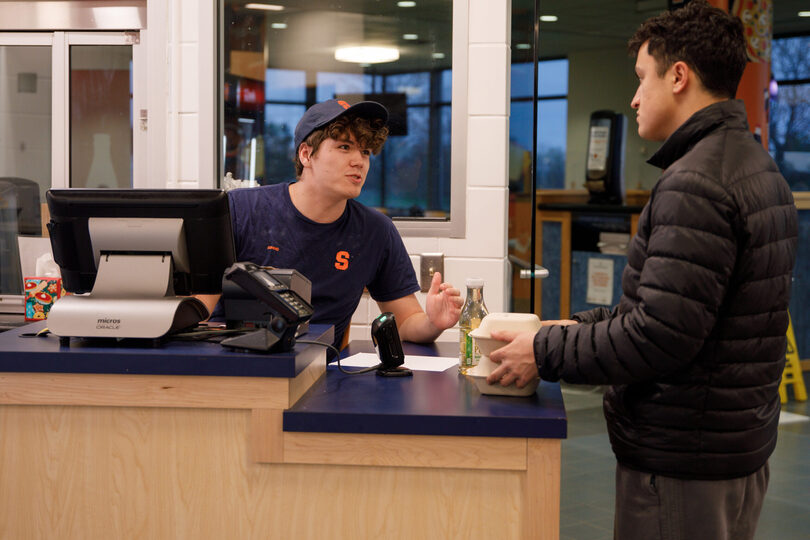
Speek checks out a customer while asking his question of the day. Initially, people were weary of Speek asking questions out of the blue, but always walked away with a memorable interaction. Avery Magee | Photo Editor
The best questions are ones that spark debate, Speek said. One of his most contentious questions he asked was “Would you rather travel anywhere for free for the rest of your life or eat free at any restaurant?” 264 customers weighed in — Speek’s paper receipt counted.
There’s a lot to consider here, Speek said. Free transportation means you can go anywhere in the world, but you still have to pay for hotels, excursions and food once you get there. Free food at restaurants might mean lighter grocery bills and cause more Michelin-star food tastings, but it does mean you’d still have to pay for food at home or eat out all the time.
Speek sent the tally to his family group chat for their opinions, where his mom, who buys the family’s groceries, thought free food was a “no-brainer.” His sister disagreed, arguing that free transportation would allow her to travel the world like she’s always wanted.
The final results? An exact split down the middle.
You’ll have to take Speek’s word for it, though. He rarely keeps the results after his shift, usually throwing the paper away after he clocks out.
Still, Speek makes it a point to remember the top three answers so he can report back if customers return and ask for updates on the final tally. He never forgets the weirdest responses, like an especially offensive answer of “tomato juice” to “what is your favorite drink?” (Speek’s personal choice is apple juice.)
If asked, Speek will reveal his own answer to the daily question, but he gets more satisfaction out of connecting to others’ responses.
Initially, some people were wary of his intentions behind asking questions out of the blue, but almost no one denies him an answer, Speek said.
“You have this conception that when you go up to random people, they’re going to really hate it or ignore you, or it’s really awkward. But, in reality you could walk up to almost any person at the university and ask them a question,” Speek said. “They might be confused at first, but then at the end of the day, usually they don’t care, or they’re bettered by the interaction.”
In fact, most people have positive reactions to his questions or look forward to seeing him at the checkout. His coworker Whitney Miller said she thinks some people come to Goldstein just for his questions.
“There’s people who thank me or clearly, visibly smile or brighten up after I ask them a question,” Speek said.
Sometimes he does “fancy things with the math,” breaking the data up into groups or looking for trends among different demographics. About a month ago, when Speek asked customers “At what age would you let your child walk to the park alone?” he made a dot plot. He marked an X for everyone’s answers on the graph. 10 was the most common, and the X’s made a generally normal distribution, Speek said.
SU sophomore Brett Holleran’s answer was represented by an X on the eight. Holleran said he and other people in line were initially surprised when Speek interrupted their usual checkout routine with his question. But, eventually everyone chuckled and exchanged smiles. Holleran said the whole interaction brightened his day.
“I can’t say I really recount any other cash register experience I’ve had,” Holleran said. “But I remember this one clear as day.”
Speek said he naturally notices patterns in the results.
Preferences between free restaurant food or free transportation, for example, differed throughout the shift, depending on people’s current priorities. When the dinner rush kicked in and customers’ hunger elevated, more people chose free food. Later in the night when the buses stopped running regularly, more people chose free transportation. Over the whole shift, though, it evened out.
Speek also said he gets the best answers working the night shift, when there’s a slower stream of customers and people have less responsibilities to rush off to.
Admittedly, Speek is “naturally pretty good at math,” but he’s lost track of the amount of questions he’s asked this semester. Though, he said it’s likely in the double digits.
“The numbers aren’t really important to me,” Speek said. “It’s just the interaction and the general consensus that I remember.”
Some questions require more difficult tracking methods, like when he asked “What is the most important quality in a partner for you?” This question prompted customers to “launch into something” about their own experiences and preferences, Speek said.
With more complex answers, Speek divided his sheet into responses from men and women and took notes on the top qualities. Speek expected women to want humor in their hypothetical partner, but that wasn’t the case; only three women said humor. Overall, he found men were more likely to prioritize loyalty, while women looked for empathy and compassion.
This wasn’t true for everyone, though. When Speek showed the results to an international student from China who came through the checkout line halfway through his shift, he was appalled. He told Speek he didn’t even think about loyalty as a characteristic. In China, loyalty is the baseline, without it he wouldn’t even consider it a relationship in the first place.
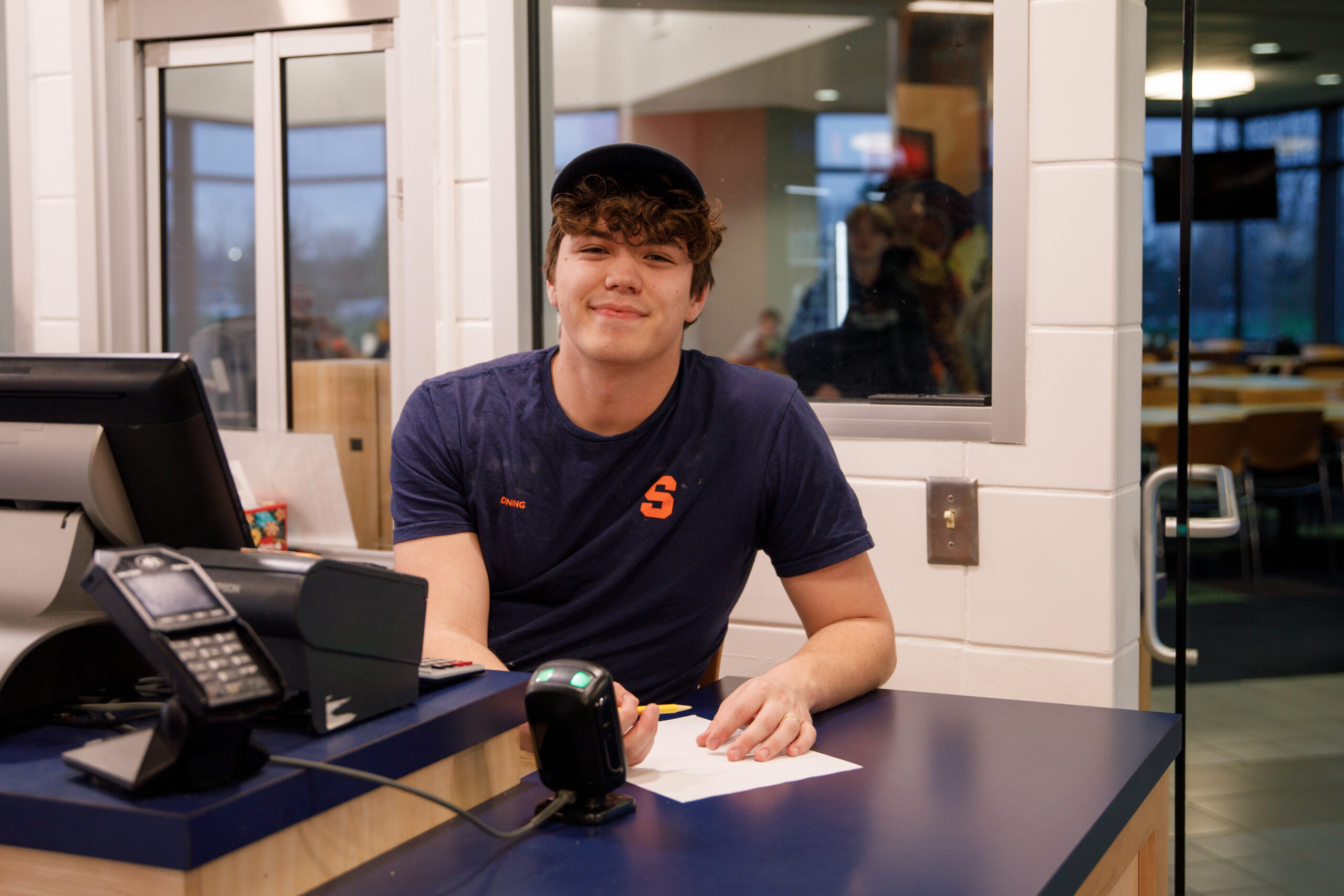
Speek sits on the checkout counter that many Goldstein customers know him from. Each day, Speek asks customers questions ranging from “What is the best state?” to “Would you rather travel anywhere for free for the rest of your life or eat free at any restaurant?” Avery Magee | Photo Editor
One of Speek’s regular customers is nonspeaking. But, the two have a routine down. After he swipes his dining dollars (his usual payment method – Speek doesn’t have to ask), Speek hands him the pen and paper so the student can record his own answer on the tally.
Some questions have a bigger purpose. One of Speek’s supervisors, Richard Roberts, was brought onto the Goldstein Dining team to experiment with expanding different food options. In this vein, he had Speek ask customers, “What is your favorite side for Thanksgiving?” It was one of the biggest surveys, with nearly 200 responses, Roberts said.
That question worked because it connected to people’s families, Speek said. Customers often shared cultural dishes as their favorites.
Roberts has been working with Speek since he came on as a supervisor in February. He said he noticed Speek’s engagement with students from the first shift they worked together.
“It’s something they actually look forward to, and it breaks up the monotony a little bit,” Roberts said.
Roberts said the questions don’t slow down the checkout line because Speek is competent enough to multitask. Even if it does take a few extra seconds, Speek said it’s worth it for the sake of human connection.
When the line dies down and there are no customers to check out, Speek goes around to his coworkers asking them the question of the day. They often get into “small debates,” Miller said.
Miller, an SU junior, has been working with Speek for about a year. She said the Thanksgiving question was especially debatable. Macaroni was the winning choice at the time she saw the score card, and Miller was appalled. “Macaroni cannot be in the lead,” she remembers saying. Casserole was the obvious choice, she said. Speek told her that was the craziest thing he’d ever heard.
Along with fostering camaraderie between staff and customers, Miller said Speek’s question ritual has made the Goldstein staff closer.
“If he wasn’t asking these questions, I don’t think any of us would talk to each other,” Miller said.
Speek said he’s always had an innate curiosity and an easy time talking to people — the perfect storm for his in-shift hobby. He said he loves “picking people’s minds.”
“You know when you’re at that delirious point at like 1 a.m. and you’re just yapping about who knows what, you just ask random questions and then you just get into a conversation?” Speek said. “I love that and I’ll just stay up forever for it.”
Speek said he could play 20 questions forever. Even before he started asking questions in Goldstein, his go-to question to approach people has always been, “What is your favorite fruit?” He can talk at length about the merits of a mango or a blueberry. Are you talking about the fruit during peak season or just an average one from the supermarket? That changes the whole question, he said.
People often don’t have the opportunity to speak about “inward things,” Speek said. His goal is to give them that chance.
“A lot more people want to interact than you might think,” Speek said.