National challenges await Haynie’s ‘impossibly difficult’ upcoming role
Get the latest Syracuse news delivered right to your inbox.
Subscribe to our newsletter here.
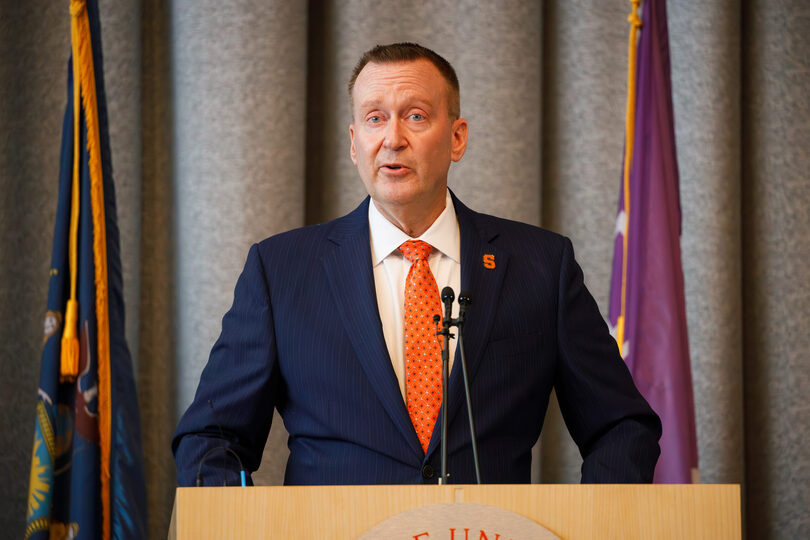
Chancellor-elect Mike Haynie made it clear he knew what he was stepping into as the university’s next leader during a press conference on the day Syracuse University announced his appointment.
“There was an article in The Atlantic six, eight months ago talking about college and university presidencies. I think the first paragraph of that article described this job as a form of ‘self-harm,’” Haynie said. “There’s a lot to think about.”
But the chancellor-elect, with a decades-long tenure at SU, maintains he’s up for the challenges ahead.
“I would be a hypocrite on one hand, to have put roots down and invested in this university the way I have over 20 years, to then to say, ‘Oh, this job is going to be hard,’” he said. “Not for me.”
Haynie will enter his new position at a time when the federal government, under the direction of President Donald Trump, has cracked down on several aspects of higher education, amid greater cultural strides away from the value of a college education.
From federal directives discouraging language about diversity, equity, inclusion and accessibility to a nationwide movement in dismantling college humanities programs, it’s clear that Haynie’s rise to power comes at an uncertain time for universities.
The new chancellor will also inherit several intra-university controversies from within the last year of Chancellor Kent Syverud’s tenure: the removal of DEIA language in SU’s newly stylized Idea courses, conversations surrounding “shared governance” and the restructuring, combining and “sunsetting” of several majors and programs in the academic portfolio review.
At a March 30 Student Government Association meeting, Haynie told attendees higher education faces “political attacks,” as well as broader critiques of the “values” of higher education and the demographic cliff.
SU isn’t alone in its challenges. Calvin Jillson, a Southern Methodist University professor with expertise on national and state-level higher education policies, says institutions across the country are facing declining enrollment, cuts to federal research funding and a loss of international students due to federal policy changes and cultural shifts.
In May 2025, Syverud issued a campus-wide statement expressing concerns over federal policy changes, warning that SU “risks its place” as a higher education institution if drastic federal funding cuts are made to the university.
“In recent weeks, I’ve heard from many people, on campus and beyond, concerned about federal policy changes that have significantly impacted colleges and universities, and ones that may be forthcoming,” Syverud wrote in the May 2025 statement. “The reality is that higher education institutions, including those here in Central New York, face tremendous uncertainty.”
Jillson said universities across the country face two “dominant frameworks” when addressing the political shift in higher education: give up or fight back. Institutions like the University of Texas have already formally agreed to enter federal compacts, promising they’ll eliminate DEIA language. Others, like Columbia University and Harvard University, have pushed back.
Haynie’s primary focus should be on earning the trust of university faculty, Jillson said, a sentiment the chancellor-elect has shared since his appointment. While being the executive dean of the Whitman School of Management markets Haynie as a sustainable financial head, Jillson said it’s important to value the university’s humanities program as a research institution.
“When you are a new chancellor coming out of schools of business, entrepreneurship and innovation the way he is, oftentimes, you don’t have an immediate feel for the humanities and social sciences, which are a large part of a research institution like Syracuse,” Jillson said. “So, the question is whether the language of innovation and entrepreneurship, and building a new university for the 21st century, is going to strike the sort of standard academics in the mainline department as a promising future.”
Haynie made it a point to prioritize academics in his first remarks as chancellor-elect. At his appointment, he outlined commitments to academics, solidifying SU’s role in central New York’s economy and “reinvention.” As Haynie closed, he cited the university’s mantra of “Academic Excellence” as a key factor in SU’s success.
“As a moral obligation in the face of all the change and all the uncertainty that higher education must confront, I am convinced that Academic Excellence is the engine that will sustain everything that we value about this institution today and also fuel everything that we aspire to achieve into the future,” Haynie told an audience at the National Veterans Resource Center.
John Torrens, an entrepreneurship professor at Whitman, who said he was brought to SU by Haynie himself, describes the chancellor-elect as someone who is “very competitive” and aims to “put Syracuse front and center” in academics, athletics and entrepreneurship.
“He’s an academic at heart,” Torrens said. “He loves research. He’s good at it. He knows that side of the university’s business model. I don’t think that’s gonna be a head scratcher for him at all.”
Crystal Bartolovich, a professor at SU’s College of Arts and Sciences and president of SU’s chapter of the American Association of University Professors, said she has hope for the new chancellor’s leadership, particularly because of the time he’s spent as a member of the university’s faculty.
“Given the almost impossibly difficult role being a chancellor of a university, any university, is today, my first response that anyone is willing to do it is awe and gratitude,” Bartolovich wrote in a statement to The Daily Orange. “I’ve also always known Mike Haynie personally to be an extremely hard worker and direct, both of which I appreciate.”
When it comes to the chancellor-elect’s upcoming tenure, faculty shared how they are curious and, in some ways, hopeful for change under Haynie’s leadership.
Margaret Susan Thompson, a Maxwell School of Citizenship and Public Affairs professor and co-chair of the University Senate’s academic affairs committee, said while the chancellor-elect places emphasis on SU’s state of athletics, she’s curious to see the chancellor’s vision for academics.
In the first few days after Haynie’s announcement, Thompson said she and her USen colleagues emailed the chancellor asking for a meeting before he begins his tenure, and he responded the same day.
“I see that as a really good sign that he wants to meet with different constituencies,” Thompson said. “We obviously are going to be asking him some of the same questions about the academic dimension of his vision. So, I think that is a good sign that he didn’t try to put us off.”
Bartolovich stressed the importance of prioritizing shared governance — a standard she has upheld — and understands the university’s distinction as an institution rooted in it.
“A university is a union of faculties, of necessity, each responsible for collecting, advancing and disseminating branches of knowledge,” Bartolovich wrote. “Whatever else the university has become, or may become, that is irreducible. I expect Chancellor Haynie to respect that.”
Torrens said Haynie, as Whitman’s executive dean, constantly collaborated with faculty and campus leaders.
“He’s very collaborative,” Torrens said. “I don’t know what his plan is, but I’m sure that he’s going to be a collaborator.”
But Jillson, who has watched state legislation effectively eliminate shared governance in his home state of Texas, said shared governance is a “myth” as universities are pressured to exercise more administrative power.
“Shared governance is largely mythological, and becoming more and more mythological over time, as university administrations increasingly gain the upper hand over faculty structures,” Jillson said. “Shared administration is both mythological and under siege.”
Haynie is slated to begin his position sooner than expected on May 11 with Syverud’s departure to Ann Arbor to serve as president at the University of Michigan.