Cjala Surratt Q&A: At-large Common Council candidacy, Black Citizens Brigade
Get the latest Syracuse news delivered right to your inbox.
Subscribe to our newsletter here.
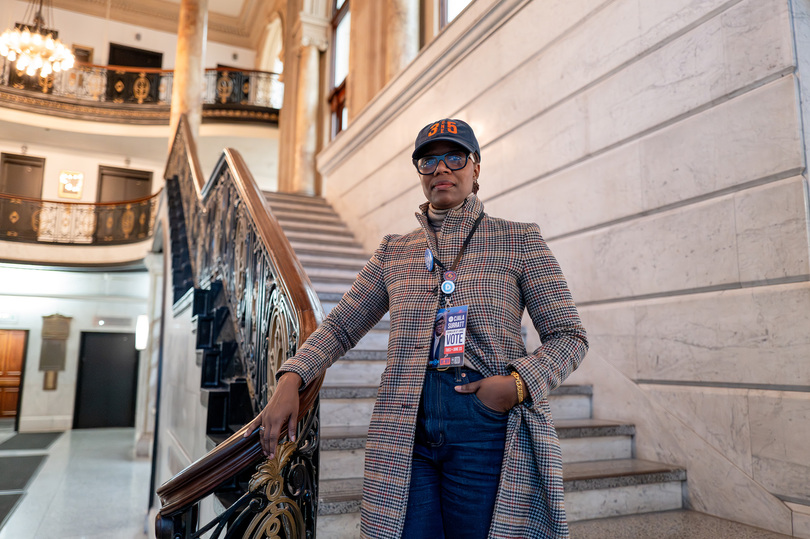
Cjala Surratt’s great-grandmother, Ruth McCrae, a ship fitter from Norfolk, Virginia, was the first Black woman to serve as president of the Boilermaker Union. Through her grandmother, Surratt, a local business owner and current candidate for common councilor at-large, said she learned that true equity requires persistence, dedication and leadership that centers those most impacted.
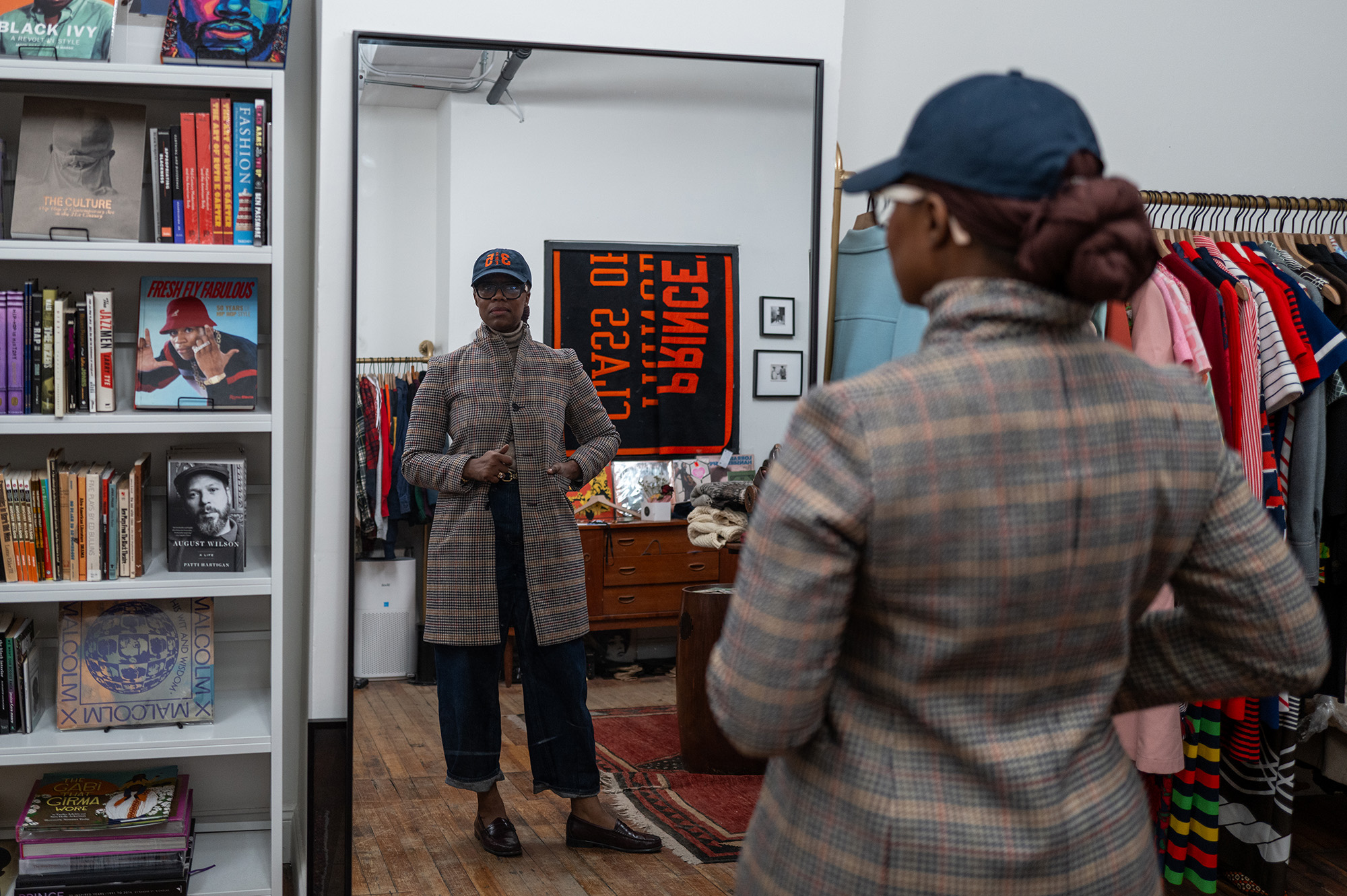
In her downtown Syracuse store, Black Citizens Brigade, Surratt keeps her grandmother’s union coat in the window. She said it’s there as a reminder that big actions take “small radical acts” – it’s people’s passions that move the needle.
Now, Surratt is running for councilor at-large against Helen Hudson, who currently occupies the position. Both are running as democrats.
The Daily Orange spoke with Surratt about her campaign and business and how they intersect.
The D.O.: Why did you decide to run for Common Council?
Surratt: It really begins (with) that I grew up here in Syracuse, New York. I’m a proud alum of the Syracuse City School District, which I think is particularly important because there’s, of course, a lot of different perceptions about our public schools, and there’s a lot of really great people who graduate from the Syracuse City School District (who) are doing amazing things in the private and public sector here.
I’m also an alum of Syracuse University, the school of performing arts. And then I worked there for eight years in marketing public relations at Lightwork Urban Video Project.
There are a lot of individuals and people who poured into me and helped me be able to aspire and then achieve the things that I want to do within academia, and then as an entrepreneur. And so it only makes sense then that I lean in and do that for those who are coming behind me.
I spend a lot of time working in the nonprofit sector, but also in social justice and organizing spaces as well. Particularly, as we were in conversation about George Floyd, I was a part of a lot of movements here, where we marched across the city for 40 days and 40 nights. And we really were in conversation with our local governments about various things that were of concern to us.
And I realized that we needed another mechanism in addition to the ability to assemble and make noise and march and be in the streets. We also need metrics of accountability, and that comes through policy and governance. I think (that) was an integral part of me deciding to step into running for common councilor at-large.
The D.O.: What issues in the community do you believe are the most important?
Surratt: I think it’s interesting because they all are situated within an ecosystem. We have 45.9% of our children living in poverty. We have a housing crisis. We have an environmental crisis here in terms of lead poisoning. Still, about 14,000 service lines to our homes are (of concern) regarding lead poisoning.
The numbers are 600 of our youth every year are impacted by lead poisoning, and particularly that centers Black and brown youth living in our city centers. There are larger health implications that we’re going to have to look at in conversation down the road.
As I opened my phone this morning, I was really excited to see that our new mayor, Sharon Owens, along with other mayors across upstate New York, are really pushing and advocating for the New York State For All Act. I think that’s very much important as a sanctuary city, that we want to make sure that our immigrant, refugee, new American communities feel safe here and protected, and assured that no parts of our government, our police, are engaging with or interacting with ICE.
The D.O.: How do you use the managerial and leadership skills that you’ve developed from owning your own store to now running for Common Council?
Surratt: It’s wonderful to have your own store, to have your own hours, but it’s also you have your own hours, which means that you’re never necessarily off the clock. And I think that’s also about constituent services. It’s something that I learned about. Customer services, constituent services, listening to people, leaning in — I very much believe in a participatory process.
I think (what) comes out of my organizing space and my nonprofit space as well, is that you have to be listening to people. It doesn’t make sense to try to advance a policy … if I haven’t necessarily engaged and listened to what people need.
Tara Deluca | Asst. Photo Editor
In her store, Black Citizens Brigade, Surratt keeps her grandmother’s union coat in the window as a reminder that big actions take “small radical acts.”
The D.O.: What has been one of your proudest moments as a local business owner?
Surratt: I think first and foremost is that I always say the store is relational and not transactional. One of the proudest moments I’ll say is that I expanded the store, and I expanded the store explicitly because people kept standing around. They would come in to purchase, but then we began to be in conversation with each other about things that are important to them. Some of it was personal, some of it was policy, and I was like, OK, I think you guys want a place to be. And so ultimately in year two, I was able to expand the store.
And now, there is a performance space, a community space, there’s a book club. But, the other thing that I’m definitely very proud of is that we saw a rescinding of SNAP benefits. In November, I had (a) Books for Food program. So over the course of a month and a half, I was able to raise over $3,000, and that was by individuals coming into the store and purchasing books with the explicit intention of all that money going to local food pantries. So it’s expanded beyond this retail experience, being one that is participatory and one that’s responsive to community, and that’s also how I want to lead, that it has to be practical.
The D.O.: What would you say Black Citizens Brigade’s mission is, and how are you going to carry this into your campaign?
Surratt: Our mission is to be a gathering space, a place in which we can have challenging conversations, but I also think the Black Citizens Brigade is also a prime example of how we can reimagine underutilized corridors in our city.
I’m very proud of what it looks like now. When you’d (first) come down, it was a service alley. There wasn’t much pedestrian activity. Because when I first came, I won’t lie, it was me and the garbage chute. That was it. So there’s me, and then there’s an art gallery on the other side, there’s a speakeasy that’s being developed. We have a tea lounge at the other end of the block. During the summer, there’s much more pedestrian activity. There’s music going in the alley.
So how do we, through a small business, reimagine these corridors that generally before, again, had a lack of activity? So now we have economic and workforce development happening because those people are being employed in this space. So I think that those two things, that’s the kind of things I would like to bring into the Common Council. I’m also thinking about how we think of small impacts, microcapacity building, that also then have these radical kinds of change making moments in our city.