Opinion: Hempcrete’s practicality makes it key for sustainability
Get the latest Syracuse news delivered right to your inbox.
Subscribe to our newsletter here.
In 2024, hempcrete was officially recognized in United States residential building codes. Hempcrete is made from mixing hemp hurds, lime, water and a binder, and then forming the solution into blocks. It can be used as insulation for walls, floors and roofs.
This recognition was a drastic turning point for the material, going from an experimental option into a code-approved solution, which stated that hempcrete could legally be used for homes. The reworked policy provides guidelines for how hempcrete can be mixed, installed and applied.
Hemp has a complicated history that explains why it isn’t more widely used today. In the 1700s, farmers were legally required to grow hemp for rope, textiles and other essential goods. Over time, hemp became associated with marijuana, even though the two don’t produce the same psychoactive effects. The Marihuana Tax Act of 1937 grouped hemp with cannabis, despite their differences, and the hemp industry declined entirely. Hempcrete couldn’t fully develop because of this, but recent shifts in legalization and sustainability have revived hemp-based building.
Giving hempcrete a formal place in regulatory framework not only legitimizes its performance and safety, but also opens the door for wider use nationwide. Sustainable materials are no longer just alternatives, instead they’re becoming part of future construction.
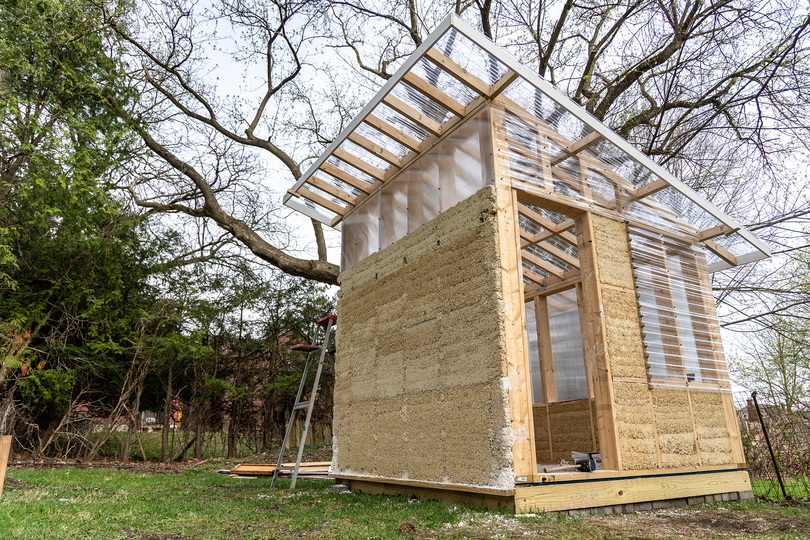
My interest in hempcrete stems from experience. I had the chance to work with my friend Carmela Garcia for her capstone and build a hempcrete shed. Being involved in the process showed me how the material can be applied to large-scale construction sites, regardless of weather, time or resource constraints. My academic background in engineering and architecture helped with designing the shed, but the most impactful part was collaborating with my friends to bring the project to life.
Materials like hempcrete aren’t just far-fetched ideas — they’re real solutions we can implement today.Saimun Uddin, Columnist
Hempcrete isn’t a perfect replacement for traditional concrete, slightly lacking in strength. But its pros outweigh its cons. In many cases, hempcrete’s limitations might redefine how the material is used rather than diminishing its value, encouraging creative and efficient design.
Materials like hempcrete aren’t just far-fetched ideas — they’re real solutions we can implement today.
Hempcrete is a carbon-negative, biocomposite material. It absorbs carbon, continuing to strengthen the structure as time passes, making it sustainable. Beyond the environmental benefits, it’s also durable and fire resistant, while remaining a breathable insulation material.
It’s also effective at regulating temperature and moisture, making it perfect for prolonged performance. It can absorb and release water vapor without degrading. Hempcrete is naturally antifungal, antimicrobial and resistant to pests, making it healthy and long lasting. When installed correctly, it can last for decades to centuries.
Hempcrete is already used in Europe, where hemp-based construction has a longer history. In the U.S., companies like Hempitecture are working to expand the use of hempcrete, signaling a shift toward more sustainable building practices.
For students at Syracuse University, the relevance of hempcrete goes beyond construction. While most students won’t be mixing hemp and lime any time soon, the material itself represents a broader shift in environmental action. Sustainability is often framed as a large-scale effort, implemented through policy, corporations or major infrastructure projects. Exposure to materials like hempcrete challenges that idea.
Whether it’s supporting sustainable campus initiatives, being more aware of the environmental impact of buildings or simply staying informed about emerging alternatives, students must make a better effort to shape future environmental practices. Even taking small steps to recycle or compost can lead to lasting change and lead the way for larger initiatives.
Pairing hempcrete with structural systems like timber or steel framing, constructors can take advantage of its environmental and insulation benefits without compromising safety or function. Instead, we can develop hybrid approaches that combine sustainability with performance.
Ultimately, hempcrete is more than a building material. It represents a different way of approaching sustainability. Sustainable practice doesn’t always require complexity — sometimes it’s the willingness to rethink what we use and why we use it.
Whether it shows up in future careers, campus advocacy or everyday choices, being open to solutions like hempcrete is how small awareness turns into meaningful change.
Saimun Uddin is a graduate student majoring in engineering management. She can be reached at sauddin@syr.edu.