Common Council introduces 26-27 fiscal year budget in weekly meeting
Get the latest Syracuse news delivered right to your inbox.
Subscribe to our newsletter here.
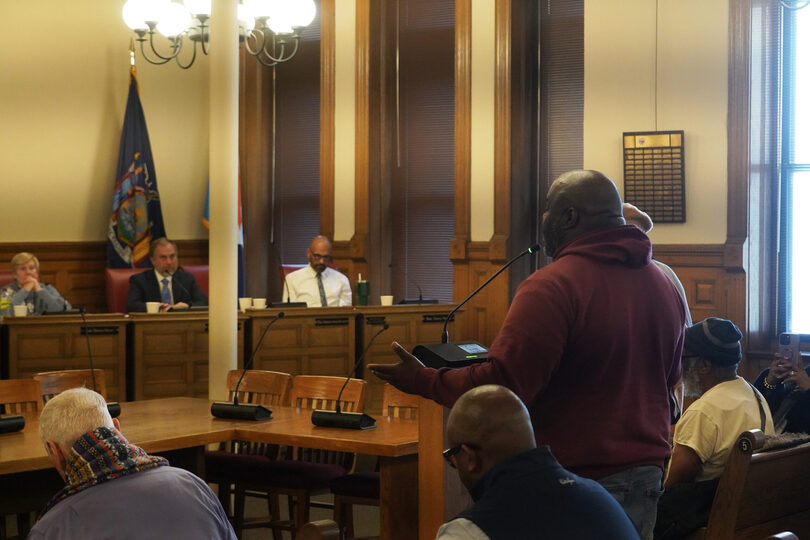
Syracuse Common Council introduced its $354.5 million 2026-27 fiscal year budget proposal and faced backlash over its failure to pass Good Cause Eviction at its budget hearing Wednesday.
The budget proposal is an approximately $6.1 million increase from the $348.4 million city budget for the 2025-26 fiscal year. The hearing also opened the podium to attendees to promote laws or pitch their own city contracts.
The 2026-27 budget proposal includes a 4% water rate increase, with no increase in the property tax rate. The proposal also delegates $2.25 million for the Housing Strategy Corporation.
Multiple attendees spoke out against recent actions of the council that have increased living costs for Syracuse residents.
John Meyer, a Syracuse resident and leader of the Washington Square Task Force and Neighborhood Watch, spoke about his concern with Syracuse taking on another budget deficit. He said it’s “nice” that they don’t have a tax increase this year, but called the deficits a “ticking time bomb.”
Meyer expressed frustration with increasing budgets for city employees, resulting in more people hired who “do the same thing.” He emphasized “consolidation” as a way for the city to save money.
“We trust you as our elected officials to be prudent with our money, it’s not a matter of being liberal or conservative,” Meyer said. “You can make these cuts without being a terrible person.”
Andrew Sievers, a resident of Syracuse’s second district, used the open podium as a chance to scold the council for not adopting Good Cause Eviction, a tenant-friendly rent law that would prevent landlords from evicting tenants without “good cause.”
Sievers demonstrated particular frustration with Councilor Donna Moore, the representative from Syracuse’s second district and one of the councilors who flipped their vote against the law.
“Donna, since I’m still one of your constituents for the next 24 hours, let me say publicly, shame on you,” Sievers said. “Your wishy-washiness makes you an embarrassment to this chamber.”
Sievers said he is confident Good Cause will get approved by the council in time, but will require some changes on the council.
“There is plenty of energy still out there. I think the energy is more focused on getting these people replaced,” Sievers said. “When you have representatives like Donna, who simply only make time for less than 10% of her constituents, what are you going to do?”
Some attendees spoke at the hearing about a potential opportunity for the city to save money or even generate additional revenue.
Kim Cameron, a volunteer speaker for activist organization Beyond Plastics, spoke in support of the “Bigger Better Bottle Bill,” a bill designed to save Syracuse taxpayers money by increasing the bottle return deposit from five to 10 cents.
Cameron explained that while New York has a 68.3% bottle return rate, other states that have increased their deposit costs have seen return rates increase to 90%. Bottle deposit data shows Oregon has the highest return rate in the United States at 87%.
Cameron said that if passed, the bill could save Syracuse taxpayers as much as $190,000 annually. She urged the council to show residents that they will do everything in their power to reduce costs.
SU alum Zane Connell and Cliff Ryan Jr., founder of OG’s Against Violence, attended the budget hearing to continue their support of a city contract for their startup Cavline, a business that allows small businesses to utilize screens in private and public spaces for advertising.
Connell said he believes Syracuse would financially benefit from a city contract with Cavline, because it allows the city to make money by allowing campaigns to advertise on public screens.
“Any person that’s running a campaign in the city, they’re actually putting money back into the city by using campaign funds,” Connell said.
The Common Council will vote on the 2026-27 fiscal year budget on May 8.