ROTC students find ‘sense of purpose’ when juggling responsibilities
Get the latest Syracuse news delivered right to your inbox.
Subscribe to our newsletter here.
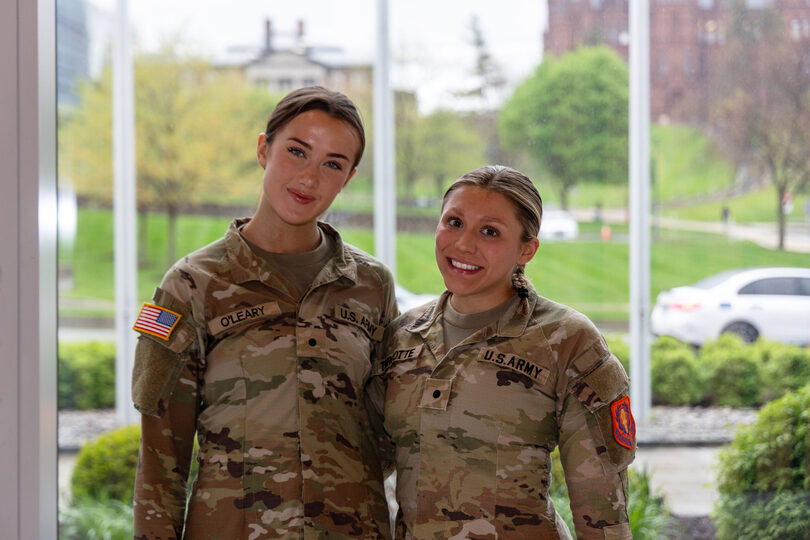
Amanda Turcotte wakes up for a 12-mile ruck march at Onondaga Lake at 3 a.m. She doesn’t get back to her dorm until around 7:30 a.m.
After removing her weighted backpack, she hops in the shower to get ready for class like any other college student, which she is, except for when she attends ROTC classes.
Outside of ROTC, Turcotte, a Syracuse University freshman, is also a member of Delta Delta Delta and the Syracuse University cheerleading team, which she’s fit into her schedule alongside her other commitments. Given that cheerleading practices are typically at night, Turcotte can commit her mornings to the Army, she said.
She and other ROTC students wear operational camouflage pattern uniforms to all of their ROTC-related classes and labs. In their lab, they go over field training, drills, situational training exercises, lanes and high-intensity physical training scenarios.
Turcotte admits that sometimes the schedule can be overwhelming, especially because she’s expected to be in so many different places at once, but she’s gotten used to the rigorous routine.
While a typical student may attend classes, work out, study and see their friends daily, students in SU’s ROTC program are meeting for physical training (PT) three times a week, usually from 6:30 to 7:30 a.m., taking military-specific classes on top of a normal course load and training for high intensity scenarios.
In ROTC, students also have a four-hour military class each week, usually split up between Tuesdays and Thursdays. The course is taught by military instructors, who students call “the cadre.”
Saoirse O’Leary, a member of ROTC, could’ve chosen to be like any other freshman, but joining the ROTC program was non-negotiable for her. Being raised by a father who was in the Marine Corps, honoring her familial roots was why she joined.
At first, O’Leary felt like an outsider as an ROTC participant, especially because her roommate and many of her friends weren’t in the program. The summer before joining the program, freshmen military students, or MS1’s, were put into groups. Eventually they began DM’ing each other on Instagram to get familiar with one another, O’Leary said. So far, O’Leary said it’s worked.
“I was like, ‘Gosh I hope I make friends in the program,’ but all the MS1 girls are actually amazing. We definitely have a good group of people to stick with for the next couple of years,” O’Leary said.
As a business analytics major, O’Leary sees herself going into finances or logistics in the Army, where she said the opportunities are endless.
Seth Waxler, a sophomore in the Air Force ROTC Detachment 535 — a specific military training unit at SU — said he was accepted to the Air Force Academy but was talked out of going by his parents who wanted him to have a traditional college experience.
However, he chose to join ROTC at SU. He sees it as one of the best decisions he made, Waxler said.
“I had no intention of joining the military (program) and then like second week of school I saw people walking around in uniform and was like, ‘this is it, I’m going to do it,’” Waxler said.
Last summer, Waxler received a call from his commander saying he was chosen for scholarship through SU’s ROTC program. Receiving a military scholarship while in college means the military is helping pay for a student’s education in exchange for a service commitment once the person has graduated.
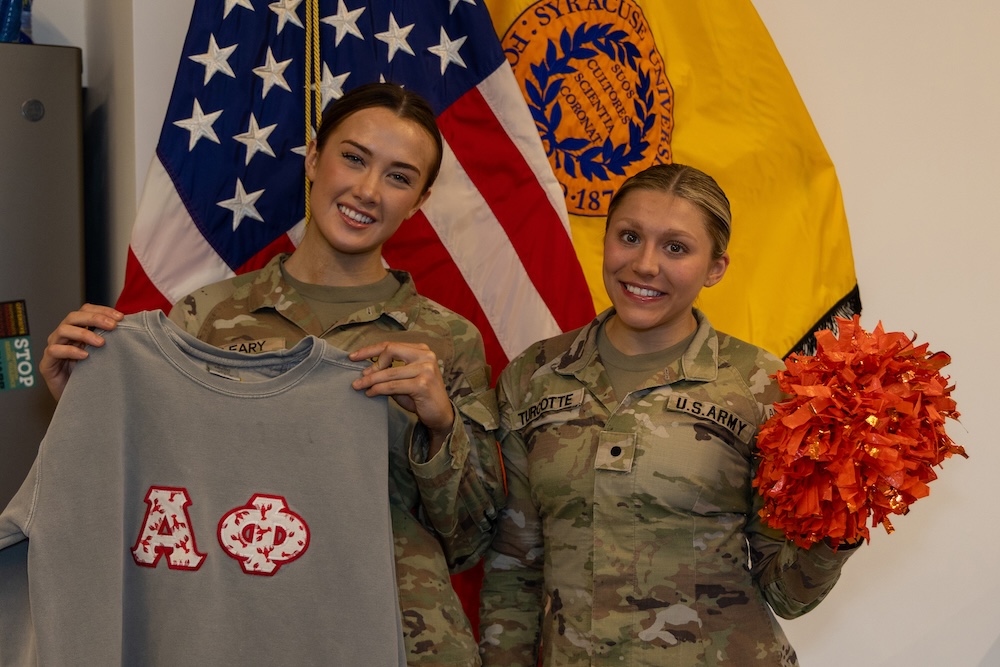
Saorise O’Leary (left) holds up her Alpha Phi sweater while Amanda Turcotte (right) poses with her SU cheerleading pom pom. Though the pair juggle ROTC and other commitments, neither minds being busy. Eli Schwartz | Asst. Photo Editor
Other students, like Turcotte, weren’t sure what to expect when it came to being in ROTC but were pleasantly surprised by how hands-on everything had been.
For ROTC students, PT is a commitment in itself, O’Leary said. But other parts of the program, such as the ruck marches, take up more time in their schedule.
But the countless hours are worth it for O’Leary.
“Coming out of college, we’re getting the same rank as West Point students, and their entire life is based off the army. We have a commitment four times a week, but I think it’s going to be so worth it,” O’Leary said. “We are going to be 2nd Lieutenants right out of college, I don’t think you can get any better than that.”
Going into the program, both Turcotte and O’Leary were involved with sports. O’Leary was captain of both her high school softball and basketball teams, and Turcotte was a gymnast and cheerleader. Turcotte believes her background in sports has helped her be comfortable working in a team dynamic, making it easier to build relationships in college, she said.
Not only have their sports backgrounds helped with social dynamics, but they’ve helped with the physically demanding parts of the program, like the Army Combat Fitness Test. The students in MS1 get ranked on a scale called the order of merit. This ranking includes factors like GPA, the Army Combat Fitness Test and military labs.
“Everyone has to be competitive at some point because everyone wants to be at the top,” O’Leary said.
While balancing different activities on campus, like being a member of Alpha Phi sorority, O’Leary tries to keep a positive mindset.
“If you put a lot of hard work into the program, you’re gonna get what you want out of it. If you work hard you’re gonna get a reward in return,” O’Leary said.
While many see ROTC students walking around in uniform, they don’t see Air Force cadets practicing combat techniques, including handling improvised explosive devices, Waxler said. Cadets are also put into group leadership practices, where they’re given problems and have to work their way out of them — most of which Waxler says are nearly impossible.
Within his squadron, Waxler has a job as the Finance Non-Commissioned Officer in Charge (NCOIC). Waxler manages four other cadets and controls the finances, bookings and has regular meetings with the school.
“It’s definitely a commitment, but it’s super doable and definitely gave me a sense of purpose. I’ve learned a lot, probably more than what college could teach me,” Waxler said.
Outside of ROTC, Waxler was involved in Syracuse University Ambulance and is now involved in the Phi Delta Theta fraternity. On top of that, he’s a biotechnology major taking a full schedule of classes.
During his time in the ROTC program, Waxler has learned valuable lessons he hopes to take with him into the military.
To him, one of the most important lessons he’s learned is about stewardship: being the last person to eat after serving everyone and the last person to sit down sets the standard for others, Waxler said. That is why he takes his role in the program so seriously.
“ROTC isn’t just a club or a thing. It’s a career. And you have to treat it like a job because I do, I get paid to go to school,” Waxler said. “Once you get the priorities down, it’s relatively easy to manage your time.”