‘Earth Day, every day’: How SU, ESF students practice sustainability
Get the latest Syracuse news delivered right to your inbox.
Subscribe to our newsletter here.
Kathryn White vividly remembers her first time celebrating Earth Day. Sat in front of a computer with her first-grade class, she played educational games, virtually cleaning up trash and planting trees.
At just seven years old, White already knew she wanted to do more.
“I thought it was so fun just doing it on the computer, but I was like ‘I want to do this in real life,’” White said. “Why is this not a bigger thing if Earth Day is that important?”
From then on, the SUNY ESF junior made it a priority to celebrate Earth Day every year. The holiday, which takes place annually on April 22, is a reminder to love the planet we live on and it’s something we should all be thinking about every day, not just once a year, White said.
The first Earth Day was in 1970 and has been important to environmental movements for decades. But throughout the year, celebrating the planet is a common ritual for many Syracuse University and ESF students, from spearheading campus initiatives to researching bio-based materials.
For some Syracuse University students, like senior Carmela Garcia, that awareness for the planet runs deep and has grown into in-depth passion projects.
After Garcia attended a Cornell University-hosted workshop on hempcrete last September, she’s since learned everything about the material. A biodegradable and eco-friendly material, hempcrete is made from the woody inner core of industrial hemp plants, mixed with a lime-based binder and water.
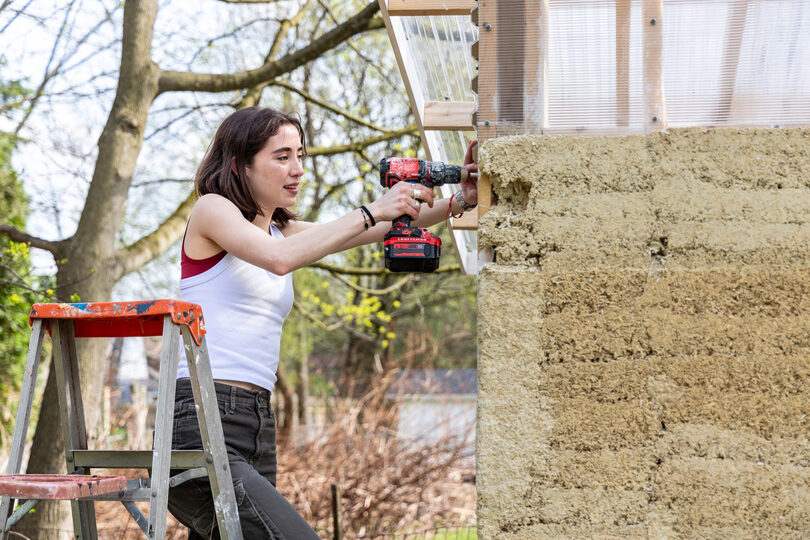
Hempcrete is primarily used for insulating infill for walls, floors and roofs of buildings, but with a lack of established supply chains, it’s not widely used for construction in the United States. Over the past month, Garcia’s been working with the material, hand-mixing and packing hempcrete blocks with her father and friends to build a greenhouse as part of her senior thesis. It’s currently taking shape in the backyard of her Syracuse home, which they moved into a year ago.
Currently, the greenhouse is fully equipped with plexiglass walls and windows. Garcia’s original senior thesis was on renewable furniture. However, when her hometown in Kerrville, Texas, was obliterated by the Guadalupe River floods in summer 2025, Garcia officially landed on hempcrete architecture as her senior thesis topic.
If a hempcrete building is destroyed, the pieces can be collected and remolded with little negative impact. After the flood, seeing building debris strung over Texas made Garcia realize how much infrastructure is built mindlessly, decaying and eroding over time. The experience reaffirmed her notion that architecture should be more environmentally forward.
For Garcia, a large motivator for her passions in sustainable architecture is the health benefits. When she and her dad were renovating their home, they found mold all along the concrete walls and removed it.
“It’s kind of insane we don’t really take into consideration that we’re living in a plastic bubble,” Garcia said. “That can’t be good for our health, it can’t be good for a lot of things.”
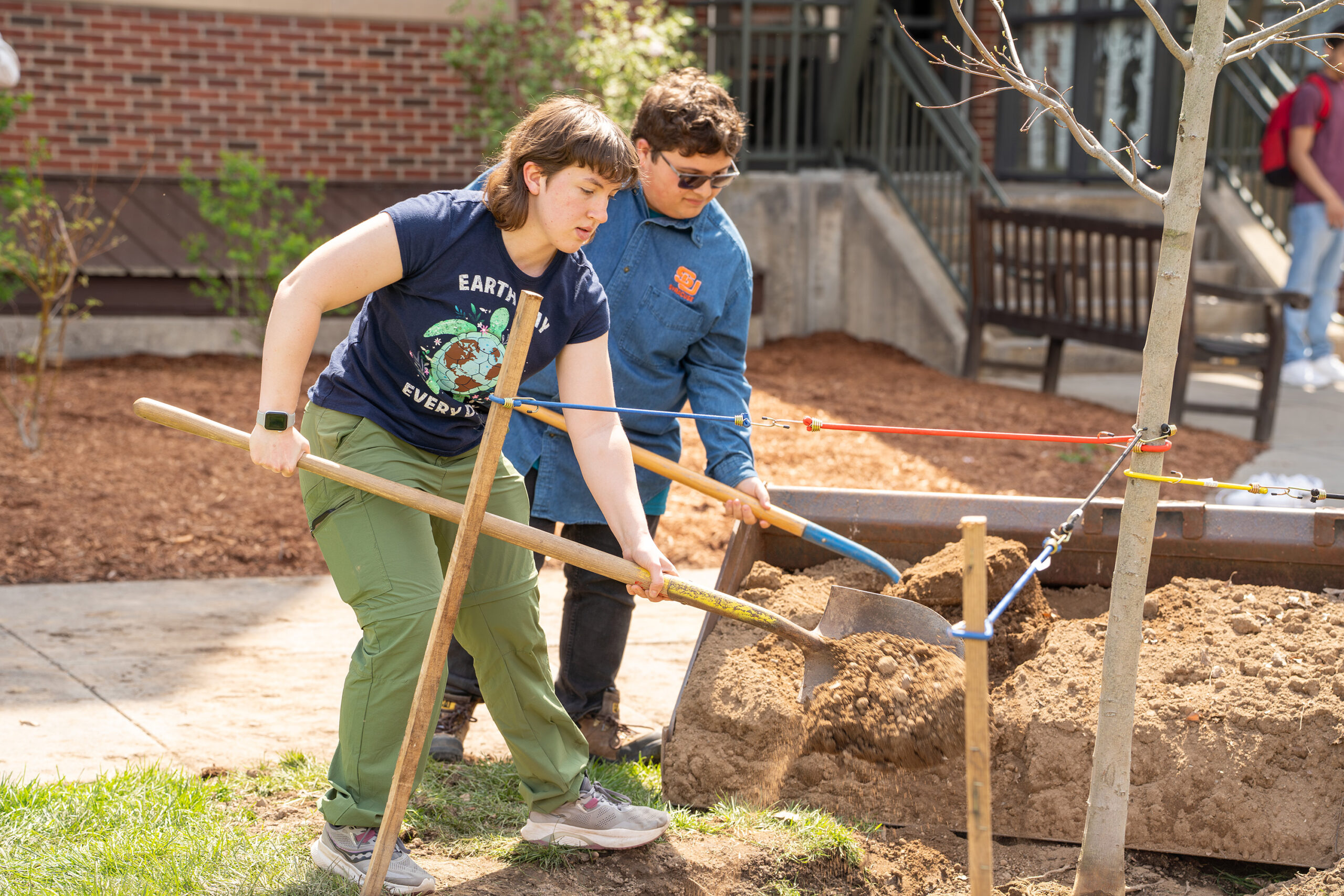
Kathryn White plants a tree on SUNY ESF’s Quad for Earth Day. White, who is the president of ESF’s Oakie’s Green Team, initially got into sustainability in first grade. Zoe Xixis | Asst. Photo Editor
Joshua Richter shared similar sentiments. The SU senior is the co-director of SU’s Sustainability Forum, a Student Government Association committee. If there’s any harm enacted to the environment, people are bound to feel the long-term health effects, he said.
For Richter and Garcia, being conscious of their actions and the subsequent ecological implications was something they became aware of at a young age.
Garcia was raised by eco-conscious parents, who drilled a green-thinking mindset into her early on. From watching her family in construction use sustainable materials to biking and walking to school throughout her life, Garcia has experienced firsthand the importance of sustainability, she said.
“(Construction) really has no meaning unless it’s helping the environment or taking something that isn’t used and making it useful,” Garcia said.
Growing up in California, Richter has been separating plastic and paper for as long as he can remember. As he’s gotten older, Richter has held onto that responsibility, even recently convincing his parents to get more involved in personal composting.
But on a college campus, those good intentions can be harder to implement, Richter said. He tries to keep composting at SU, but it’s not always as easy. If more students put in the work to educate themselves on the benefits of sustainability, real change can happen, he said.
“I know a lot of students don’t care, but it does have more of an impact than they might realize,” Richter said.
In his time working for the forum so far, Richter has worked on initiatives like Ecosia, a search engine that uses 100% of its profits to plant trees. ESF enacted it on campus last October, and now over 2,000 students use it a day, planting hundreds of trees.
Ecosia is the resource that inspired White the most, she said. She recalls discovering it during the COVID-19 pandemic, when she and her sister were looking for ways to help the environment while quarantined.
Making a difference can start from just changing your search engine; it can be “as simple as that,” she said.
White is president of ESF’s Oakie’s Green Team, which hosted a tree-planting event on Wednesday on ESF’s Quadrangle sponsored by Ecosia. To continue her annual tradition of an eco-themed outfit, White wore an “Earth Day, every day” T-shirt to the planting. Students gathered on ESF’s quad, all pitching in to shovel and pack dirt around the growing sunset maple tree.
ESF junior Savi-Cartier Stewart was one of those students, and she said participating made her think of everything “beautiful” that’s growing on campus.
“I was thinking that as an alumni, what will I come back and look at and be like, ‘Hey, I was there when that was started.’” Stewart said. “I feel like every alumni has that moment.”
Richter hopes to make Ecosia a norm on SU’s campus as well. He’s also worked with SU to try and increase composting bins in more dining areas. But Richter said sometimes being more environmentally aware starts small, like drinking out of a reusable water bottle or separating your trash.
“Stuff like that, students can do on a regular basis,” Richter said. “It doesn’t have to be some big policy change, it can be also joining the forum or bringing ideas up to us.”
Whether it be thinking twice about what you’re throwing away or diving deep into a renewable resource, there are plenty of ways to give back to the Earth. Even just getting outside more often will nourish a deeper connection and appreciation for the planet, Richter said.
“Ultimately, the Earth wasn’t born on Earth Day,” White said. “It exists every day, and we should be taking care of it.”