


E
arly in his tenure, outgoing Syracuse University Chancellor Kent Syverud gathered his senior leadership team for what they assumed would be a routine meeting. Instead, a bus awaited them.
It drove them to the Marion-Kimmel complex — a crumbling residence and dining center that hadn’t changed much since the 1950s. A picnic table stood in the middle of that dining center. Syverud sat his team down and told them to look around.
“How do we explain this to parents who were gonna be dropping their 18-year-old freshman off at this dorm?” a member of that senior leadership team, now acting Chancellor Mike Haynie, remembers Syverud telling them.
That moment, Haynie said, shaped the campus Syverud is leaving behind.
Syverud took office as SU’s 12th chancellor in January 2014 with a mandate from the Board of Trustees to stabilize the university’s spending from its reserves.
He leaves behind a fundamentally changed institution — one that is, in almost every financial measure, larger and stronger than the one he inherited. It is also one with deeper debts, a declining national ranking and a shrinking international student population.
Before SU, Syverud served as dean of Washington University School of Law in St. Louis. A lawyer by training and a graduate of the University of Michigan Law School, he also served as dean of Vanderbilt University Law School and as associate dean for academic affairs and a professor at UMich. He replaced former SU Chancellor Nancy Cantor, who departed in 2013.
Syverud officially stepped down on April 15, weeks ahead of his planned May departure, after announcing he had been diagnosed with a form of brain cancer. Haynie assumed leadership and is now the university’s acting chancellor.
Colleagues described Syverud as intelligent, well-intentioned and meticulous, but reserved and difficult to access outside of formal settings. Several faculty also pointed to his leadership during a series of challenging periods for the university, including the pandemic and broader changes across higher education.
A Daily Orange review of university financial reports, enrollment data and public records from 2014 to 2025 — along with interviews and written responses from more than a dozen current and former faculty members across multiple schools and colleges — paints what Samuel Gorovitz, a philosophy professor and former College of Arts and Sciences dean who has been at SU since the 1980s, called “a complicated legacy.”
Balancing the books
The Board of Trustees brought Syverud in to fix SU’s finances after Cantor overextended the university’s budget. By most financial metrics, he’s delivered.
Under Syverud, SU’s annual revenue rose 59% to $1.4 billion between 2014 and 2025, according to university financial reports. Its endowment — the university’s long-term investment fund — nearly doubled.
“He did a great job with the SU budgets during some challenging times, especially since his predecessor, Nancy Cantor, was lacking in that department,” Donald Dutkowsky, professor emeritus of economics in the Maxwell School of Citizenship and Public Affairs, wrote in a statement to The D.O.
The university’s operating surplus — what’s left after expenses — nearly tripled to $133.3 million by 2025. Grant and contract funding grew 78% over the same period, and in 2015, SU earned an R1 designation from the Carnegie Classification of Institutions of Higher Education, placing it among the country’s top research universities.
The Forever Orange fundraising campaign, which ran from 2019 through 2024, raised $1.59 billion from over 100,000 donors — the most successful campaign in SU’s history.
Additionally, in October 2022, Micron Technology announced plans to invest up to $100 billion to build the largest semiconductor fabrication facility in the United States in Clay, New York, minutes from campus, with SU as the company’s lead academic partner.
But SU’s growth came with tradeoffs. The university’s long-term debt increased by nearly 160% to $1.185 billion between 2014 and June 2025, according to university financial reports.
Much of that increase is recent. In April 2025, the university issued $435 million in new tax-exempt bonds to fund three residence halls and other campus projects. As of June 30, $432 million of those proceeds remained unspent.
As chancellor, Haynie is responsible for deploying that money — and for the debt payments that come with it.
For the university, net tuition and fee revenue grew 67% to nearly $803 million under Syverud. For students, the total cost of attendance for an undergraduate living on campus has risen to a little over $92,000 for the 2025-26 academic year, according to SU’s website, up from roughly $52,000 in 2010-11.
The university provides financial aid, grants or scholarships to more than 81% of its students, according to its website.
Those financial gains are now being tested. SU’s own 2025 report described the current environment as “an unpredictable federal regulatory landscape combined with the demographic cliff and a turbulent economy.”
Anne Osborne, a professor of communications at the Newhouse School of Public Communications, arrived at SU the same year as Syverud. She said the university appears to have avoided the direct federal confrontations that are consuming other institutions.
“At a time when we’re seeing a lot of universities who are directly under attack by the national administration, we are below the radar,” Osborne said. “Some of his risk aversion has probably paid out.”
SU remade: Syverud’s investments in campus infrastructure
The dining hall Syverud showed his team that day in April 2014 no longer exists.
Marion and Kimmel Halls were demolished last year, and a 762-bed residence hall will go up where it once stood, according to university financial records. It is one of more than a dozen major construction and renovation projects launched under Syverud, several of which will be completed after his departure.
Campus infrastructure reached a net book value of nearly $1.75 billion in 2025, according to university financial reports.
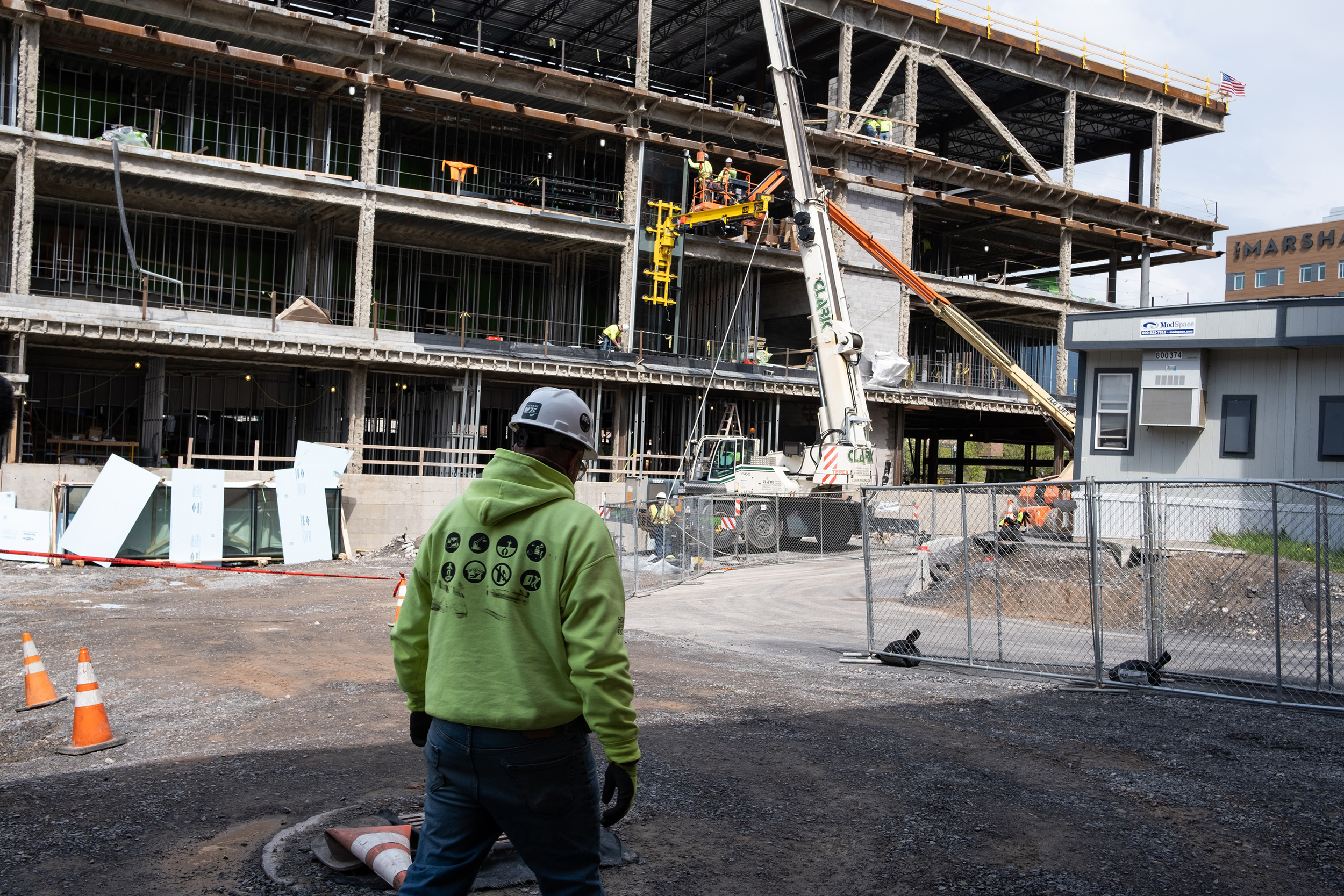
Construction continues at the National Veterans Resource Center in May 2019. Outgoing Chancellor Kent Syverud and acting Chancellor Mike Haynie worked closely to create a dedicated space for veterans and military-connected students to study at Syracuse University. Dan Lyon | Daily Orange File Photo
Major projects completed under Syverud include the National Veterans Resource Center — a first-of-its-kind 115,000-square-foot facility that opened in January 2020 — the Barnes Center at The Arch, a renovated Schine Student Center, a stadium renovation with a naming rights deal with JMA Wireless, the football performance center and three esports centers.
Three new residence halls are currently under construction: a 566-bed dormitory on Ostrom Avenue, a dormitory on Waverly Avenue with a new dining center and a 537-bed dormitory on Comstock Avenue. A new Graduate by Hilton hotel near campus was also approved in 2025. All four are expected to open in winter 2027.
SU also joined the Atlantic Coast Conference in 2013, just months before Syverud arrived. The move significantly increased the university’s annual conference payout and national exposure, but came with higher travel costs and pressure to invest further in athletic facilities.
“When we’re asking families to pay tuition, it’s not just for what happens in the classroom,” Haynie said in an interview with The D.O. “It’s for all of this. It’s for the holistic experience that their children are going to have here at the university, and we have to pay attention to all of it, all the time.”
Not everyone agrees that these investments were made in the right order. Gorovitz said the most notable gap in Syverud’s building program was the absence of comparable investment in academic facilities.
“From my point of view, one of the least impressive features of the last 10 or 12 years is the lack of adequate attention to building facilities that serve fundamentally academic purposes,” Gorovitz said. “We desperately need much better instructional facilities, especially for the humanities.”
Slipping in the ranks
When Syverud took office, SU nationally ranked 62nd in best colleges and universities by U.S. News & World Report. In the 2026 edition, it sits at 75th — tied with Clemson University, Rutgers University-Newark, the University at Buffalo and the University of California, Riverside. The ranking has declined for seven consecutive years.
The drops extend beyond the flagship list. SU fell 15 spots in Best Value Schools in a single year, landing at 95th. Its ranking among Top Performers on Social Mobility has dropped roughly 30 spots over the past two years. The Military Times has ranked SU among the best private universities for veterans several times since 2017, though SU’s Best Colleges for Veterans ranking in U.S. News slipped two spots to 45th.
Individual schools have fared better. The Maxwell School recently ranked first in the country for “best public affairs programs.” SU remains in the top 10 nationally for study abroad programs and in the top 15 for learning communities.
The decline in social mobility coincides with a drop in the share of students receiving Pell grants — federal aid given to students from low-income families. In 2013-14, 27% of SU undergraduates were Pell recipients, according to federal IPEDS data. By 2023-24, that figure had dropped to 18%. SU now sits below average in The New York Times’ College-Access Index report published in November 2023.
Osborne pointed to the university’s decision to scale back its Posse scholarship program as one contributor. Posse recruits cohorts of students from underserved urban communities and provides them with full-tuition scholarships and built-in peer support networks.
“When I got here, I think we had relationships with five Posse programs, and we have systematically cut that back,” Osborne said. “Speaking as a first-generation college student, I really appreciate where our commitments used to be, and I would love to see us get back to that level of commitment.”
A shifting student body
SU’s total enrollment has grown modestly under Syverud, from 21,267 in fall 2014 to 22,589 in fall 2024, according to university financial records. Undergraduate applications have set records for five consecutive years, reaching 47,169 in fall 2025, Syverud told the University Senate in September.
Graduate enrollment, however, has moved in the opposite direction, declining from a peak of 6,985 in fall 2019 to 5,881 in fall 2025 — a drop of more than 1,100 students. Syverud told USen the decline was driven “largely by declines in international enrollment and master’s numbers.”
In fall 2023, international students made up 12% of the entering undergraduate class. By fall 2025, they composed just 5%, Syverud said at the September senate meeting. He attributed the decline in part to students “especially from China” facing visa difficulties.
The Trump administration’s revocation of three SU international students’ visas in April 2025 — which were later reinstated — and a weeks-long pause of visa interviews in May and June further disrupted enrollment. SU’s Center for International Services lost just over a third of its key staff over the summer of 2025, with additional staff losses also noted in a February USen forum.
Craig Dudczak, a retired professor of communication and rhetorical studies who chaired the USen Budget Committee from 2012 to 2014, said the financial impact of declining international student enrollment is significant. When he served on the committee, international students almost always paid close to full tuition, while domestic students, on average, received discounts of nearly 40%, he said.
“Even if you got an additional American student for an international student, you’d need multiple American students to make up for the difference,” Dudczak said.
In a 2013 budget report — a year before Syverud arrived — Dudczak’s committee warned that SU’s growing reliance on international tuition revenue was a vulnerability, noting that about two-thirds of graduate students came from just two countries: China and India.
The concentration of international students from a few countries could make the university “subject to political or economic disruptions that would reduce their numbers precipitously,” the report, obtained by The D.O., cautioned.
Twelve years later, Dudczak said the committee’s warning proved “prescient,” echoing broader concerns about universities’ reliance on international tuition revenue.
Pramod Varshney, a distinguished professor of electrical engineering and computer science, wrote in a statement to The D.O. that the drop in international students is one of the most pressing challenges Haynie will face.
“This has significantly impacted the revenue, and one has to figure out how to handle this shortfall,” Varshney wrote.
SU’s most recent admissions cycle suggested broader enrollment pressure. A New York Times report in June 2025 found that after the May 1 deposit deadline, SU sent escalating merit aid offers to students who had already committed elsewhere — in one case totaling $50,000 per year.
One area of enrollment that has grown steadily is military-connected students. As of fall 2025, more than 1,000 veteran and military-connected students were enrolled at SU, up 60% since 2014, according to the university’s 2025 report.
SU’s ROTC program has seen its highest enrollment in 20 years, and 15 Pat Tillman scholars have studied at the university since Syverud took office.
“The veterans building and bulking up of the veterans program is a significant achievement, and goes along with SU’s history of embracing veterans’ education,” Dutkowsky said. “(Syverud) has taken some forward-thinking actions, especially in a time in which so much of higher education is retrenching.”
Changing priorities, growing tensions
Grant Reeher, a professor of political science at Maxwell, said Syverud’s academic leadership went through distinct phases.
The early years, he wrote, were “primarily concerned with bolstering the traditional academic reputation of the university” after Cantor’s community-oriented approach, which emphasized engagement with the city.
Major investments in veteran programming followed, then COVID-19 — which Reeher said SU was generally perceived to have managed well financially — then the Micron semiconductor partnership and, in the final years, a period of spending reductions and program closures.
“As he has come closer to the end of his time here, we have seen more efforts at belt-tightening and program cutbacks, which are typical in a transition period, and were also necessary in response to declines in tuition income from overseas students,” Reeher wrote. “Some of these efforts, and in particular the way they have been done, have not been popular with a lot of the faculty.”
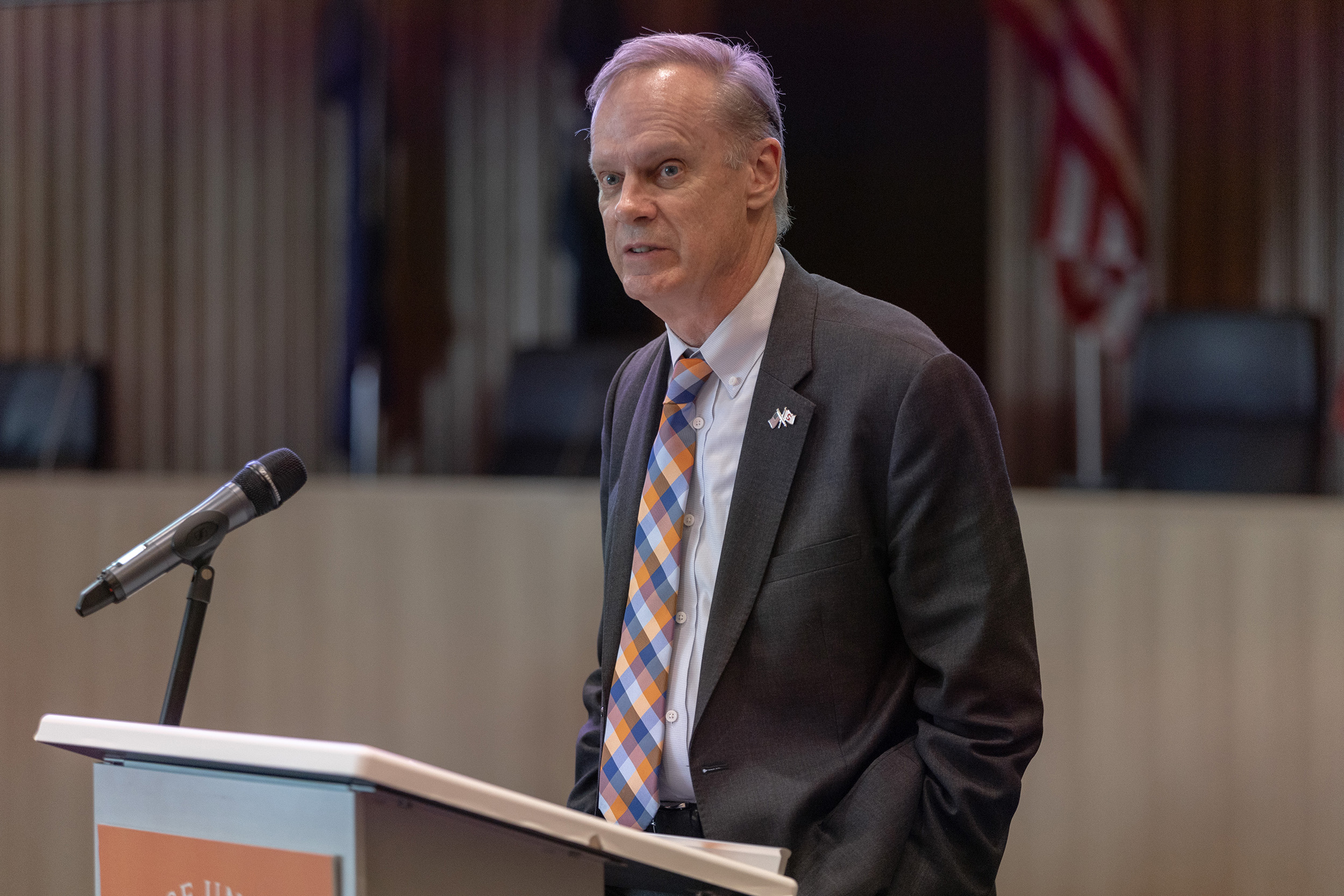
Syverud delivers his scheduled remarks at Syracuse University Senate’s in-person meeting in September 2025. At the meeting, the chancellor outlined the bleak higher education landscape and discussed SU’s dwindling international student population. Joe Zhao | Daily Orange File Photo
In a recent university-wide academic portfolio review, approximately 26 active programs have been slated to be closed, including nine in the College of Arts and Sciences. The closures follow Provost Lois Agnew’s university-wide portfolio review, which directed deans to carry out across their respective schools and colleges. The decisions have prompted concern from faculty, students and alumni over the process and the future of humanities programs at SU.
The closures also raised questions about earlier plans to grow SU’s faculty. In 2017, SU launched a $100 million “Invest Syracuse” fundraising plan, which — alongside its “Signature and Cluster Hires” initiatives — aimed to bring in up to 200 new faculty members. According to university financial reports, SU added 100 faculty over those eight years, though the number of tenured and tenure-track employees grew by just three.
Osborne said with resources being “tightened” over Syverud’s tenure, faculty have been left to “figure out how to do more with less.”
Multiple faculty members also pointed to the rapid turnover of provosts and chief academic officers as one of the most damaging features of the Syverud era. Six provosts served during Syverud’s 12-year tenure, three of them in an interim capacity.
“If you look over the 12 years and ask how many chief academic officers has he had? How many provosts and acting provosts and interim provosts … it’s very distressing,” Gorovitz said. “It’s a very big number. And that churning has a cost. You lose people with institutional memory. A lot of what is important about the history of a university is not written down … it is in people’s minds and their memories.”
Concerns about transparency and limited faculty input in decision-making persisted throughout Syverud’s tenure, several faculty members said. Dutkowsky, for example, praised Syverud’s “loyalty to the university,” national profile and infrastructural investments, but said the administration’s communication was a weakness.
“My biggest critique of Syverud would be the continued positive spin put forth by his tenure,” Dutkowsky wrote. “Bad news for SU … tends to be either glossed over or ignored.”
Mark Rupert, a professor emeritus of political science, concurred and said his decision to retire was shaped in part by the changes he observed during Syverud’s tenure.
“I regret the diminished role of faculty in what we used to refer to as a system of ‘shared governance’ on campus, the pervasive tendency to view the university as a business and students as customers,” Rupert wrote.
Others defended Syverud’s record. Philip Arnold, a professor of religion who’s been at SU for 30 years, praised his commitment to centering the Haudenosaunee and the Onondaga Nation in campus life. Since his inauguration, the university has adopted a policy of opening public events with a land acknowledgment recognizing the Onondaga Nation.
“I’m going to miss Chancellor Syverud … (he) was really kind of a class act,” Arnold said.
Francine D’Amico, a teaching professor emerita of political science who served on a chancellor-appointed Workgroup on Diversity and Inclusion, said Syverud’s leadership was tested repeatedly.
“Syverud led this university through some very challenging years — including the student movement for social justice, an equity lawsuit by women faculty, and a global pandemic … and he did so with extraordinary care, compassion, and commitment to change for the better,” D’Amico wrote in a statement to The D.O. “Above all, he listened.”
Campus culture under pressure
Syverud’s 12 years also saw significant changes in free expression on campus. He inherited an institution that the Foundation for Individual Rights and Expression named the worst school in the country for free speech in 2011, three years before he arrived. FIRE later awarded SU its Lifetime Censorship Award in 2021.
Syverud created a Free Speech Working Group in October 2019 to review university policies. The university later formalized its stance on free expression and academic freedom in a 2024 “Syracuse Statement.” By 2025, SU climbed to No. 76 out of 257 schools in FIRE’s rankings — still a “D-” score, but a 170-place improvement.
Zach Greenberg, FIRE’s director of faculty legal defense and a SU College of Law graduate, called Syverud’s record on free speech “a mixed bag, with several egregious violations of expressive rights earlier in his tenure, and then improving more recently” in a statement to The D.O.
At the beginning of his tenure, Syverud closed the Advocacy Center, the university’s support service for victims of sexual assault, as part of his Fast Forward Syracuse framework. The decision catalyzed THE General Body, a coalition of student organizations that led to an 18-day sit-in in Crouse-Hinds Hall. The group came together to create a 45-page list of grievances and demands.
THE General Body saw some of its demands met, but not others. The Advocacy Center was divided into the Counseling Center, the Office of Student Assistance and the Office of Health Promotion. Syverud also created a workgroup on diversity and inclusion, among other solutions.
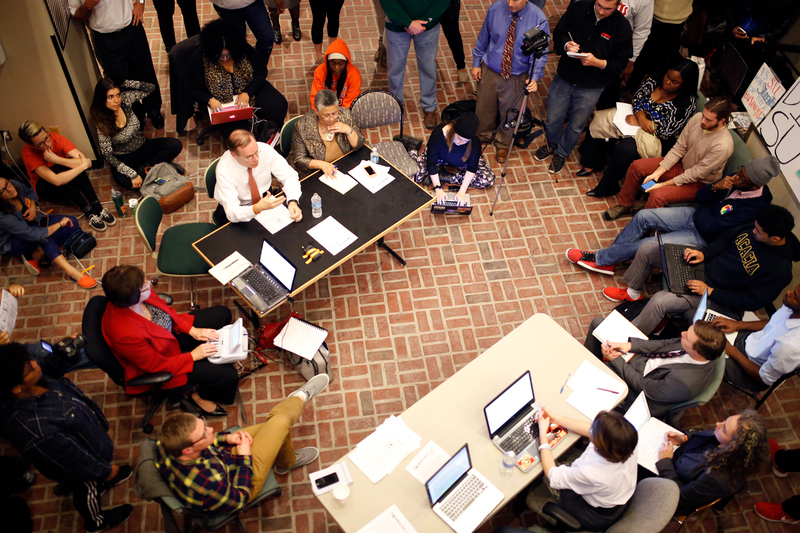
Syverud sits beside Bea González, surrounded by members of THE General Body, negotiating the terms demanded by the protesters. His tenure saw multiple protests that gained national attention; free speech at SU became a hallmark of his 12 years leading Syracuse. Daily Orange File Photo
Five years later, #NotAgainSU resurfaced many of the same concerns. The movement, led by Black students, drew national attention after at least 33 racist, antisemitic and homophobic incidents occurred on campus. Jesús Tiburcio Zane, SU junior and president of Latiné Undergraduates Creating History in America, wrote that it was “one of the most defining moments” of Syverud’s tenure.
In November 2019, there was an eight-day sit-in in the Barnes Center where organizers created a list of demands. Syverud signed 16 of 19 of them on Nov. 21, 2019, but organizers clarified they were not done.
On Feb. 17, 2020, #NotAgainSU began a 31-day occupation of Crouse-Hinds Hall after organizers said the university was not honoring its commitments. They revised their demands and called for the resignation of Syverud and three other administrators. By November 2020, #NotAgainSU organizers told The D.O. there had been progress, but not enough.
Since then, the university has made additional changes to its diversity and inclusion efforts. In July 2025, SU closed its Office of Diversity and Inclusion, replacing it with a human resources unit named People and Culture. The move came alongside a national trend of higher education institutions revising programs to comply with President Donald Trump’s executive order targeting DEI language.
In October 2025, Syverud declined to sign the Trump administration’s “Compact for Academic Excellence in Higher Education,” which offered universities priority federal funding in exchange for policy changes. He also didn’t join more than 200 university presidents who signed a letter condemning what they called “unprecedented government overreach” in higher education months earlier.
Several faculty said they wish SU had taken a firmer public stance on diversity during this period. Osborne said the university’s decision to downplay its diversity commitments, even if driven by external pressure, sends a message.
“I think in not amplifying them, we are communicating something about our commitment to having a diverse university,” she said.
Zane wrote that while the university has introduced diversity-related initiatives in response to student activism, many students of color felt they were “more symbolic than transformative.”
“This era has also been marked by a heightened willingness among students to organize, speak out, and hold the university accountable,” Zane wrote. “However, institutional responses have often felt reactive rather than proactive, contributing to a sense of fatigue among students who continue to push for meaningful change.”
With his departure, Syverud leaves Syracuse for UMich, where he will serve as a law professor and special advisor to its Board of Regents, bringing an end to more than a decade of leadership. His successor, Haynie, has been part of the university’s leadership throughout that period, serving in administrative roles under Syverud. As he prepares to take over, he inherits a changed university, alongside the challenges that come with it.
“Syverud will leave him a solid foundation and Haynie knows the university well,” Dutkowsky wrote. “Haynie’s go-getting, outgoing, visible nature will enable SU to deal forthrightly with the serious challenges of higher education today.”
– 30 –
Managing Editor Rosina Boehm contributed reporting to this article.
Design by Ilana Zahavy | Presentation Director