Lyman nest cam follows Ruth and Oren, 2 red-tailed hawks ‘bonded for life’
Get the latest Syracuse news delivered right to your inbox.
Subscribe to our newsletter here.
UPDATE: This story was updated at 6:59 p.m. EST on Monday, April 20, 2026.
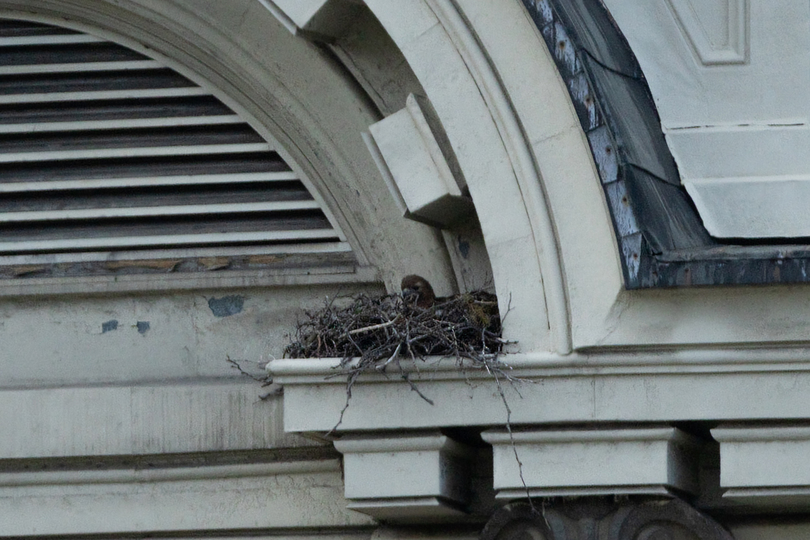
Ruth remains unbothered as a light spring breeze ruffles her dark brown feathers. Suddenly, Oren returns from a campus flight, and the pair switch places in their nest as Ruth soars off.
The couple — together for a third hatching season — are bonded for life.
“I just find them fascinating, beautiful, majestic,” Anne Marie Higgins, an SU alum and true “hawkaholic,” said. “Just very loving to each other, to their chicks, (they’re) very protective.”
Syracuse University installed new nest cameras this year, offering a front-row viewing of the red-tailed hawk pair’s nesting season. Situated in the east side archways of Lyman Hall, the 24/7-accessible livestream provides not only an intimate look into Ruth and Oren’s day to day, but an outlet for wildlife science education — at zero cost.
A third camera offers a wider view of the pair’s movements from the top of the Life Sciences Complex.
Nest cameras aren’t new to SU, nor is the red-tailed hawk species. Oren was born in 2020 to SU-Sue and Otto, a pair of red-tailed hawks who raised 28 chicks from 2012-22. The couple died of avian influenza in 2023.
Ruth and Oren are named in honor of two SU alumni — Oren after Oren Lyons, an All-American lacrosse player and one of the first Native Americans to attend SU, and Ruth after Ruth Johnson Colvin, founder of Literacy Volunteers of America and a Presidential Medal of Freedom recipient.
Two other red-tailed hawk pairs actively frequent SU’s campus. Oren’s sibling, Sarah, and her partner, Jesse, are also a pair in the area. Ensley, a 2016 offspring of SU-Sue and Otto, and her partner, Cliff, claim South Campus. Last year, Oren returned to the building where he once took his first flight to raise his own.
Funded by Higgins, the cameras are monitored by her and seven volunteers. Higgins has donated 11 nest cameras on campus — with six currently active — over the past decade in memory of her late husband, Thomas Higgins Jr., also an SU alum.
The Higginses were avid birders, often exploring central New York for their favorite raptors, red-tailed hawks. The species is monogamous, meaning they typically mate for life.
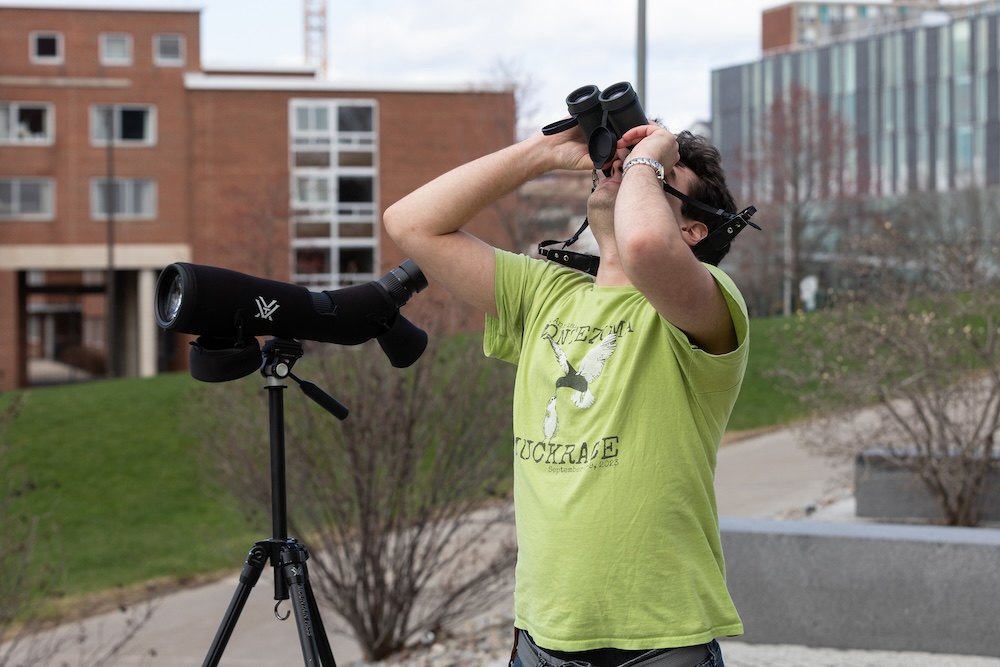
With a telescope and binoculars on hand, SUNY ESF junior Anthony Russo searches for the rich red-tailed hawks population on Syracuse University’s campus. Russo was initially uninterested in birding until he joined his high school birding club. Tara Deluca | Asst. Photo Editor
The nest cameras, similar to outdoor security cameras, capture high-quality resolution. Their zooming abilities and night-vision mode give viewers a glimpse of Ruth incubating her two eggs from dusk to dawn.
The live feed often plays on loop on the desks of some College of Arts and Sciences faculty members, but its viewership has expanded far beyond SU’s campus. Higgins said the cameras have even gained international viewership.
“Not only is it making (birding) more accessible to people … but it also spreads awareness,” SUNY ESF junior Anthony Russo said. “It’s going to make a lot more people understand sort of what’s going on behind urban ecology.”
Known as the “bird guy” on ESF’s campus, Russo always keeps a pair of binoculars with him — just in case. Despite growing up with a bird-loving father, Russo always thought birding was the “most boring thing in the world.” But after joining his high school’s birding club, Russo became fixated on his father’s passion.
“Anyone can do birding,” Russo said. “It doesn’t need to be hard, like sleeping in the woods every day, as long as you are looking for or listening for birds, you’re birding.”
Since learning about Ruth and Oren, Russo has felt a “connection” to the pair, saying he plans to keep watching the livestream for the rest of their nesting season and hopefully years to come. Whenever he sees them on campus, he snaps a picture.
SU physics professor Alan Middleton is also no stranger to a birds-of-prey-centric camera roll. With over 30 years of working experience at the university, Middleton has photos of red-tailed hawks on campus dating back to 2011.
Middleton’s been following the various iterations of nest cams over the years and said these cameras emphasize the intersection between the urban environment and nature.
“It would be great for students to be aware of (the cameras) and to understand that we are living side by side with these animals on campus,” Middleton said.
During his graduate school days at Princeton University, Middleton’s wife introduced him to birding. Now, his passion for ornithology has entered his curriculum. He uses bird feathers he collects to conduct experiments on the wave properties of light.
Middleton said his interest in birds stems from their indicator abilities, diverse variety and adaptability — pointing to their descent from dinosaurs.
“They are the bit of nature that stands out the most,” Middleton said. “They’re fascinating animals, and there are so many of them.”
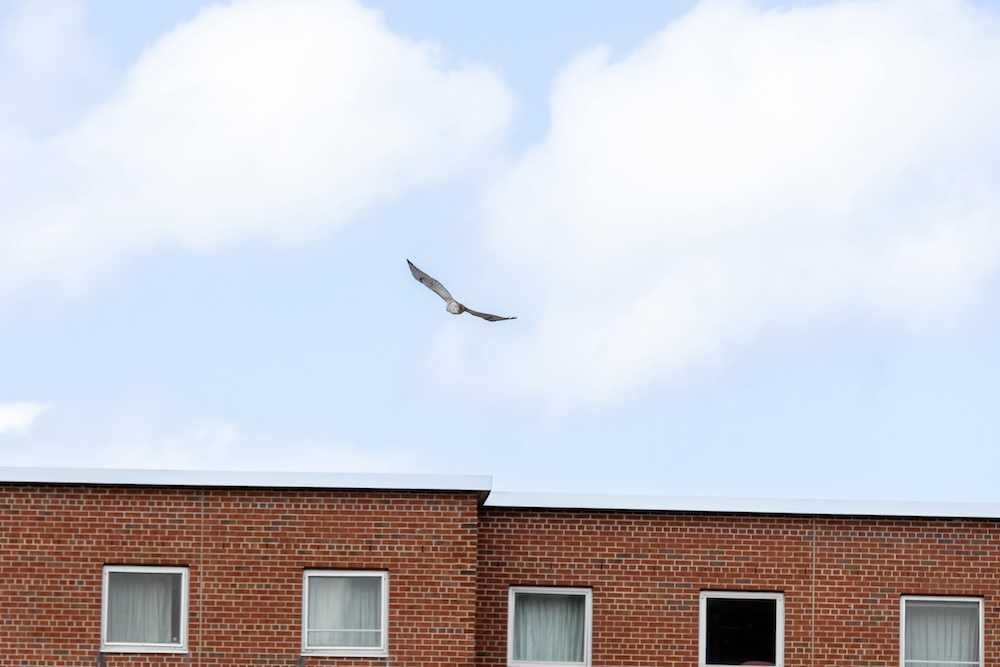
A red-tailed hawk soars in the air of Syracuse University’s campus. SU’s urban campus environment and the surrounding nature provide a thriving space for the hawks to live in. Tara Deluca | Asst. Photo Editor
Red-tailed hawks are one of the most common hawk species in North America. With broad, rounded wings, a short brick-red tail and keen eyesight, they’re also exceptional hunters. Some days, Oren brings back feed to the nest for him and Ruth, or vice versa, Higgins said.
Red-tailed hawks have adapted to urban environments. SU’s campus and the surrounding area serve as a sufficient hunting ground for their small-mammal diets. Oren will often perch on top of Lyman Hall, surveying his surroundings for supper. Other times, he’s peering down at the hundreds of students shuffling in between classes. Not to worry, he doesn’t find nourishment from fraternity boys.
“I hope the impact (of the cameras) is to teach people about the natural world and that we coexist,” Higgins said. “We’re just a part of their environment.”
The nest cameras allow for learning from a safe distance, according to Higgins. She recommends SU community members learn about hawk behaviors to avoid disrupting their natural activities, especially when eyas, or chicks, are fledging. The “Watch for Hawks!” signs around campus every spring are another one of Higgins’ efforts to protect the chicks.
Ruth and Oren’s eggs hatch after around 35 days of incubation. Then, they’ll train their young for six to 10 weeks, beginning approximately 45 days following hatching. The hatchlings will eventually become fully independent, and Ruth and Oren will move on from their chicks, but not each other.
“It’s really remarkable that you have a pair because they’re monogamous,” Middleton said. “They’re bonded for life.”
ESF master’s student Kennedy Sullivan has committed her life to bird conservation. Though she mostly studies piping plovers for the Great Lakes Piping Plover Program and is a National Audubon Society board member, she’s also become interested in hawks.
For Sullivan, the red-tailed hawk nest cams are a great educational resource for people unfamiliar with birds.
“Nest cams are helpful in getting the public interested in bird conservation and caring about a certain species,” Sullivan said. “Birds encourage people to steward the land. So if people come to a site and they see a wide variety of different-looking birds, I think it encourages people to care a little bit more about an area.”
Local schools also collaborate with Higgins to integrate the nest cams in their classrooms. The Syracuse Latin School tunes in to teach students about chick embryology and their life cycle. Higgins will often share her wisdom with elementary students over Zoom. She also runs a hawk-dedicated Facebook page.
By constantly monitoring the nest cameras on SU’s campus, Higgins ensures the well-being of the hawks and takes note of their behavior. With her own camera in hand, Higgins visits Ruth and Oren every day, snapping a closer look at her feathered friends.
Ruth and Oren’s eggs are expected to hatch over the next 10-14 days, right in time for commencement. As the semester ends, both SU’s class of 2026 graduates and the hatchlings prepare to take flight.
“We’re all a part of one big world, and they deserve to be here just as much as we do,” Higgins said. “Live and let live.”
CORRECTION: A previous version of this article stated that Oren and Ruth were named by Anne Marie Higgins. They were named by an SU employee who found them. The previous version also mentioned the location of Sarah and Jesse’s nest the last two years. This year’s location is not clear. The Daily Orange regrets these errors.