Student-run Meuschketools gives performers autonomy with select instruments
Get the latest Syracuse news delivered right to your inbox.
Subscribe to our newsletter here.
On Tuesday nights, the air of the Setnor Auditorium fills with the sound of woodwinds and the low hum of brass. Instead of the guitar and drums, the ensemble aims to bring a new rhythm.
“Meuschketools was different because the sound it created was more nontraditional,” junior Sydney Kincaid said.
The classical ensemble didn’t have a traditional start. It began as part of Bryce Meuschke’s masters thesis. Instead of having a traditional instructor leading the ensemble, Meuschke wanted to give student musicians full autonomy.
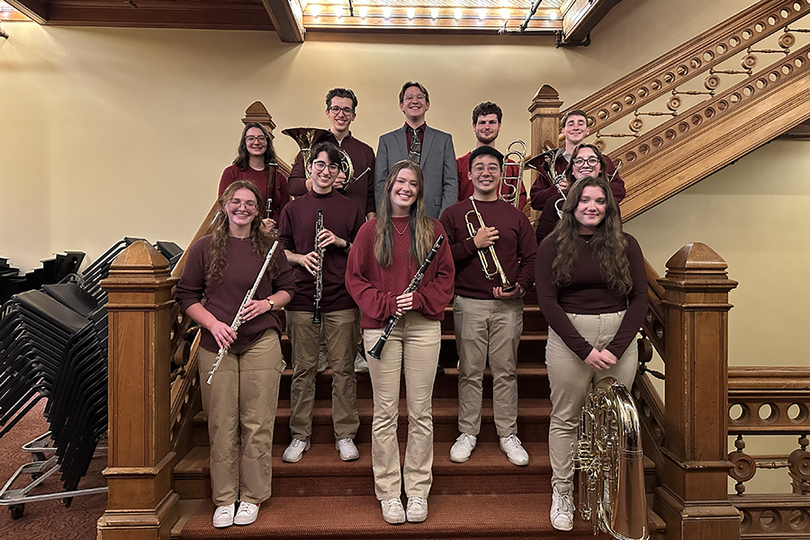
Last fall, Meuschke selected students from the Setnor School of Music who he considered the most talented and formed the group as a collaboration. The result led to a 10-person double wind quintet ensemble, with Meuschke as the conductor.
“It wasn’t supposed to feel like a class, but 10 people coordinating something together,” said junior music education major Ryan Hill.
Meuschketools is built around wind and brass instruments like the oboe, trombone, tuba and more. This specific selection of instruments wasn’t random. Meuschke said he deliberately picked music that doesn’t get performed often, avoiding the more popular composers such as Mozart or Beethoven where viola or violin take a heavy lead. The group is a double wind quintet, which is a chamber ensemble with 10 pieces.
“I wanted to do music that people don’t typically hear,” Meuschke said.
This double wind quintet resulted in a sound that felt experimental and fresh, Meuschke said. Kincaid became involved with the Meuschketools last year. Since joining, Kincaid would describe the ensemble’s repertoire and personal relationships as “high quality.”
After gathering his ensemble together, Meuschke hosted two Meuschketools performances, one in October and one in February. Following their performance in October, Meuschke said professors he had never interacted with walked up to him and said, “I have wanted to hear this piece be played for 30 years.”
The creation of the group by Meuschke is a reminder not to back down from ambitions, Kincaid said.
“(The ensemble) was one of those things Bryce had dreamed up for a while, and you didn’t think it would come to a path and then it did; it’s one of those things where you just have to chase your goals,” Kincaid said.
Each member’s path into music and into the group is different but led to them to be the founding members of Meuschketools. Sophomore music education major Elijah Campbell switched from viola to trombone after asking his sixth grade band director for the “easiest instrument.” Kincaid chose the oboe because the students at that table were the nicest during a fifth-grade orchestra assembly. Junior Cassie Daum, a psychology and music performance double major, switched to tuba because her high school band needed one.
Despite their different backgrounds, the group shares a passion for making something great and is very dedicated to the performance, Meuschke said. Rehearsals run late into the night, often on top of already packed academic schedules.
“There’s basically no free time,” Daum said. “I’ve never met more hardworking people than in these halls.”
The ensemble name reflects that collaborative spirit. Since the ensemble is fully autonomous, Meuschke initially presented several options to name the ensemble, but ultimately allowed the group to vote. The name “Meuschketools” emerged from that process, combining Meuschke’s name with the idea of giving musicians the “tools” and autonomy often missing from more strict spaces. For Kincaid, that autonomy is what makes the group special.
“Some ensembles are too serious,” Kincaid said. “But here, you actually feel like what you’re doing matters.”
That dedication paid off at the Otto Awards on March 21. The double wind quintet won “Best Musical Ensemble,” though Meuschke assumed their win was a joke.
“There are so many groups on this campus that perform way more often than we do,” Meuschke said. “The ensemble only plays a handful of concerts each year, compared to others performing regularly across campus.”
Though the group was in disbelief, the award validated something deeper: the group’s commitment to take on extremely difficult music written for professionals.
“Doing things that we didn’t think were as attainable as they were was the most rewarding part,” Hill said.
Loyalty and appreciation for the music they perform anchors the group, Daum said. It is about making something meaningful with a group of people they trust, Meuschke said.
The group has agreed to not continue performing after four members graduate in the spring, because they “can’t replace a member of the current select,” Kincaid said.
To other students trying to start their own ensemble, Meuschke kept it simple: focus on the people.
“It doesn’t have to be perfect,” Meuschke said. “Just get a group of people you like and make music together.”