NYPIRG wants its funding restored. SGA demands its RSO status 1st.
Get the latest Syracuse news delivered right to your inbox.
Subscribe to our newsletter here.
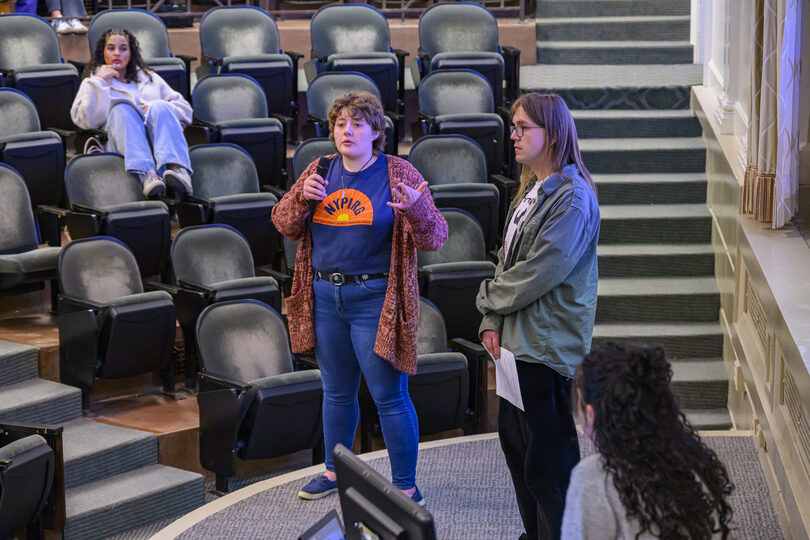
Every Monday, the New York Public Interest Group takes to Syracuse University’s Student Government Association’s weekly meetings to speak during public comment about its programming and work around campus.
But the past few weeks, the group has used the meetings to urge the assembly to restore its recently denied 2026-27 budget.
At an April 6 SGA meeting, NYPIRG, a nonpartisan outreach organization that’s had an SU and SUNY ESF chapter for over 50 years, announced SGA had cut the entirety of its annual budget during its advanced allocations process. SGA said it did this because of its non-Registered Student Organization status, which places the group in a unique position compared to other advocacy groups on campus.
NYPIRG’s funding request, which totaled $95,000, was reduced to $0 for the 2026-27 academic year. SGA said the funds are largely allocated to a full-time salary and a physical office space, located on Marshall Street.
NYPIRG and SGA first established a relationship in 1999 that’s been governed by a contract, according to a joint statement issued Wednesday by SGA President-Elect Emily Castillo-Melean, Comptroller Alexis Leach and current President Germán Nolivos. However, the university terminated the contract after SGA cut all of NYPIRG’s funding during its advanced allocations process.
Members of NYPIRG, like Leandra Hernandez and Natallie Cox, told The Daily Orange the decision to cut its funding came down to the resources their organization receives as a result of its non-RSO status, regardless of the work they partake in. NYPIRG receives its funding outside of SGA’s four-tier funding system.
“We are doing something every single day, and we’re doing at least seven different campaigns all at the same time,” Cox said. “It’s stuff both in the Syracuse community, but … in New York state as a whole, we do a lot of work. I think that fundamentally makes us a little bit different.”
SGA, however, maintains that the decision came down to NYPIRG’s place among student advocacy groups and the privileges they receive while not being an RSO.
“This decision was grounded in careful review, objective data, and extensive discussion among elected student representatives,” SGA’s statement said. “At its core, the decision reflects a responsibility to prioritize the needs and sustainability of the more than 350 recognized student-led organizations on campus.”
Prior to the budget cut, NYPIRG received $6 from each enrolled undergraduate student’s student activity fee, according to the 2025-26 tuition and fees handbook. The fee is given to NYPIRG “on a mandatory basis at the time of registration,” but can be refunded if students contact the organization, according to the handbook.
In the statement, SGA said the decision to cut funding stems from limited student participation in “NYPIRG-led initiatives,” compared to the growing number of student-led advocacy organizations on campus.
Notably, the statement highlighted that the total amount received by over 35 advocacy and service RSO’s was $44,079.60 for the 2025-26 academic year, including 1,909 members, while NYPIRG requested more than double that for the 2026-27 academic year.
NYPIRG’s full-time program coordinator, Azaria Chapman-Walker, whose position is paid for by annual SGA funding, said her role won’t be the only one affected by the cuts. She pointed out NYPIRG’s connection with a course in the Maxwell School of Citizenship and Public Affairs, where students are required to attain 35 hours of community service.
“This class relies on us to get students credit,” Chapman-Walker said. “Having $95,000 and going completely to zero… means that can’t happen.”
Interns who facilitate NYPIRG’s campaigns take leadership roles within the organization, addressing issues from homelessness and hunger to transportation and higher education costs, Chapman-Walker said. She said this will become “impossible” to continue without funding.
Other students associated with NYPIRG expressed concern about the program’s future without the funding to sustain a full-time staff member and a dedicated space.
Callie Morales, a SUNY ESF sophomore and NYPIRG member, said that a full-time program coordinator is “absolutely” necessary for the organization to function and continue functioning as is.
“To do the sheer amount of work we’re doing, yes,” Morales said. “She’s very much a part of the greater NYPIRG, so she has a lot of interconnectivity with them.”
In response to the imposed budget cuts, NYPIRG circulated a petition advocating to restore its funding to Chief Student Experience Officer Allen Groves, which the group distributed at Monday’s SGA meeting.
NYPIRG reported 2,209 students and 79 faculty members signed its petition. However, SGA claimed some of the signatures were repeated or used fictitious names. Some entries are duplicated, with a change in capitalization, or only include a first or last name.
Chapman-Walker said the petition included outside community members who came across petitioners and wished to offer support, indicating the petition went beyond SU affiliates in its purported numbers. The petition only includes 27 signatures labeled as faculty and 37 as staff, according to the support petition distributed by NYPIRG.
As a non-RSO organization on campus, NYPIRG’s ambiguous status made response efforts challenging for student members, including Xochitl Quinones, who said they’ve encountered “complications” since the funding cut.
“It gets kind of muddy on what we are, and we’re just continuing to try to fight the appeal process and possibly be an official RSO next semester,” Quinones said.
Others, including SUNY ESF sophomore Scott Newman, are angered by the move. In a statement to The D.O., he argued that a lack of attention and care from SGA prompted this decision.
“SU’s administration pushed the decision, and executives rolled over, assembly members played games on their phones while ignoring NYPIRG when they speak,” Newman said. “The SGA is a powerful, yet pointless organization that wields privilege and power defensively, lashing out when criticized.”
In its Wednesday statement, SGA recognized NYPIRG’s impact on campus and the Syracuse community and suggested that the interest group take the steps to become a student-led RSO. Chapman-Walker said NYPIRG is “happy” to become an RSO.
“I think the real opposition to (becoming an RSO) for us comes from the fact that when (SGA is) saying we can be an RSO, they’re not saying ‘We’re gonna keep funding you at what we’re funding you,’” Chapman-Walker said. “We’re happy to become an RSO. But the issue is (that) they still plan to have us zeroed out.”
SGA also criticized NYPIRG for the accuracy of its efforts to garner student and faculty support, claiming the information shared with students is often misleading or incorrect. The statement also notes that a number of students have shared with SGA that they felt “pressured” to sign the petition or lacked full context when doing so.
Moving forward, NYPIRG members shared deep concerns about the organization’s viability without a program coordinator to lead them.
“There’s always a fear of what’s going to happen with this club next year,” Cox said. “There seems to be a revolving door of different members and different E-boards, and that’s great, but that can really sometimes put a club’s survival in danger.”
Chapman-Walker maintained that while she was disappointed in the decision, she hopes the future holds a continued partnership with SGA that allows NYPIRG to continue to operate on campus.
“NYPIRG is an organization that wants to uplift the community … we want to uplift the people around us, and we want to uplift the organizations around us, and obviously we can’t if we don’t have the funding,” Chapman-Walker said. “I think that this was an oversight of democracy at the end of the day.”