Opinion: No-tech classrooms improve student retention, focus
Get the latest Syracuse news delivered right to your inbox.
Subscribe to our newsletter here.
During my first class of the spring semester, my history professor banned all technology. For 55 minutes every week, their lecture would require my full, undivided attention.
At first, a no-tech classroom sounded intimidating. I’ve relied on my laptop throughout high school for everything. Typing notes was faster and certainly more familiar. I’d forgotten how much energy and focus writing by hand demands.
It’s common to assume that note-taking on a laptop or iPad is more efficient, especially with the immediacy of modern technology. But, this assumption doesn’t hold up in practice.
Studies show taking notes on a device isn’t as effective as handwriting for memory retention and learning. A study of 3,005 participants found that 9.5% of students who take notes by hand earn an A, compared with 6% of students who type their notes. While handwritten notes don’t guarantee an A, they increase the likelihood.
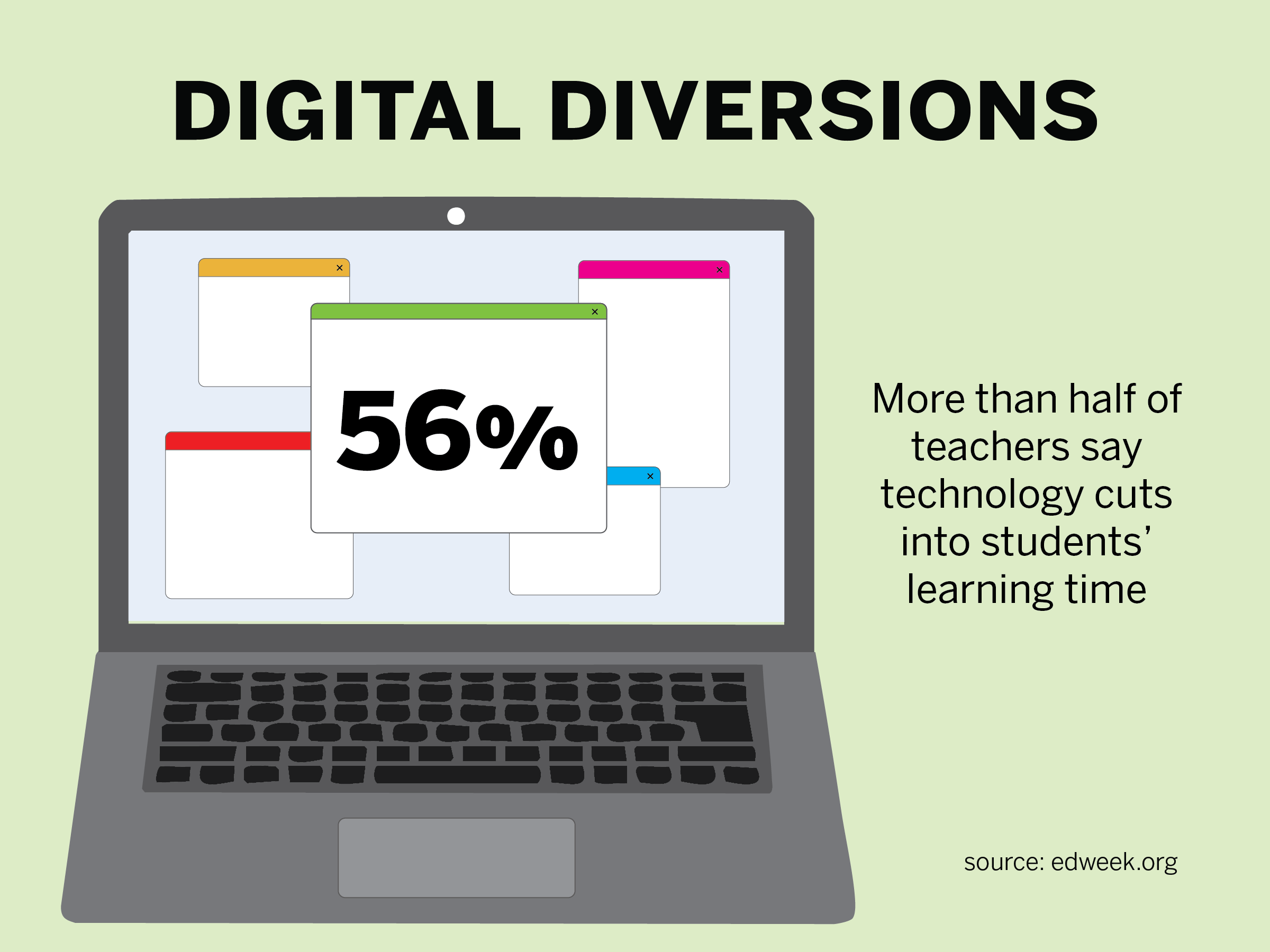
But, the challenge isn’t just how we take notes. Today’s constant stream of short-form content interferes with focus in the classroom. Media surrounds students and challenges their ability to sustain attention for long periods of time.
The presence of laptops in classrooms makes it easy to disengage in just a few clicks. Students can move from lecture notes to social media or email within seconds, often without even thinking.
It’s a common misconception that humans can multitask, also known as cognitive switching. We’d like to believe we can effectively listen to lectures while checking messages or browsing tabs. But, in reality, it’s impossible to be fully focused on both.
Adelaide Guan | Design Editor
I spoke with Charisse L’Pree, an associate communications professor at Syracuse University, who researches how media impacts attention and behavior. She has authored two books that explore the impact of media on people’s thoughts and behavior. L’Pree said multitasking in class takes more time and energy than we think.
“You’re inevitably cognitively switching and wasting energy. I think that’s the most important thing I would want students to know. You will burn yourself out by simply going back and forth between two things. You won’t process either of them,” L’Pree said.
Something as simple as a notification in the corner of your screen is capable of diverging your full attention. Suddenly, all you can think about is the alert, not what you’re supposed to be focused on. Before long, your attention drifts elsewhere.
There have been many times when I’ve felt frustrated or confused as to why I wasn’t properly retaining information from my classes. I’ve noticed that sometimes when I look back at my typed notes, there are things I don’t remember writing because I was more focused on transcribing rather than understanding.
“Students get uncomfortable and honestly get upset if you tell them no computers in the classroom, and it’s a fight,” L’Pree said.
After four months in a no-tech class, I’ve noticed a significant difference in my performance. I remember more of the content and can better apply class material on tests and projects.
While we tend to think technology makes class easier, it only pulls us further away from being fully present in lecture.
If the goal of higher education is not just to hear information, but engage with it, then attention must be prioritized. Students must be willing to put distractions aside and reconsider the usage of technology in the classroom.
Emalie Vera is a freshman majoring in English and textual studies. She can be reached at ehvera@syr.edu.