Opinion: Trump’s push to deny birthright citizenship uproots U.S. identity
Get the latest Syracuse news delivered right to your inbox.
Subscribe to our newsletter here.
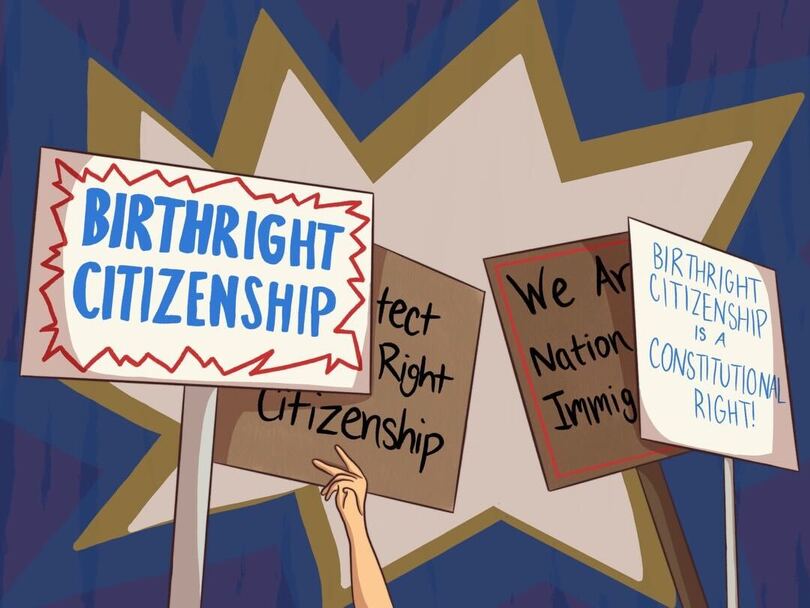
On April 1, the Supreme Court of the United States heard arguments in Trump v. Barbara, a case brought by the American Civil Liberties Union that, until recently, wouldn’t have been up for discussion. Birthright citizenship is now being challenged at the highest level of American law.
On the first day of President Trump’s second term, he issued an executive order stating that birthright citizenship — guaranteed by our Constitution — only applies to children of U.S. citizens or green card holders.
The order excludes children of temporary visitors, such as student visa holders, H-1B skilled workers and tourists.
It also ignores a fundamental right. Birthright citizenship isn’t a policy preference, as framed by Trump’s order. It’s a constitutional guarantee made unmistakably clear by the 14th Amendment.
“All persons born or naturalized in the U.S., and subject to the jurisdiction thereof, are citizens of the U.S. and of the State wherein they reside,” the 14th Amendment states.
The order’s supporters argue that the phrase “subject to the jurisdiction thereof” was never meant to include children of noncitizens. That interpretation was tested — and rejected — over a century ago.
The Supreme Court clarified the meaning of the 14th Amendment in U.S. v. Wong Kim Ark (1898). Ark was born in San Francisco to Chinese parents who were legal residents but not citizens.
He was denied reentry to the U.S. after a trip abroad, and the government argued he was never a citizen to start. The Court disagreed. The majority opinion made clear that “subject to the jurisdiction thereof” simply meant not owing allegiance to any foreign power that would exempt a person from U.S. law.
The amendment was never written to exclude children of immigrants who lived, worked or started families in the U.S. v. Wong Kim Ark established a clear precedent. Trump’s current challenge reframes a settled constitutional rule as an unsettled question.
Trump’s current challenge reframes a settled constitutional rule as an unsettled question.Navya Varna, Columnist
The legal debate can’t be separated from its human consequences. After speaking with Ashlee Coloma, a Syracuse University freshman double-majoring in political science and Spanish, it became clear how questions of citizenship shape identity and belonging. Coloma reflected on her father, an Ecuadorian immigrant.
“To him, having legal status means protection, being able to live in this country without a constant fear of deportation or uncertainty,” Coloma said. “It provides a sense of stability that not everyone has, especially for those with different immigration statuses.”
She explained how her birthright citizenship represents more than her identity as a first-generation college student; it offers her a chance for a better future for both herself and her family.
I see that reality reflected in my own experience, too. I have birthright citizenship, and my parents immigrated from India on an H1-B Visa. One came to the U.S. to attend graduate school, and the other came to work. Their decision to start a family here has shaped every opportunity I’ve had. My citizenship represents the stability that made those opportunities possible.
The 14th Amendment was ratified to rectify one of the most infamous U.S. Supreme Court rulings in our nation’s history, Dred Scott v. Sandford (1857). The amendment was a deliberate repudiation of the idea that the government could pick who belongs in the U.S.
So, Trump’s executive order asks the Supreme Court to forget all of that and erase what was already confirmed.
If the Court sides with the Trump administration, it won’t just be ruling on immigration policy. Birthright citizenship has never been a loophole; it’s the law.
The Supreme Court is expected to issue a ruling by the end of June on the legality of Trump’s executive order ending birthright citizenship.
At its core, this case is about whether a settled constitutional decision can be rewritten by a constitutional order. For more than a century, the 14th Amendment’s promise of birthright citizenship has remained clear.
Weakening that guarantee now unsettles a principle that has defined who we are as a nation. Some rights aren’t meant to shift with different administrations — birthright citizenship is one of them.
Navya Varma is a freshman majoring in political science. She can be reached at navarma@syr.edu.