Personal Essay: This poetry month, take time to rediscover the genre
Get the latest Syracuse news delivered right to your inbox.
Subscribe to our newsletter here.
This April marks the 30th National Poetry Month, and to celebrate, I think students should give poetry a shot. If you felt a shiver down your spine reading that sentence, I get it.
Poetry can be complicated and confusing, but it can also be beautiful and insightful. Created before prose, poetry is the oldest form of literature in the English language, yet it still has so much to offer readers.
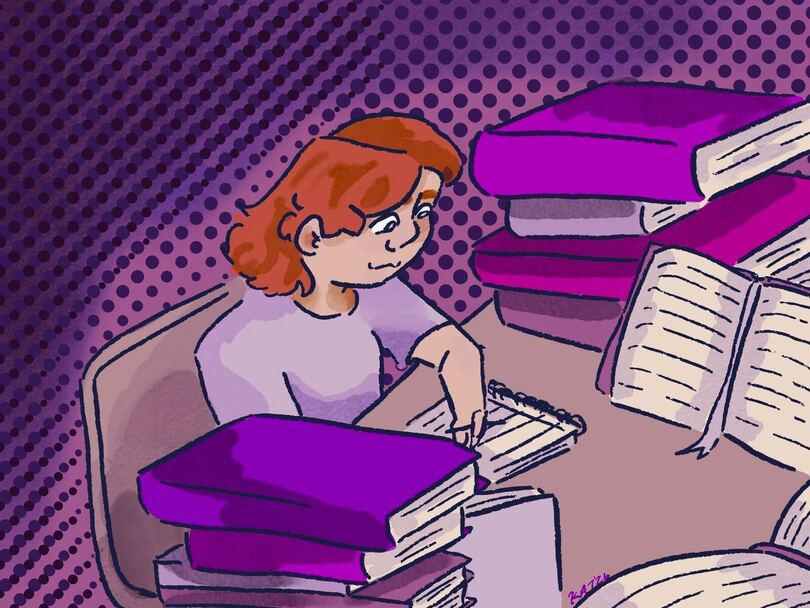
I love reading. There’s nothing like getting lost in a piece of literature that drags you in with beautifully written language. But as a college student, finding the time to dive into a new literary world can be daunting. I’ve recently found an easy solution to fit reading into my schedule: poetry.
For most, reading poetry is merely a burden they must overcome for whatever English class they’re taking. Admittedly, before this year, I’d never read poetry outside of class. But poetry’s short storytelling and flowing language lends itself well to the busy reader.
Poems are very short, typically no longer than a page and can stand alone or be a part of a longer narrative, like chapters in a book. As a student, poetry volumes featuring stand-alone poems with a loose narrative or overarching theme work best for me.
With a novel, it’s difficult for me to stay interested in the story when there’s so much time in between when I start a book, and when I find free time to pick it back up again. With poetry collections, I can read a few poems, put the volume down for a week or two and continue where I left off without needing to reread certain parts.
The main problem people have with poetry is how they’ve been taught to consume it. My first experience with poetry was in my fifth grade classroom, and each year since, I’ve had to analyze increasingly difficult pieces of poetry — poking and prodding it to reveal secrets the poet must have left behind.
I’ve come to enjoy that not every poem needs to be completely understood. Literary devices in the text don’t need to be defined, and symbolism doesn’t need to be identified — the only expectations you need to have for yourself is to enjoy it.
I also believe people are hesitant to read poetry because it’s not easily interpretable to the modern reader. Some of the most common poets taught in American high schools include William Wordsworth, William Shakespeare, Emily Dickinson and Walt Whitman, all of whom wrote poetry before the 20th century.
There’s another side of poetry that isn’t typically taught in schools, featuring voices of a younger, more diverse range of authors, mainly found in contemporary poetry.Hannah Hewitson, Personal Essayist
These poets are all iconic for a reason — they’re pioneers of American poetry and should be recognized for their work. But their poems are typically harder to decipher due to the older language.
The supposed lack of fresh voices in poetry has also resulted in a perceived lack of representation in the genre.
Eighty percent of common texts studied in schools about historical and social topics contained little representation of minority characters and perspectives, according to the Association for Supervision and Curriculum Development. This is out of touch with the world students live in.
The poetry taught in American schools often comes from the perspective of white men, leaving out more diverse and modern perspectives that students can better identify with.
Students tend to associate poetry with this limited perspective, which is far from reality. There’s another side of poetry that isn’t typically taught in schools, featuring voices of a younger, more diverse range of authors, mainly found in contemporary poetry.
By reading work from authors outside of, say, the “Big Six” of poetry, you hear from different perspectives that not only add more variation to what you’re reading, but also show you how people from different walks of life experience the world.
Poets who write about modern life, like Ada Limón and Ocean Vuong, challenge the monotonous themes and voice of poetry that many of us were taught. These works are much more digestible and enjoyable to read than anything I learned in school.
While April showers are hard at work bringing May flowers during this National Poetry Month, I will be curled up in my dorm reading some great poems, and you should be, too.
Hannah Hewitson is a freshman majoring in journalism. She can be reached at hrhewits@syr.edu.