Physical media fulfills SU students who go analog in surging digital age
Get the latest Syracuse news delivered right to your inbox.
Subscribe to our newsletter here.
On the wall of Anzor Mustafa and his roommates’ Syracuse University dorm room, a growing collection of Polaroid photos documents a year’s worth of friendships. The group has made a tradition of documenting every guest who walks through their door in Booth Hall.
Each photo is signed and displayed, creating a record of the people who have passed through and the memories they’ve made. Over time, the collection has grown to around 25 photos.
For Mustafa, the appeal goes beyond decoration.
“We’re sort of in a digital age right now,” he said. “Having physical reminders of the things that we love and the people that we love is so important.”
Across SU’s campus, some students are turning toward analog forms of media and creativity, from CDs and vinyl records to journaling and crafting, as a way to disconnect from screens and use their time more intentionally. This has become a nationwide trend for Generation Z — a distaste for the increasing digitization of society ironically spreading over social media.
Sophomore Avalon Whitney’s connection to physical media began at 14, when she received a CD player from her parents and inherited some old CDs. Since then, her collection has grown to over 100.
She often searches for new additions while thrifting, making CDs the first section she checks in secondhand stores. Whitney listens to the CDs regularly while doing chores or driving, often choosing them over streaming platforms, she said.
For Whitney, the appeal is partly convenience, since her 2012 Subaru Outback doesn’t easily connect to Bluetooth. But there’s also a comfort and pride to the physical presence of the collection, she said.
That interest in tactile hobbies extends beyond music. Whitney also builds Lego flower sets, something she does with her boyfriend to step away from her phone and focus on a more hands-on project.
“I like doing things with my hands,” Whitney said. “It’s nice to just have something to sit down and focus on for a while. It’s nice to get off my phone that way, too.”
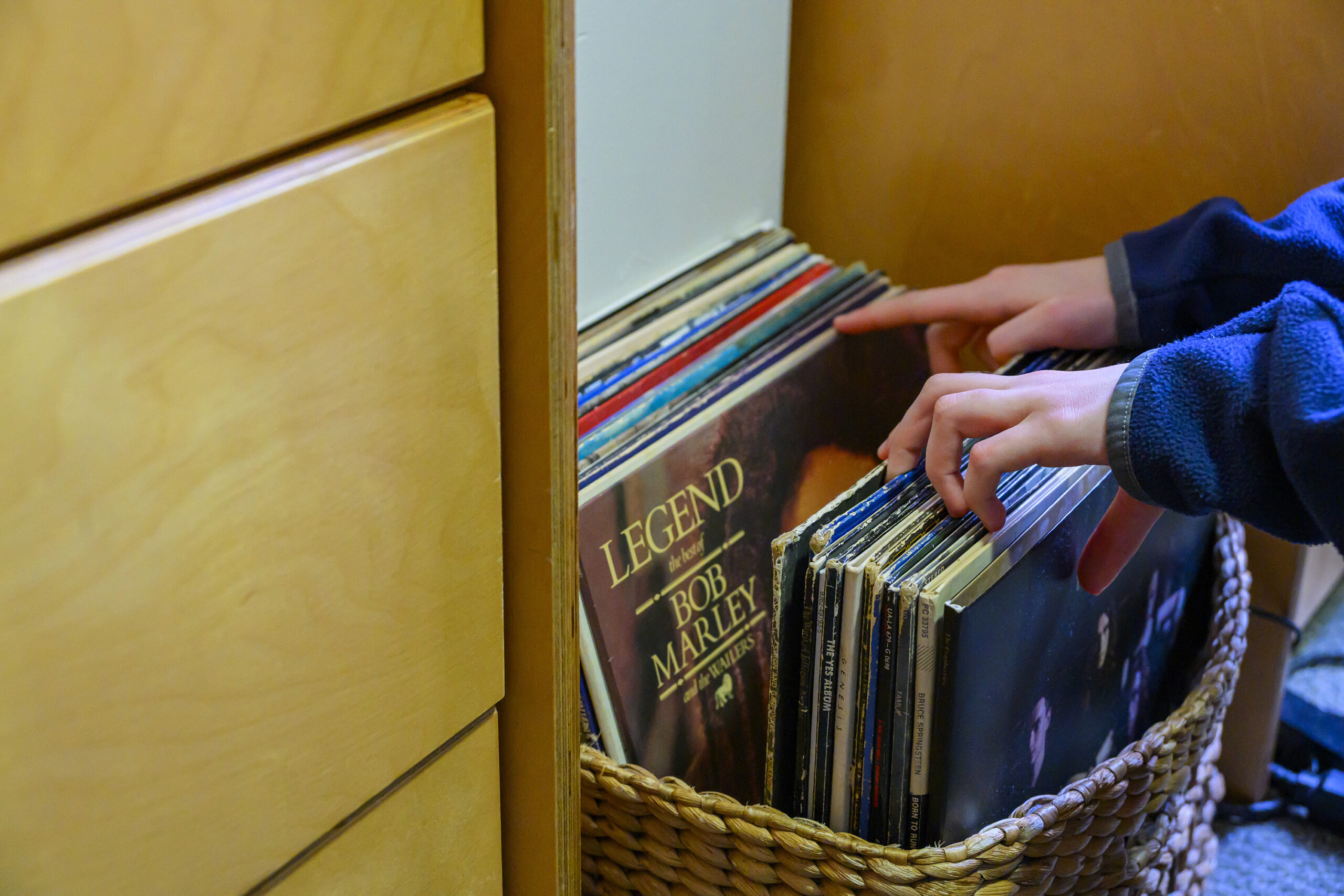
Lexi Weber flips through her milk crate-sized collection of vinyl records. Weber’s collection began in middle school after receiving a record player. Charlie Hynes | Staff Photographer
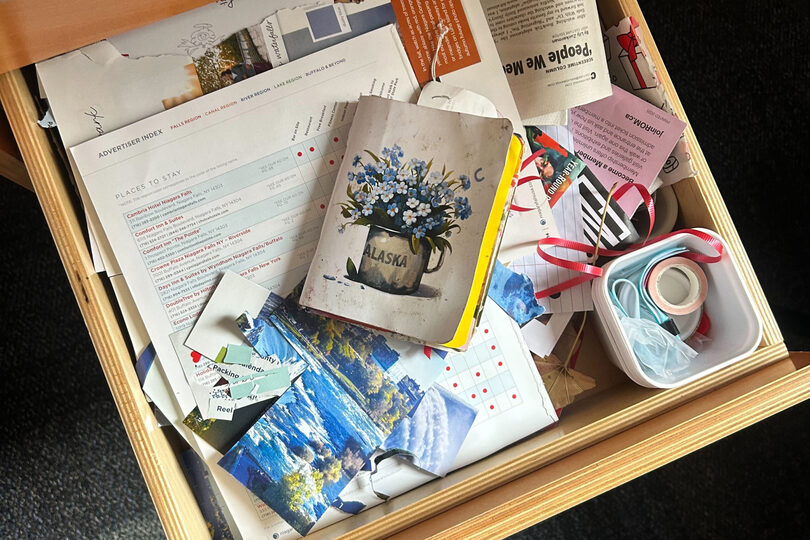
Sophomore Yusra Khasawneh began junk journaling — where artists glue pieces of “junk” aesthetically into a journal — about a year and a half ago after stepping away from more traditional art forms.
“With junk journaling, it feels like there’s no skill barrier,” Khasawneh said.
Built from materials Khasawneh finds, including pamphlets, newspaper clippings and everyday objects, her journals are built from what she comes across in daily life, she said. Over time, Khasawneh revisits pages, layering and adjusting them as her ideas evolve.
Some pages remain untouched for weeks or months before she returns to them, adding new material until they feel complete. Khasawneh said the practice feels like a more productive use of her time than being on her phone.
“It feels like I’m creating something for myself, rather than just consuming something someone else created,” she said.
The difference between creating something and participating in passive consumption is part of what makes the practice feel more intentional, Khasawneh said. She sees journaling as a way to produce something tangible.
Still, Khasawneh doesn’t fully reject digital entertainment. She often plays YouTube videos in the background while working, describing it as a “compromise” between productivity and entertainment.
SU freshman Lexi Weber also approaches creativity by blending physical and digital practices together rather than rejecting one.
Weber began collecting vinyl records after receiving a record player and vinyl from her sister in middle school. Now, her collection fills a milk crate. She often plays records while cleaning or spending time with friends, letting others choose what to play to share the experience.
For Weber, the process of playing a physical record is part of the charm. Unlike streaming platforms, which offer endless options, vinyl requires more deliberate choices, Weber said. She often listens to albums in full rather than skipping between songs.
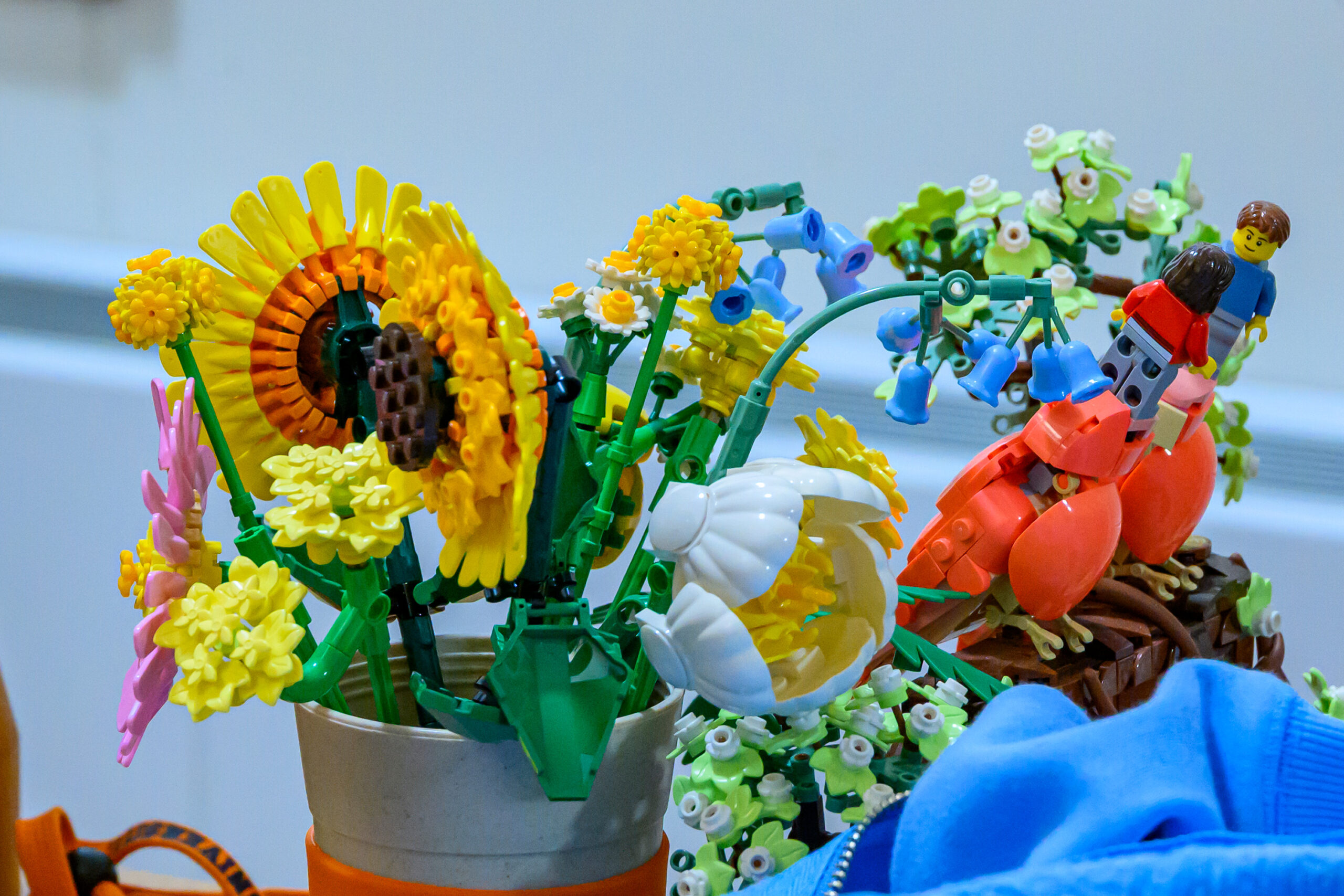
Avalon Whitney builds Lego flower sets with her boyfriend to step away from her phone. She also collects CDs, with a library of more than 100. Charlie Hynes | Staff Photographer
“It’s so easy to just pull up Spotify,” she said. “But taking a moment to actually think about what you want to play, you only have a limited choice.”
Weber does, however, maintain a digital journal on her phone. The experience complicates the analog-versus-digital divide: while she values the intentionality of vinyl records, her creative writing process exists primarily online, she said.
These digital writings are more accessible, Weber said, especially when she’s on the move. Both Weber and Mustafa said they aren’t fully abandoning digital tools, but instead purposefully separating them — analog for presence, digital for speed and access.
Mark Povinelli, an adjunct professor in SU’s Renée Crown University Honors Program, teaches his classes, including one about technology ethics, almost completely on paper. He’s done this for years, even though much of his course content has historically covered engineering and technology — topics that would typically be mostly online.
He said his choice to stay away from digital practices is based on research that keeping a “blank-page journal” helps with nonlinear thinking, retention, creativity and reasoning.
Povinelli advocates for both analog and cyber practices, however. He acknowledges that some skills or processes require the high-computation abilities of the digital world.
“It’s not an either-or thing here,” Povinelli said. “It’s not a moving on, it’s an adding to.”
All of the skills learned via analog practices, he said, are crucial when it comes to education. Moving into the digital space allows teachers to “push off” education onto a computer, depriving students of learning important skills.
Povinelli said he views Gen Z’s return to analog as an acknowledgement that they’re being cheated.
“That’s them recognizing something, that they’ve been shortchanged in their development, education,” Povinelli said.
For Whitney, the motivation is simpler than any generational critique.
“It’s nice to get off my phone,” she said.
Disclaimer: Anzor Mustafa formerly worked as a staff writer for The Daily Orange. Mustafa did not influence the editorial content of this article.