PRISM’s student concert series emulates live basement show atmosphere
Get the latest Syracuse news delivered right to your inbox.
Subscribe to our newsletter here.
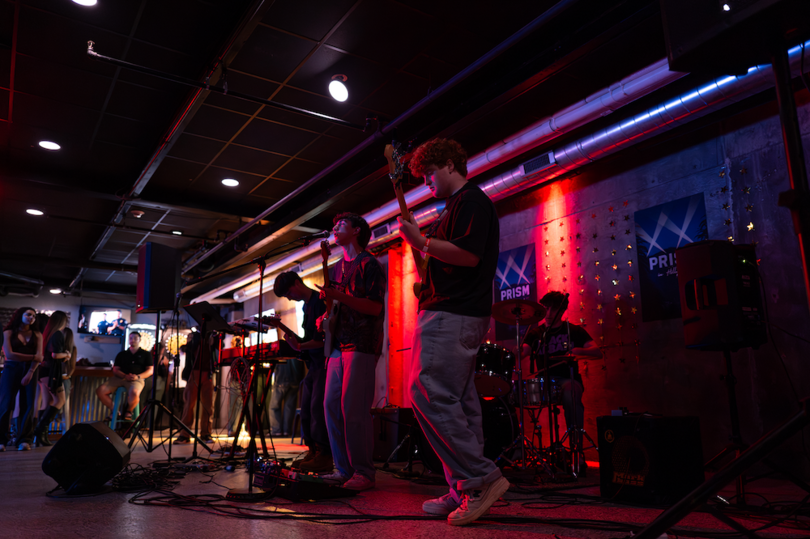
The basement of Lucy Blu Island Bar and Club was filled with the clamor of students waiting for live music, playing pool and talking to friends on Thursday night.
Old Hollywood glamour posters decorated the walls as five acts took the stage on Marshall Street, filling a void that many Syracuse University students said they’d been feeling all year.
“Getting to do something off campus when the house shows aren’t as active this year was really special,” CC Cosenza, a senior music industry student and PRISM performer, said.
PRISM is an annual student concert series from the Setnor School of Music. The show has been running since 1999, originally held in Setnor Auditorium and funded by the school. This year, the show was fully student-run and funded, with the help of a faculty advisor.
The band Hydrogen headlined the event, alongside performers Liam Nolan (known as Cassidy), Anthony Martinelli, Cosenza and Jobi and Friends. Co-producer Maya Perez said auditions and direct outreach were used to select the lineup, with an emphasis on original music.
Co-producers Bella Ierano and Perez said Lucy Blu’s was chosen to host the event to recapture an energy that’s been fading from campus life.
Ierano, a junior in the music industry program, said the venue change was part of a larger effort to grow the show’s reach beyond students in the music school.
“We were trying to advertise it as a basement show because people were really missing the house show scene,” Ierano said. “We find that a big issue in the live music scene is not the fact that there isn’t live music to go to, but it’s the accessibility.”
The production came together in under a month. Ierano and Perez said PRISM normally begins organizing the show at the end of the fall semester, but a university budget cut to the music industry extracurricular fund made things harder.
Without any institutional budget, the pair covered upfront costs themselves, negotiated a door revenue split with Lucy’s and raised additional money through a raffle. Then, they started assembling their lineup, Ierano said.
Despite the compressed timeline, attendees like sophomore Liz Turner said the event felt “polished,” and the atmosphere exceeded her expectations.
“I knew it was going to be good, but it was a lot better than anything I could imagine,” Turner said. “I had more fun than I’ve had at some other student shows.”
PRISM was the debut performance for Nolan’s project, Cassidy. He played three songs — two originals, including one co-written with bandmate and roommate Damian Doyle and a cover of “Melissa” by The Allman Brothers Band. Nolan said he plans to continue performing as Cassidy and hopes to have enough material for an EP by the fall semester.
“It was a pretty perfect setting to debut a solo project like that, a mini set and not a very high pressure situation,” Nolan said.
Martinelli said he first heard about PRISM through an announcement in a class in the Bandier Program for Recording and Entertainment Industries. Soon after, Martinelli received a direct message from the show’s Instagram account asking him to perform for them.
On Thursday, he performed five songs, including three originals and two covers. Two of the original songs are recorded but unreleased, with a planned summer release.
“My favorite thing about performing is being able to brighten someone’s day or just create an atmosphere where people can have a good time,” Martinelli said. “It was really great to see a promising reaction.”
Cosenza, a senior music industry student, performed a three-song set including songs influenced by soft rock and surf rock. Cosenza said she’d played at PRISM in previous years with other groups and was invited back by the production team for a second consecutive year under her own name.
“There are just so many talented musicians on this campus, and we only heard and saw a handful of them the other night,” Cosenza said. “I really hope that this encourages people to take matters into their own hands and revamp the live music scene.”
Turner said she was drawn partly by the show’s social media presence. She said the bar setting felt more like a basement show than a campus event — a change from its previous renditions.
“It very much felt personal,” Turner said. “It felt way more casual, rather than having to go into Schine and find your way to the underground.”
Junior Goldie Singer, who’s attended PRISM in previous years, said the move to Lucy’s marked a noticeable shift in quality and atmosphere compared to past editions, which were held in the Setnor Auditorium in Crouse College.
Ierano and Perez announced they’re considering expanding their show schedule to once a semester instead of annually, an idea Singer liked.
“I saw people who wanted to have their music out but just didn’t have an outlet to do so,” Singer said. “It was a really great opportunity.”
The show took place amid a broader decline in on-campus live music, Cosenza said. Multiple attendees and performers referenced Dazed, a house concert series that is no longer active, as an example of what the campus music scene once looked like.
Ierano said the downtown Syracuse scene remains active — with shows at venues including Funk ‘n Waffles, Westcott Theatre and The Song & Dance — but that distance and accessibility remain barriers for students.
Martinelli echoed that sentiment, saying he’s been working to find more performance opportunities on and off campus despite the limited options.
“I am so for the live music scene growing, and I really am happy that PRISM is playing a part in keeping it alive,” Martinelli said.
Ierano and Perez don’t want that to die out when they graduate. On top of expanding to two shows per year, they said that they plan to build out the production infrastructure so the event can continue after they leave.
“We want to leave something behind for other people in our major that they can take over,” Ierano said. “We’re really just trying to establish this and make it more than what it was.”