SCRC activism exhibit revisits protests, politics for America’s 250th
Get the latest Syracuse news delivered right to your inbox.
Subscribe to our newsletter here.
No matter which entrance of Bird Library you enter from, you’ll see a poster next to the door with the words “WE DEMAND” printed on top.
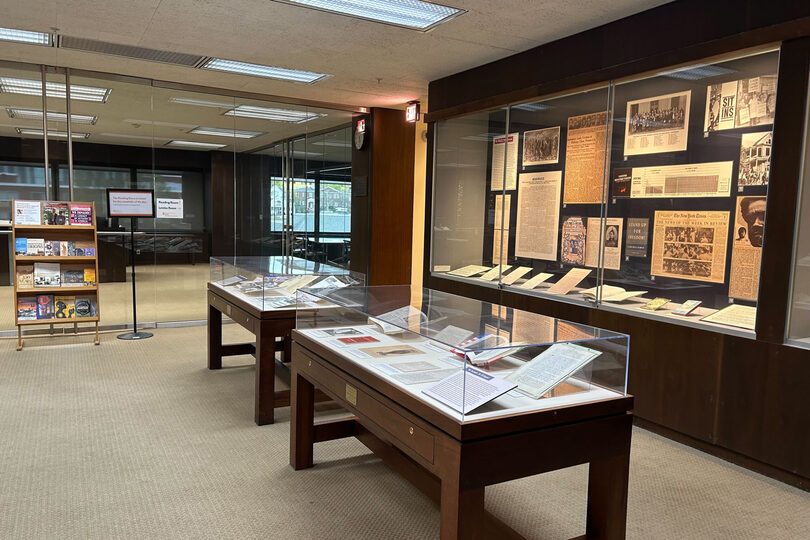
If you follow its instructions and take the elevator up to the sixth floor, you’ll see an enlarged version of the posters on the wall. Whether you decide to turn left or right, you’ll end up in an open gallery with physical evidence of social activism spanning from the last 176 years.
“A lot of history, people assume that it’s made by people who have power and money and influence,” said Lindy Smith, the Special Collections Research Center’s assistant director and exhibition co-curator. “But when people get together, you can gain the power and influence to change a community.”
SCRC’s newest exhibit, “We Demand!: A Legacy of Activism in America,” opened March 2, with its official reception on Tuesday. The exhibition will remain on display through December.
Boasting original newspaper prints, posters, protest signs, photographs and newsletters, the collection spans from 1850 to the late 2010s. From an original 1957 New York Times cover after The Little Rock Nine to an original print of Frederick Douglass’ “What the Black Man Wants” speech, the exhibit revisits pivotal moments throughout United States history in celebration of the upcoming 250th anniversary.
“One of our major collecting areas is activism and social reform, and that’s had a huge impact on the development of our community and the country,” said Jana Rosinski, SCRC instruction education librarian and co-curator. “We wanted to put a unique Syracuse twist on the anniversary and really play to the strengths of our collections.”
Rosinski worked with Smith for over a year and a half, researching, assembling the exhibition and closely assessing quality and meaning. Many of the pieces come from the library’s archival collections, while others were specifically acquired for the exhibition. Smith called it a “hard process.”
The exhibition is part of the research center’s bigger efforts to expand access to its materials beyond the more traditional research audiences, said Nicolette Dobrowolski, director of the SCRC. By bringing archival items into a public space, the center aims to make the archives more visible and approachable for students and the wider Syracuse community.
One of the SCRC’s goals is to provide youth and the community with physical materials they feel connected to, Dobrowolski said. Collections like “We Demand!,” serve a “representative purpose” through their accurate depiction of real moments in history.
SU sophomore Chris Martinez-Rivas who stumbled upon the exhibit’s opening reception by accident, said he felt represented.
“I found it so fascinating how these ideas of activism are on display in a time in America where these ideas are so valuable,” Martinez-Rivas said. “Real engagement can create change and help so much in today’s climate.”
While the exhibition isn’t specific to student activism on college campuses, it showcases a part of that evolving landscape, highlighting how activism has adapted from generation to generation, Smith said.
As conversations about activism have become increasingly digital, the exhibition underscores the importance of physical spaces where history can be seen, shared and felt, Dobrowolski said. The words “WE DEMAND” not only represent the civic advocacy of the past, but also show that change has always started in a physical environment, she said.
“We want the word to get out that here people can come in and research, or students can learn, experience and develop their own thoughts and interests,” Dobrowolski said.
“Our goal was to bring in all different points,” Rosinski said. “While some historical points may be more familiar, we wanted to bring in different voices that may be different from the dominant narrative of the United States.”