Setnor students, faculty ponder music school future after VPA portfolio review
Get the latest Syracuse news delivered right to your inbox.
Subscribe to our newsletter here.
Syria Jarvis-Herbert, a sound recording technology major at Syracuse University, has surrounded herself with music since she was five years old — learning concert piano, then viola, eventually diving into the world of composition.
During her college search, Jarvis-Herbert discovered SU’s sound recording technology major — a program she felt offered an opportunity to work in the music industry beyond the realm of performance.
Now a junior at SU, Jarvis-Herbert said she feels disheartened and frustrated to hear about the consolidation of the major she’s grown to love following a university-wide portfolio review.
SU announced it will “sunset” 93 programs as a result of the review. Within the College of Visual and Performing Arts, 13 undergraduate majors were included in the review’s results. Across VPA’s seven schools, the Setnor School of Music and the School of Art saw the most majors included in the review’s results.
Seven previously consolidated art majors, including ceramics, painting and illustration, were listed in the portfolio review results, but were integrated into a studio arts degree structure over a decade ago.
The individual programs’ inclusion prompted the School of Art to issue a statement on its Instagram page, affirming its programs remain “fully supported” in the school’s studio arts programs.
But at Setnor, the decision to consolidate several music majors into other programs has left some worried about a negative impact on future students.
In an April 2 report by SU’s Office of Institutional Effectiveness, the university said it aims to create “flexible pathways” for students with majors being incorporated into broader programs, like the music bachelor of science.
Kathleen Roland-Silverstein — the coordinator of VPA’s voice pedagogy program, which closed for future students following the academic portfolio review — said she felt confused following university communications about the major.
Initially told that the voice pedagogy program would be pausing admissions, but not closing, Roland-Silverstein, also a part of the University Senate’s Curriculum Committee, said it was “very clear” to her and other committee members that “paused” did not mean “cut.”
Still, Roland-Silverstein said she received conflicting information about the pause, leaving her and others at Setnor confused.
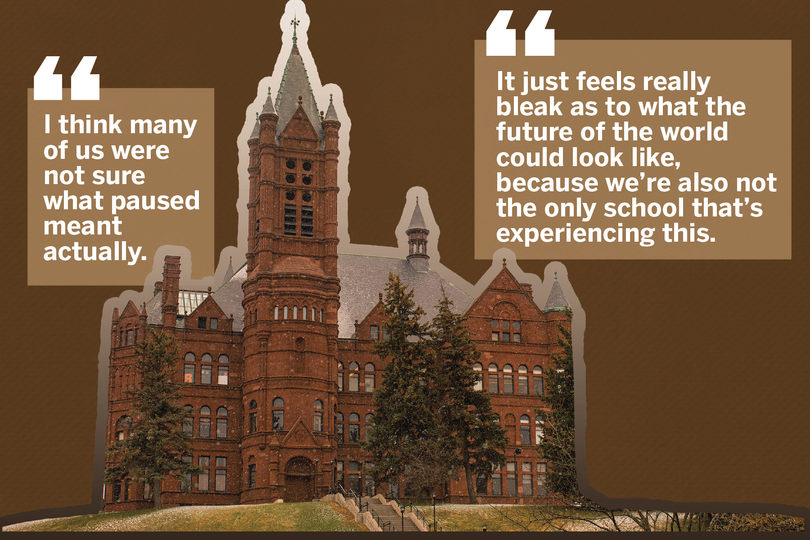
“I think many of us were not sure what paused meant actually,” Roland-Silverstein said. “And I think many of us were really working hard to see that the pause didn’t mean that.”
Following the announcement of the program’s closure, Roland-Silverstein said she wished there was more transparency since the process began last year. She added she would have liked to see “much greater” faculty governance during the process, something she said many other professors agree on.
Although Roland-Silverstein said she loves her program and is sad to hear about its closure, she said that the program’s cut, along with others in the school of music, shed light on the larger effects of SU’s portfolio review as a whole.
“I think faculty and students are distressed and trying to cope with all of it,” Roland-Silverstein said. “We’re unfortunately going to lose people. We’re going to lose not only programs, but faculty, staff, students. It’s regrettable.”
The sound recording technology major is set to close and become integrated into the music B.S. following the university’s portfolio review, according to the OIE report. Although Jarvis-Herbert said she knows her major is small, she feels the program’s content fits best with a more close-knit group.
“I feel like people don’t understand, so they just look at the numbers and they’re like, ‘Okay, they don’t have enough, let’s cut them,’” Jarvis-Herbert said
Sound recording technology senior Benny Tuong said she thinks the new program may provide a better experience for prospective students looking for a well-rounded education.
“Music and business definitely go hand in hand as an industry in general,” Tuong said. “So baking that into your education would give a good insight to possibly what the real world would look like.”
For Tuong, the opportunity to learn about business and other industries outside of sound technology is what drove her to choose SU. She said she thinks the new curriculum can help expand the range of study topics. However, Tuong acknowledged that many of her peers who chose SU for their majors’ focus on sound technology may feel differently.
When meeting with administrators to discuss the SRT program’s closure a couple of months before the portfolio review’s release, Jarvis-Herbert said students were told to “not worry” about the changes since current students will be able to finish their degrees.
But, Jarvis-Herbert said she’s concerned future students will be unable to have the same opportunities.
“We all know how valuable our program is, and I have learned so, so much within my three years here,” Jarvis-Herbert said. “It’s so disheartening that people are going to lose that knowledge, and people who have (an) interest in audio engineering won’t get that opportunity anymore at Syracuse.”
After she found out about the alterations to her major, Jarvis-Herbert said she’s felt a lack of communication from university administration, leaving her confused by the changes.
Amaya Corrinne, a violin performance junior in VPA, said she worries the changes may leave students less prepared post-graduation and harm the program’s reputation.
“My concern is that it’s going to severely diminish the reputation of the music school,” she said. “Because it won’t be considered the same level of education that is expected of someone who wants a career as a professional musician.”
Although Corrinne said she doesn’t know exactly what the new program will look like, she’s worried that a “less rigorous” program may exclude classes she views as essential for students hoping to become professional musicians. Corrinne said she is also worried that the portfolio review reflects a broader trend in declining support for the arts — and not just at SU.
“I think we’re losing the point in the sense that life is art, art is life,” she said. “It just feels really bleak as to what the future of the world could look like, because we’re also not the only school that’s experiencing this.”
Something Jarvis-Herbert loves most about her program is the community within it, she said, which the university may miss out on following the changes. She said she’s felt immense support from the program’s director, faculty and fellow students during her time at SU.
“I could just text someone and be like, ‘Hey, do you mind showing up really late at night to record saxophone for me?’ and they’ll say yes with a big smile on their face,” Jarvis-Herbert said. “Everyone’s so eager to help everyone, and (that’s) something that I feel like I probably wouldn’t get in any other program.”