Speakers highlight AI’s role in economy, business at 1st United AI summit
Get the latest Syracuse news delivered right to your inbox.
Subscribe to our newsletter here.
United AI held its first Artificial Intelligence Summit in Syracuse University’s National Veterans Resource Center on Saturday, concluding a year’s worth of startup projects and meetings by the student organization in its first year on campus.
A registered student organization at SU with over 200 members, United AI held two panels and three different keynotes, while also showcasing student projects outside the K.G. Tan Auditorium.
Outside of the summit, the registered student organization holds monthly meetings, discussing the latest developments in AI and working on semester-long student projects. Each project can compete in competitions to earn cash prizes of up to $800.
United AI was originally founded as a club, Cuse AI, before it became an RSO. The organization was co-founded by junior roommates Orion Goodman and Tyler Neary.
The projects highlighted included On The Ave, an app built using Claude Code that helps SU students find dining options in the city of Syracuse. The project was overseen by four students and led by Jessica Garcia, an international relations sophomore.
On The Ave uses AI to highlight food spots specifically catered to students, with personalized recommendations noting affordability, walkability from campus and underrepresented businesses. The app also has a conversation feature, allowing students access to a Reddit-like forum to discuss their favorite restaurants.
Another student project, Timely, allows users to create a customized, AI-curated schedule for each day. Students can schedule meals and nightly routines around their classes and extracurriculars. Timely helps optimize daily workflow, arranging routines around when users might feel the most productive to get their work done.
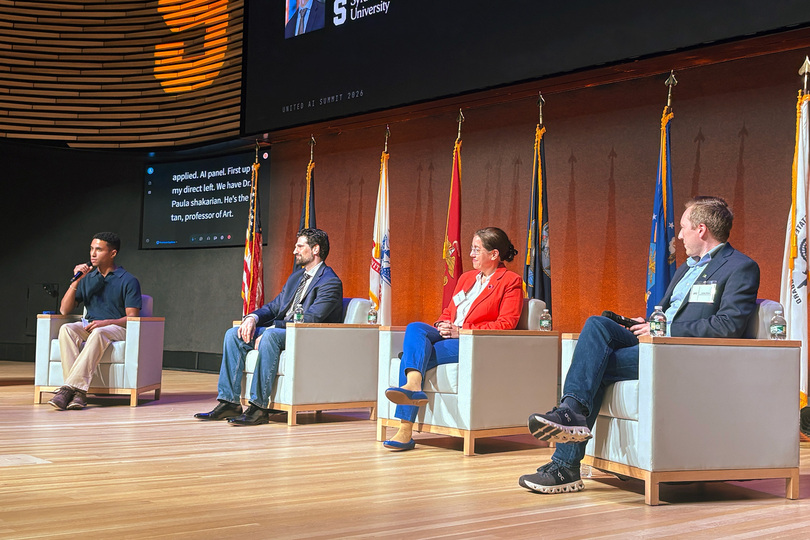
The main event of the summit included two different panels — AI economy and applied AI — featuring a range of speakers from across the industry.
As the United States stock market hits new records, the AI economy panel analyzed how technology remains a driving force in its rapid growth. The applied AI panel examined how enterprise AI and AI for business have become a pivotal priority for big AI companies, such as OpenAI and Anthropic.
Cost and constraints of the technology
The AI economy panel was moderated by Samantha Friedman, a senior communications major and United AI marketing director. It featured panelists John Liddy, vice president of innovation and entrepreneurship at INSPYRE Innovation Hub and Elizabeth Irwin, director for strategic risk at the Office of the National Cyber Director. The office, which was founded in 2021, falls under the White House’s Executive Office of the President.
Friedman asked the pair their thoughts about AI’s impact on the economy in each of their respective experiences.
“AI is expensive,” Irwin said. “It’s an extremely expensive technology in many ways in energy consumption, water consumption, and those kinds of macroeconomic resource issues.”
While Irwin and Liddy both agreed about AI’s efficiency and productivity, they warned attendees that the technology does not replace human cognitive thinking.
“I still need a human analyst to look at this (at the Pentagon). If there’s false positives, then let’s not go bomb that because AI misconstrued a hostile for something else,” Irwin said.
The following panel on applied AI was moderated by Goodman, the president and co-founder of United AI.
Goodman centered the discussion on enterprise AI when speaking with Paulo Shakarian, a K.G. Tan endowed professor of artificial intelligence at SU, Senem Velipasalar, SU professor and chief technology officer of Lamarr.AI and Collen Roller, senior generative AI solutions architect at NVIDIA.
“There’s really not enough compute around to support all the different industries today,” Roller said. “I think a lot of people are feeling that right along with the costs associated with it.”
All three panelists expressed that moving AI from a “perfect” setting to a more unpredictable lab and business format was easier said than done.
The panelists also discussed how one can “future-proof” themselves in their industry by becoming a builder who understands AI’s infrastructure.
“We like to think of ourselves as the builders of AI,” Velipasalar said. “The way we build AI involves a lot of cross-disciplinary research. What we do goes back almost a decade of research and data collection, which is very hard to duplicate.”
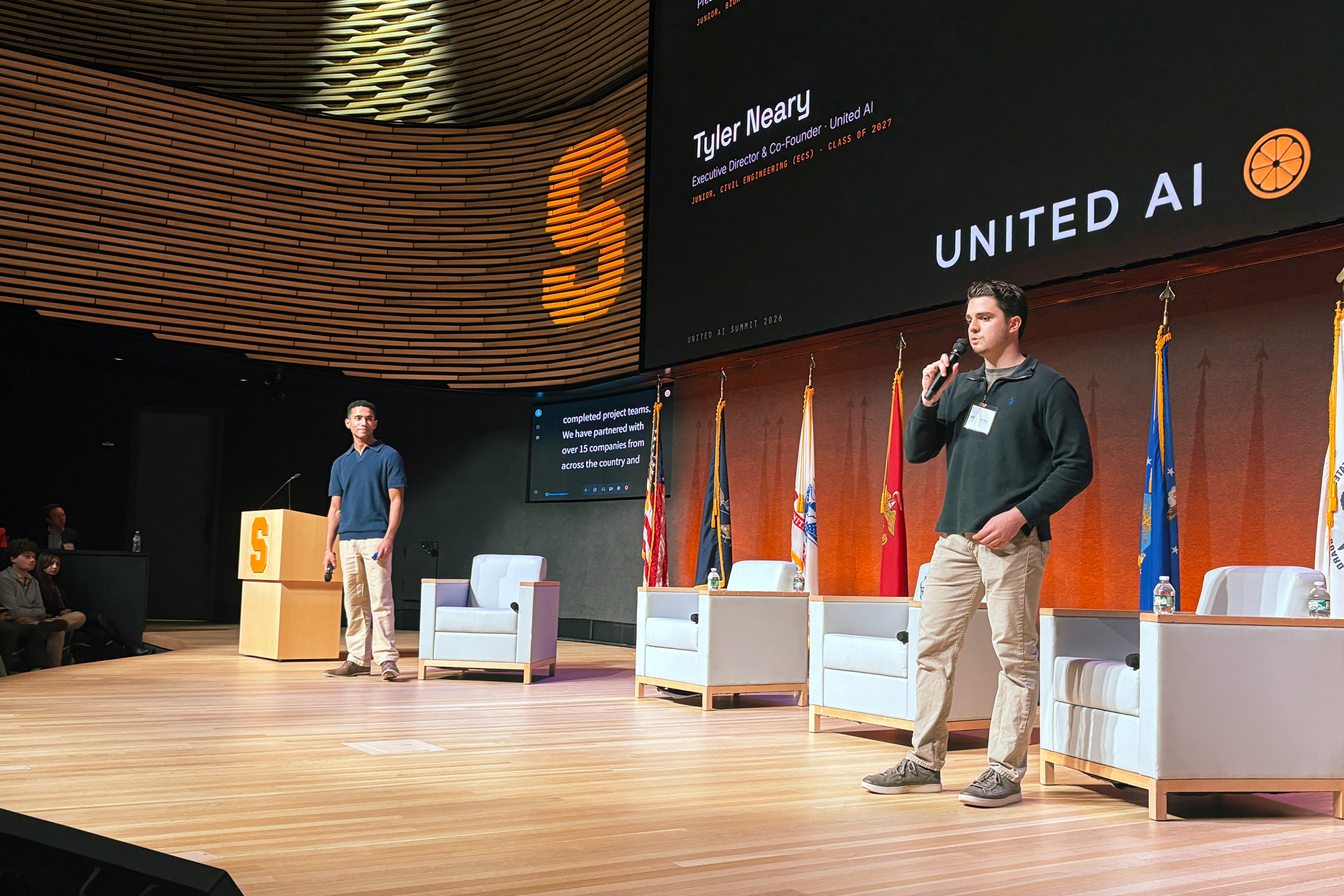
United AI co-founders Orion Goodman and Tyler Neary give opening remarks during the summit. The event was headlined by two panels and three keynote speakers. Owen Smith | Asst. Digital Editor
Breaking through the barriers of AI
To wrap up the day’s summit events, United AI brought three different keynote speakers to each talk about their story and how their company was attached to AI.
First to speak was Hailey Tredo, head of AI at American High, a Syracuse-based production studio. Tredo told a story about how filmmakers could avoid up to $250,000 in studio pitches by using AI to create concept art and storyboards.
“Historically, you needed concept art, storyboards, animatics, easy quarter of a million (dollars). Sometimes even half a mil,” Tredo said. “And that’s before anyone or any studio even said yes. That’s the wall between a brilliant idea and a movie that exists.”
While many college grads are struggling to find jobs, with some grads blaming AI, Tredo emphasized that AI has presented more opportunities for film production – with no repercussions for anyone at the company.
Tredo said she and Jeremy Garelick, founder and CEO of American High, used AI to build a pitch deck, consisting of a “world-record” 1,000 consecutive frames meant to visualize the movie they had in mind for executives. The movie ended up being greenlit, Tredo said.
“The film was finished, and in the making of it, over 300 people were employed. AI did not take a single job on that film or on that set,” Tredo said. “On the contrary, one could argue that it created every single one of them.”
Sára Nožková, founder and CEO of Flox Intelligence, shared the important role AI can play in working with the environment. Her company launched its first product, Flox Edge, in late 2025, which uses custom AI sound deterrence to help animals avoid environmental hazards, such as roadways, train tracks or mining facilities and scare them away from danger.
“With the latest advancements in artificial intelligence, pairing it also with proven wildlife science, we can actually start decoding their communication, not to use it to talk to your dog, but to prevent collisions,” Nožková said.
Nožková argued that the cameras the device uses to identify animals and play AI-generated sounds work much better than traditional human interference, such as putting up physical barriers.
“We have been creating boundaries that just don’t work,” Nožková said. “So a lot of fences at airports, they use gunshots or pyrotechnics or lasers, but animals are so smart, and they will figure it out in a matter of days. They adapt so quickly.”
The final speaker, Stephanie VanWagner, the vice president of Turing Intelligence, addressed AI’s struggle to move from smaller-scale chatbots to enterprise deployment. The SU alum spoke about the “95%” of AI efforts that currently show zero return on investment.
“Why in the single, best-funded, best-staffed, most hyped technology moment of the last 30 years, why are almost all enterprise AI deployments failing?” VanWagner said.
VanWagner said that while current models are “extraordinarily overperforming,” most projects die because of a lack of leadership and the “messy” infrastructure of real-world inputs and prompts.
“You’re not buying a model, you’re running an operation around it,” VanWager said. “The frontier in applied AI is not models anymore, it’s the systems that are built around it.”
The path moving forward
Some students in the audience expressed disappointment regarding the lack of technical discussion of AI at the summit, arguing that the event focused more on the startup and business culture around the technology.
“I think there’s a wealth of knowledge in the room, but I don’t think they’re leveraging the speakers as well as they could have,” Julian Hernadaz, a junior psychology major, said. “They have a lot of technical experience, but at this point it feels very generalised.”
Hernandez’s opinion was shared by Glenn Miller, a junior computer engineering major. Miller praised the summit as a helpful event for those new to the field, but he criticized the event for not getting into any “nitty-gritty” conversations about the tech behind AI.
“It would be interesting going forward to have this time to ask these speakers that have this wealth of knowledge questions on the more technical side of things,” Miller said.
However, Neary, the executive director and co-founder of United AI, said he was proud to see students of all majors and colleges attend the event, allowing Generation Z to learn more about AI and how it’s changing the world.
“Everyone has their own opinions about AI. I’m sure you’ve heard those older than our generation tell you countless things about how they see AI or what it might do to the world,” Neary said. “This summit proves that we will be the ones to shape this technology, we must seize the moment.”