Syracuse Art Rage Gallery hosts plastic pollution awareness event
Get the latest Syracuse news delivered right to your inbox.
Subscribe to our newsletter here.
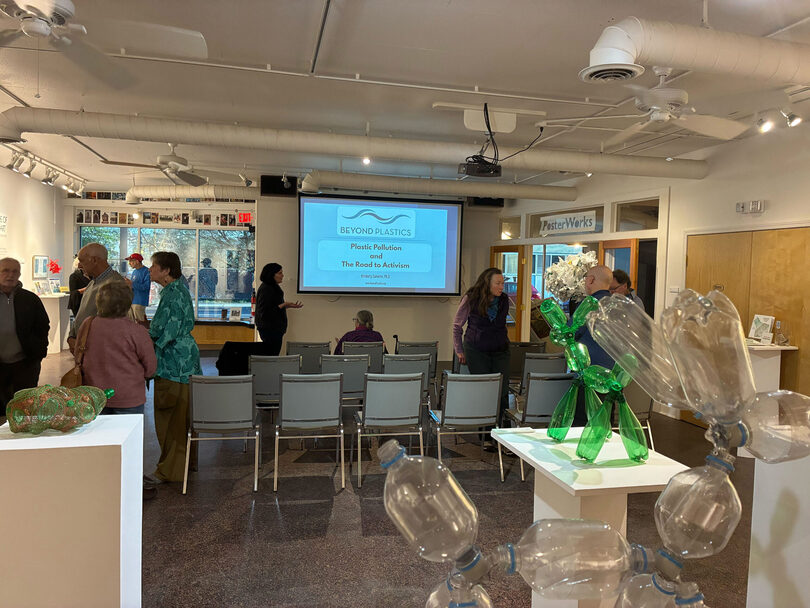
Syracuse’s ArtRage Gallery raised awareness about plastic pollution at an event Wednesday, which was presented by the organization Beyond Plastics as part of its “Rising Tide of Plastic In Art” exhibition.
The presentation, titled “Plastic Pollution and the Road to Activism,” focused on reasons for the exponential rise in plastic use and the idea that plastic is a “hazardous substance.” Wednesday’s event was sponsored by environmental groups GreeningUSA and Climate Change Awareness & Action.
The Rising Tide of Plastic in Art campaign, which inspired the presentation, features work made from plastic waste, bringing awareness to the amount that the world produces annually. The campaign was curated by Project Vortex, an international collection of artists with the goal of spreading awareness about pollution.
ArtRage Gallery Director Kimberly McCoy reached out to Beyond Plastics about the event and was connected with Kim Cameron, a speaker within the organization and Cortland County resident.
McCoy said she was motivated to organize an event with Beyond Plastics when she heard about Cameron’s connection to the area. She felt attendees would be glad to hear from an expert in their area.
Cameron referenced the public’s tendency to think only about ocean pollution when they hear the term “plastic pollution,” but she emphasized plastic pollution is a problem people confront everyday.
“This is what people think when they think of plastic, ‘It’s the ocean, it’s overflowing with plastic. We don’t have that problem here.’ But we do,” Cameron said.
Cameron explained that even though education on environmental data that scientists have had “for 20 years,” has improved significantly, the public still has a lot to learn about the realities of plastic pollution and other environmental issues.
“We have to educate about (plastic pollution) in the school systems, and I firmly believe that our elected officials have a role to play,” Cameron said. “They usually have more information than we do. They too can be spreading the word about the problems we have.”
Cameron also spoke about the lesser known health issues associated with the plastic industry, mainly those resulting from a lack of regulation regarding chemicals in plastic products. The United States has not created a policy against putting chemicals in products without understanding the chemical’s effects. Half of the chemicals used in plastic products have no data on their correlating health effects, Cameron added.
Event attendee Sam Gruber, an art historian and former Syracuse University professor, said he wished he’d known about the chemical risks associated with plastic use earlier.
“When I raised my kids, everything we used was plastic. My daughter had a plastic pacifier and drank from a plastic bottle,” Gruber said. “I should have known better back then, but I didn’t know any of this stuff in 1995.”
The disease and mortality associated with plastic, loss of marine ecosystem services and plastic litter clean up services cost the public hundreds of billions of dollars annually. But the plastic industry remains extremely profitable to the fossil fuel industry, Cameron said.
Additionally, Cameron said plastic is used wastefully, as 42% of current production is for single-use packaging. She argued the answer to plastic pollution isn’t to stop plastic production, but to stop single-use plastic production.
The extremely cheap, yet profitable nature of the industry makes Cameron believe the answer to the issue is to make plastic production expensive for the manufacturers.
“Right now there is no incentive for a company to reduce their plastic use, but if we had laws that would make them have to take over the external costs of plastic production, then they would have an incentive to do so,” Cameron said.
Cameron expressed frustration with the linear manufacturing cycle of “we make something, we use it, then we throw it away” and the notion that nothing can be done about the cycle. She called for “outside the box thinking” to solve these issues.
“I personally get mad when we think to ourselves we can’t do anything about this,” Cameron said. “Americans have been innovating forever, and it’s time for us to get off our asses and start innovating again.”
CORRECTION: A previous version of this article incorrectly referred to “Rising Tide of Plastic in Art” as a campaign. This is an exhibition. The Daily Orange regrets this error.