Syracuse-based startup uses AI to communicate with wildlife
Get the latest Syracuse news delivered right to your inbox.
Subscribe to our newsletter here.
Amid escalating threats of climate change and global warming, the impact of human pollution on wildlife remains a persistent concern. One Syracuse-based startup, Flox Intelligence, seeks to improve conditions for wildlife using artificial intelligence.
The company launched its first product, Flox Edge, in late 2025. It uses custom AI sound deterrence to help animals avoid environmental hazards, such as roadways, train tracks or mining facilities, and scare them away from danger.
The Edge device, which straps onto trees, poles and high-up objects, uses cameras to identify animals and play AI-generated sounds that only the identified species can detect and understand.
“We are a wildlife intelligence company, and we turn wildlife communication into coexistence in all shared landscapes,” said Sára Nožková, CEO & co-founder of Flox Intelligence. “As humans take more space from them, we need to figure out a better way to coexist.”
The company launched in 2020 as an AI research lab at the KTH Royal Institute of Technology in Stockholm, Sweden, one of the leading Swedish AI research institutions. In February, the company announced it secured $3 million in funding, with investors like GENIUS NY — operated by Syracuse CenterState CEO — Unconventional Ventures and Almi Invest.
Five years later, the company moved to downtown Syracuse.
Kara Jones, director of GENIUS NY, said Flox was a match for the accelerator because of its “global perspective” and ability to solve physical-world problems.
“What stood out to us was how clearly they’ve translated advanced AI into a real, immediate-use case,” Jones said. “Their platform isn’t just technically impressive, it’s solving a tangible problem around wildlife monitoring and safety.”
Jones also mentioned that Flox represents a growing trend of AI moving into “real-world decision-making.” She believes their presence in central New York foreshadows the region’s upcoming technological transformation.
That local focus, combined with the GENIUS program and “great talent,” is what Nožková said drew Flox’s leadership to the area.
While Nožková handles the commercial side of the company in central New York, Flox Intelligence’s co-founder, Tomas Becklin, oversees the technical development at the company’s other office in Stockholm.
Though Becklin grew up in Sweden, he spent 25 years building software in Silicon Valley, where he worked as one of the first-ever engineers at Myspace.
Nožková said Flox Intelligence and its camera devices are the safe, modern innovation of earlier “reactive” technology, such as scarecrows and fences. She added that the cameras have also correctly identified over 60,000 animals since Edge launched in 2025.
Flox Intelligence’s Edge operates 24/7 and is able to work in harsh environments, according to the company’s website. The camera costs $3,500, with a one-year trial of the subscription and a two-year warranty included. The subscription costs $500 a year to maintain after the first year.
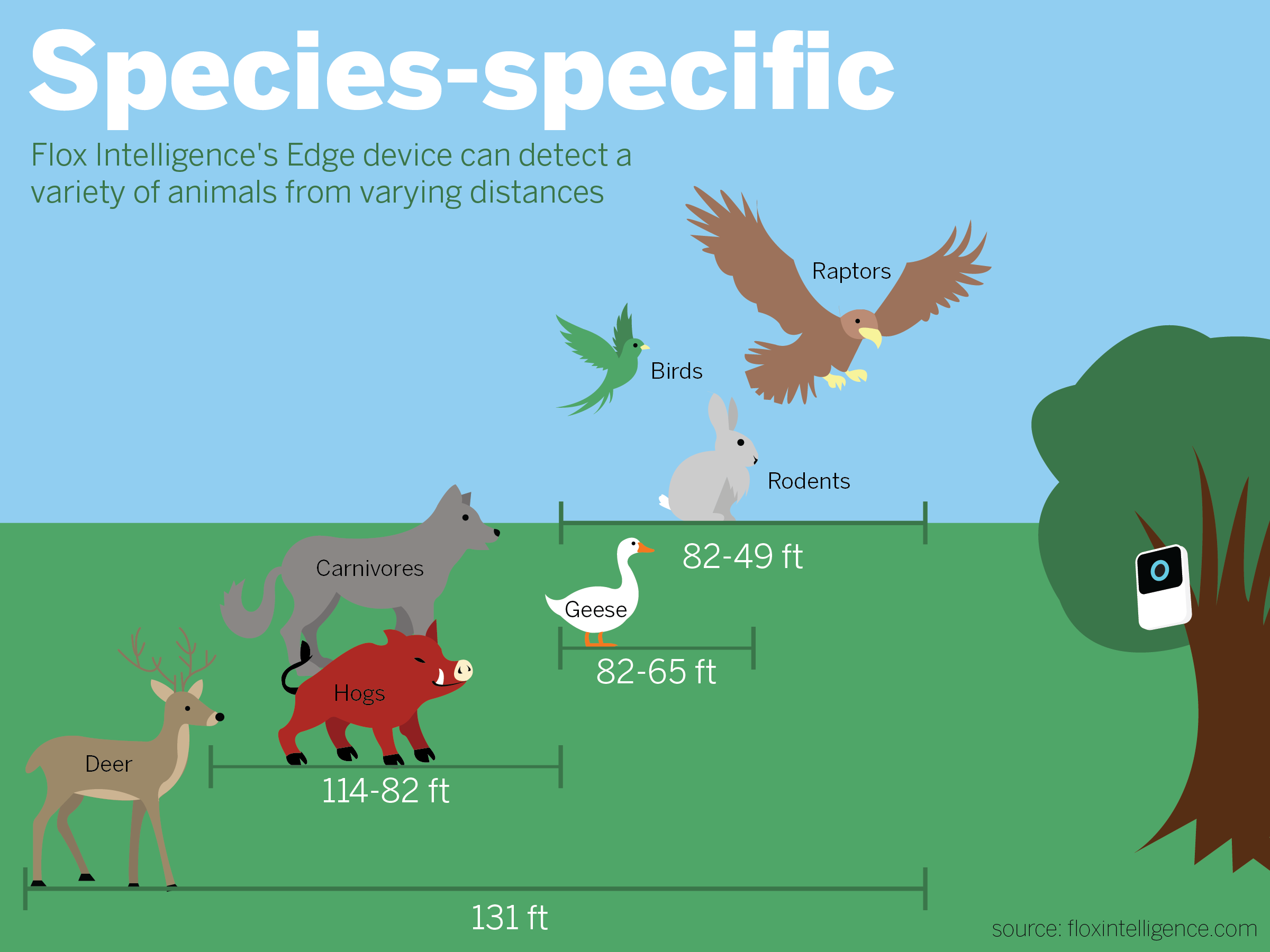
Zoey Grimes | Design Editor
Outside of Syracuse, the company established major partnerships with Gerald R. Ford International Airport, World Wildlife Fund and the United States Department of Agriculture.
The devices are already helping the Department of Transportation road networks clear common animals such as deer and bison, according to Nožková. The device is also helping farmers create “predator-healthy” ecosystems near their livestock.
To work effectively, Flox’s Edge uses AI to quickly identify an animal based on the camera surveillance, then generate a sound in milliseconds that can “communicate” with the species and create sounds that signal danger.
Once a “wildlife event” has occurred, such as an animal approaching dangerous areas, the owner of the device can view a report of what happened and surveillance footage of the event.
The company is primarily gearing its product to organizations with a physical location — anything from manufacturing plants to farms.
“The vision is to be everywhere from airports to highways, train tracks, even private gardens in a few years from now,” Nožková said.
Orion Goodman, president of Syracuse University’s United AI student organization, said the technology could eventually become more beneficial and affordable than traditional methods for animal regulation.
“To me, it sounds like less maintenance than something like an electric fence. Although they probably have a pretty niche clientele, if it’s affordable, then it could be a great alternative.” Goodman said.
In addition, Goodman said that Nožková will be a speaker during United AI’s upcoming AI Summit, an event that will bring together speakers from across the AI industry.
“We picked her and the company over a lot of other, more traditional AI startups,” Goodman said. “Flox is pushing AI in the right way, promoting a narrative that AI can be used for creating more coexistence between humans and wildlife.”
After its move to Syracuse, Flox Intelligence hired a wildlife biologist and SU alum to join the team to help with curating the company’s sound library.
Nožková said the company is also searching around the area for new employees and that local internships are a “real possibility.”
“We place a strong emphasis on talent and recruitment, helping teams connect with the right people as they grow,” Jones said.
Although the technology is relatively new, Nožková emphasized that the AI was designed with animal welfare in mind, something she believes is quite imperative.
“We work a lot with different wildlife biologists and follow ethical guidelines,” Nožková said. “At the end of the day, it’s just their own communication.”