


S
CRANTON, Pa. — A blue “Hometown Hero” banner hangs from a utility pole outside a house on West Market Street. It bears Gerard McNamara’s name and a photo of him wearing a United States Marine Corps service cap. Beneath it reads:
2nd Battalion 5th Marines
Battle of Hue City 1967-1969
Dozens of similar banners line the streets of North Scranton. This one hangs just outside a set of concrete steps, leading from the sidewalk to a home with a front porch supported by five white pillars — looking no different from any other nearby home.
It’s where Gerard raised his youngest son, Gerry, and first introduced him to basketball through “NBA Superstars” videos. A few minutes down the road, the McNamaras had a key to the gym at the Holy Rosary Center, where Gerry learned to play and later took hundreds of shots after high school practices.
It helped him become more popular than Scranton’s mayor.
“When you love something, you want to do it all the time, and when you do it all the time, you want to be really good,” McNamara said of his early passion for basketball. “And to be really good, you’ve got to beat other people.”
McNamara has done that his whole life, leading to his biggest test as Syracuse’s next head coach. Rekindle the standard Jim Boeheim set, and McNamara will forever be known for bringing SU back. Continue the decline from Boeheim’s final years through Adrian Autry’s tenure, and Syracuse slides further from relevance.
On the heels of five straight missed NCAA Tournaments — a drought he called a “shame” and pledged to end — McNamara understands the magnitude of the pressure he faces. But, it doesn’t concern him.
“Anybody that knows me knows why I’m here,” McNamara emphatically said, looking into a crowd of over 2,000 people during his introduction Monday at SU’s Miron Victory Court. “I’m here to win. It’s who I am. And it’s who I will always be.”
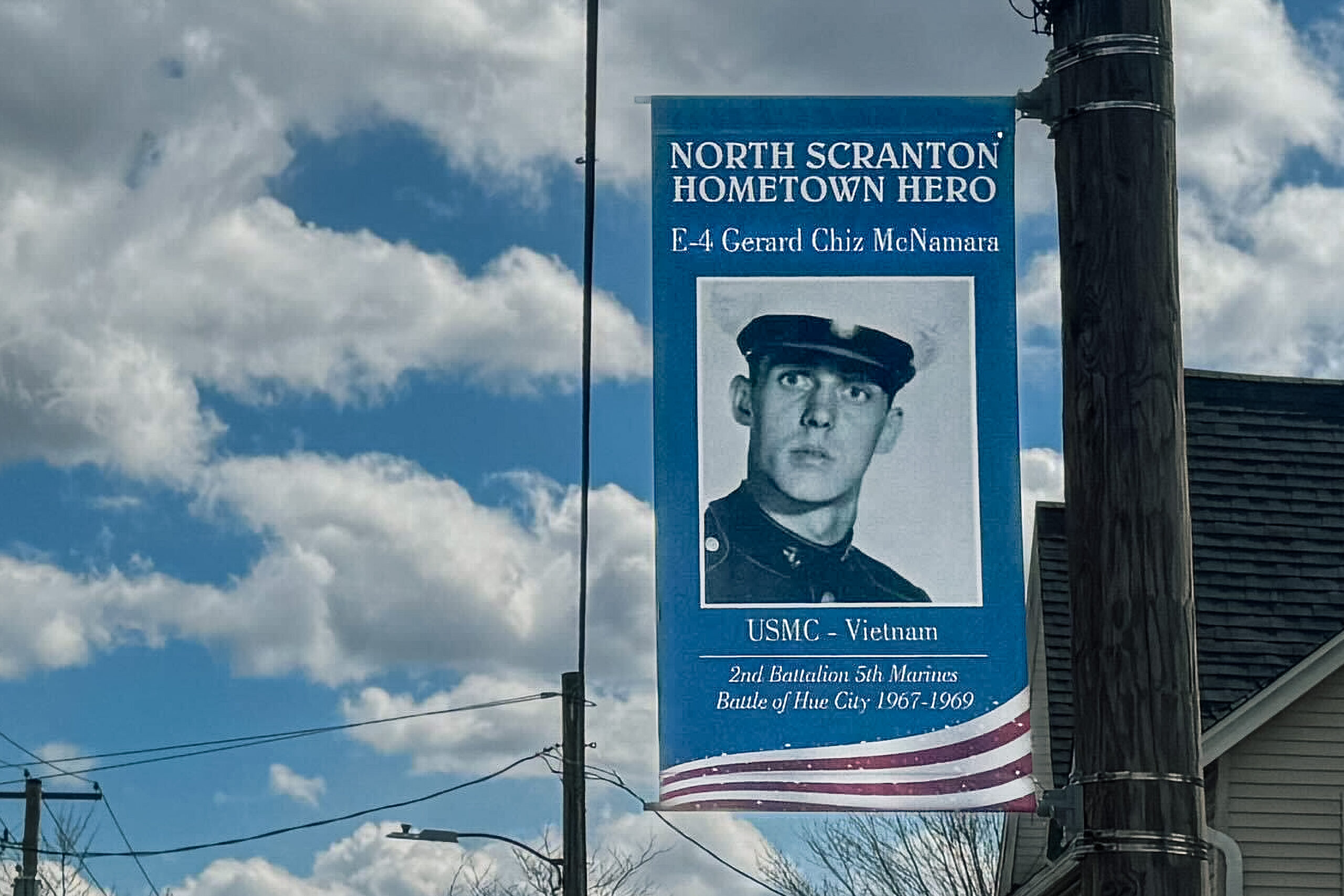
Outside of Gerry McNamara’s childhood home, a blue banner hangs honoring his father, Gerard McNamara. Gerard introduced Gerry to basketball through “NBA Superstars” videos. Justin Girshon | Senior Staff Writer
• • •
Luke Cecchi remembers McNamara laying into him during his first Siena practice. The graduate walk-on was thrown into a drill that required walk-ons to keep the ball away from scholarship players, and he turned the ball over a couple of times.
McNamara stopped the drill, telling Cecchi he didn’t have time to make exceptions for him.
“He expected basically the same out of me as anybody else,” Cecchi said, “which I love, because it showed that there was a certain standard there that each of us had to meet.”
In two years, the environment McNamara built turned a four-win Siena program into one that pushed No. 1 seed Duke to the brink in this year’s NCAA Tournament. The Saints’ 14-18 record in McNamara’s first year was among the best turnarounds in the country before their 23-12 campaign, including a Metro Atlantic Athletic Conference championship, brought McNamara national attention.
"G-Mac, he outcoached me."
Jon Scheyer told @TracyWolfson that there's a lot Duke can learn from this game. pic.twitter.com/DHUzWEkMRM
— CBS Sports College Basketball 🏀 (@CBSSportsCBB) March 19, 2026
To ignite Siena’s turnaround, Cecchi said McNamara’s ability to intertwine personal connections off the court with his ability to motivate them on the court made his players buy in.
“The ability to transition from that kind of man into somebody that’s pushing you really hard, kind of like a drill sergeant in the army, without missing a beat, is pretty special,” he said. “He can get so much out of you because you want to do so much for him.”
After the Saints lost three straight games in November 2024, Cecchi remembers McNamara telling his team that individual talent wouldn’t win any games. That’s when, Cecchi said, the Saints first realized McNamara’s system could take them far.
Though Siena finished the season with a 10-win improvement, Cecchi noted the Saints felt they “left a lot on the table.” That’s because McNamara kept the bar high and convinced his team they could beat anyone.
After Cecchi graduated, he remained close to the program. He said the expectation entering McNamara’s second season was clear: it “couldn’t go any other way” except winning the MAAC. From his perspective, Cecchi said the idea that “there’s no victory without us completely relying on each other” rubbed off on the 2025-26 team.
Cecchi is confident McNamara will bring the same moxie to the Orange in the next step of his head coaching career.
“Anything less than a guy giving his all for the school and for the ‘S’ is not going to be tolerated,” Cecchi said.
• • •
When ESPN’s Pete Thamel reported Syracuse would hire McNamara as its next head coach, Andrew Kouwe sent an orange heart emoji to the 2003 National Championship team’s group chat. He added that everyone from the team chimed in to congratulate their former point guard, whose No. 3 hangs in the JMA Wireless Dome’s rafters.
“We were all hopeful that it was going to happen, and just kind of elated that it stays within the Syracuse family,” Kouwe said.
Staying within the family versus going outside was one of Syracuse’s dilemmas in the coaching search. Throughout the process, incoming Director of Athletics Bryan Blair said Monday he felt many of the candidates were “a little afraid of the moment” that comes with leading the Orange.
Not McNamara.
He’s played in a packed Dome, knocking down game-winning shots. Throughout his 19 years at SU as a player and a coach, he’s experienced three of the program’s six Final Fours.
“He said to me, ‘I need to win, and I need to win now,’” Blair said of McNamara. “And from that moment on, I remember going back home with my wife, telling her, ‘There’s something special here.’”
When McNamara arrived on campus in 2002, Kouwe, a junior walk-on, realized McNamara was a “grinder.” He quickly realized he’d never see a player lay it all out on the line like that freshman guard from Scranton would.
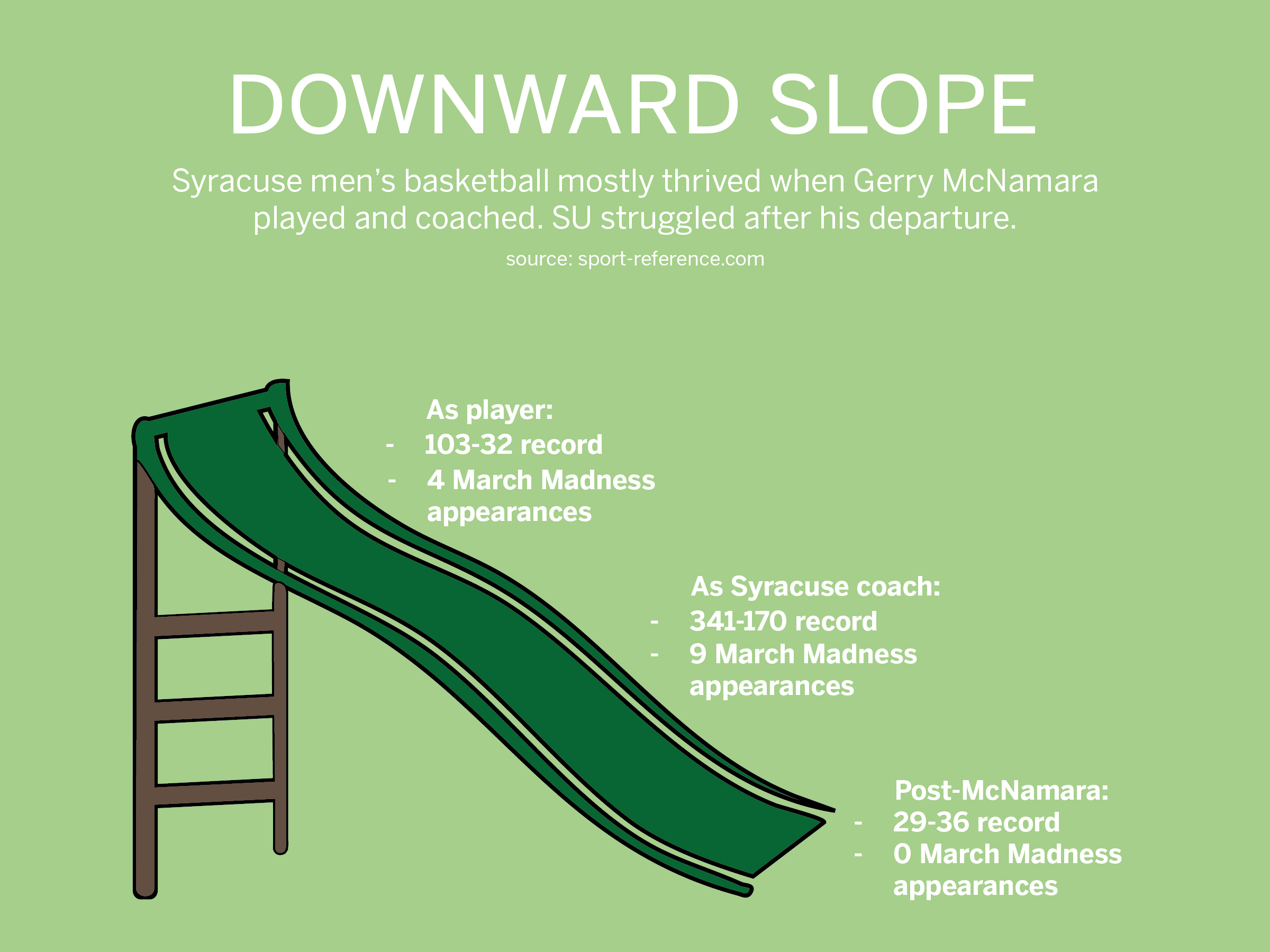
Ilyan Sarech | Design Editor
As cliché as it sounds, that tenacity was the engine that helped McNamara do exactly what he told Blair he wanted to do 24 years later — win.
He knocked down six 3-pointers to down Kansas in the national title game as a freshman. He led the Big East in triples as a sophomore and junior. He willed Syracuse to a Big East championship by magically spearheading four wins in four days as a senior.
Once McNamara joined the coaching staff, beginning as a graduate manager in 2009, he helped develop the program’s next crop of guards. Syracuse made March Madness in nine of McNamara’s 15 seasons on staff before he forged a new path at Siena.
“He checks every box from being just a Syracuse legend, part of the Syracuse family, but also just an unbelievable competitor and unbelievable drive to want to win,” Kouwe said.
McNamara helped establish the Orange’s standard. Now, he’s tasked with restoring it.
• • •
Stirna’s Restaurant was quiet and had no customers 10 minutes after opening on a Saturday evening. But once “Syracuse” and “Gerry McNamara” were mentioned, a buzz spread amongst the staff.
After reminiscing about the bus trips they used to make up Interstate 81 to watch McNamara play for SU, one of the employees quickly called someone, trying to remember which company organized it. The owner, Cathy Gavin, would have all the answers once she walked in.
Once Gavin learned the two customers sitting in front of a framed McNamara jersey and bobblehead were from Syracuse, she immediately sat down, pulled out her phone and eagerly showed a photo of herself with McNamara. She then briefly left the table to retrieve another keepsake, returning with a framed poster of SU’s 2003 National Championship team.
Gavin has known and supported McNamara his whole life. When he played for the Orange, she was one of thousands of Scrantonians who bused up I-81 to watch him live. When he coached Siena to a near-upset over Duke in the NCAA Tournament over two decades later, her restaurant hosted a watch party.
Throughout the Saints’ game against Duke, Gavin said there were whispers about McNamara’s potential return to Syracuse. Now that it’s official, they’re already trying to coordinate a plan to have Scrantonians — or, as Gavin likes to say, “people from Stirnacuse” — take buses up I-81 to the Dome again.
“When he was coaching Siena,” Gavin began, “we were all like crazy people just watching this young kid and thinking, like, ‘You got to be kidding me.’ And then his home, his love, is Syracuse, and now he gets this opportunity.”
She paused for a second. “Wowww.”
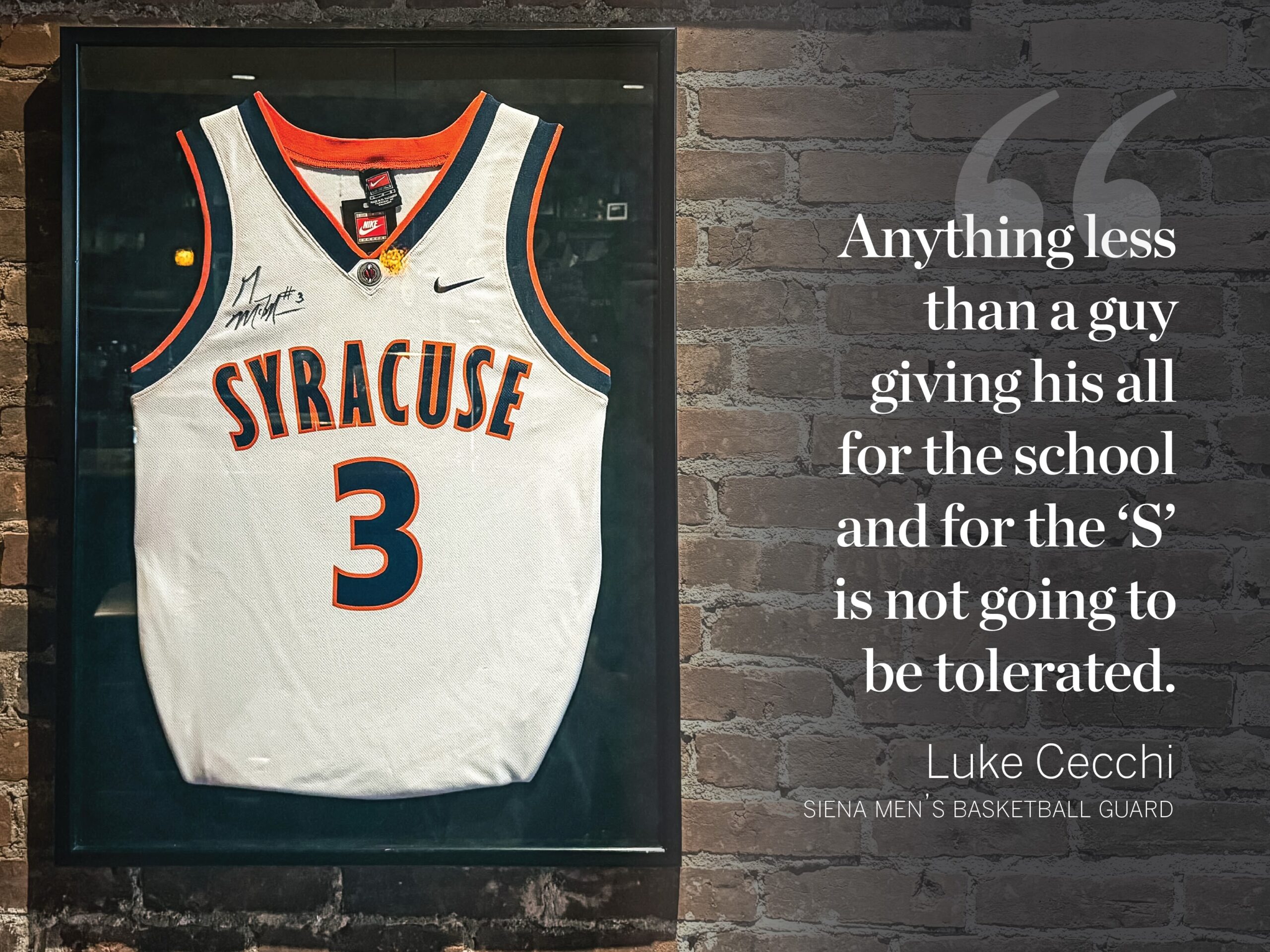
In Stirna’s Restaurant, a McNamara family staple, a framed Gerry McNamara jersey hangs from the walls. Many Scranton residents regularly bused to Syracuse to watch McNamara play. Cooper Andrews | Senior Staff Writer
Stirna’s, founded in 1908 by Lithuanian immigrants, is a McNamara family staple. Staff members even excitedly remarked they were expecting to host them later that night.
One block up the street, another place that helped shape McNamara’s legend still stands. To the naked eye, the Holy Rosary Center — that rectangular brick building on one of West Market Street’s corners — blends in with the rest of North Scranton.
To the McNamaras, it’s where Gerard’s best friend, Teddy Bloom, coached and gave them a key to the gym. By the time he was in eighth grade, McNamara etched his name in Scranton history by winning the Catholic Youth Organization title. At that point, his uncle Jimmy Connors — who was then Scranton’s mayor — became known as “Gerry McNamara’s uncle.”
McNamara’s legend only grew in his time at Bishop Hannan High School, being named 2002 Player of the Year in Pennsylvania while leading a state title run.
Anybody can say they want to win. Not everybody can say they’re still a folk hero in their hometown because they’ve won their whole life.
• • •
SU Chancellor-elect Mike Haynie called the process of hiring McNamara “one of the most consequential hires that this program has seen in decades.”
Like McNamara, Syracuse is used to winning. But over the last five seasons, that identity is unrecognizable.
“I was a player when we were (winning), and I’m telling you right now, this place was jumping,” McNamara said. “So that’s what’s a shame, it needs to change. I know that, and I’m gonna do my best to work my rear end off to change it.”
As part of that vision, McNamara explained the Orange will be strategic with chasing positional size but will also use their eyes to get “the right people.” Above all, McNamara highlighted he’ll never turn down “good,” and if he gets it, he’ll “figure it out later.”
In college sports’ changing landscape, name, image and likeness money also plays a major role. Sources told The Daily Orange SU spent around $8 million on its 2025-26 roster — a figure believed to be near the middle of the Atlantic Coast Conference. During McNamara’s hiring process, ESPN reported Syracuse officials stressed a commitment to NIL that projects in the top third of the ACC.
Blair and Haynie both stressed that McNamara will have the necessary resources to succeed. No matter the circumstances, though, McNamara has always found a way to win.
If McNamara had a “Hometown Hero” banner hanging next to his father’s in Scranton, it would bear his name and a photo of him wearing a No. 3 Syracuse jersey. Below it would read:
Winner
Now, that’s what he has to be.
Senior Staff Writer Cooper Andrews contributed reporting to this story.
Collage by Ilana Zahavy | Presentation Director
Daily Orange File Photo, Zoe Xixis | Asst. Photo Editor, Courtesy of Siena Athletics
Published on April 2, 2026 at 12:35 am