


T
he play speaks for itself.
Joel White’s miraculous wrap check at midfield. Steven Keogh’s instinctive behind-the-back pass to Matt Abbott. The midfielder’s lofted feed, which deflected off Roy Lang’s stick. The ball somehow landing in Kenny Nims’ pocket, finding the net with mere seconds left, tying it up at 9-9.
Delirium. Elation. Mayhem. Words can’t describe the most chaotic college lacrosse sequence of all time.
Then there’s John Desko, stoic as always, briefly raising his fist — wearing a slight grin across his face — and then back to business.
Abbott will never forget the ensuing huddle from that 2009 national championship game. Amid the bedlam, Syracuse’s head coach remained calm. Abbott remembers Desko telling his team to look at Cornell’s bench.
They’re done.
Desko was never one to overcomplicate a situation. He knew the game was over if Syracuse got the ball. After Cornell began overtime with an empty offensive possession, Cody Jamieson proved him right, scoring the winner off a feed from Dan Hardy. Desko could finally celebrate.
“That game is the perfect example of what coach Desko is all about,” said former SU midfielder Pat Perritt (2006-09).
If an anthology were written about Syracuse lacrosse, Desko would take up most of the chapters. That’s what happens when you spend 46 years at one program.
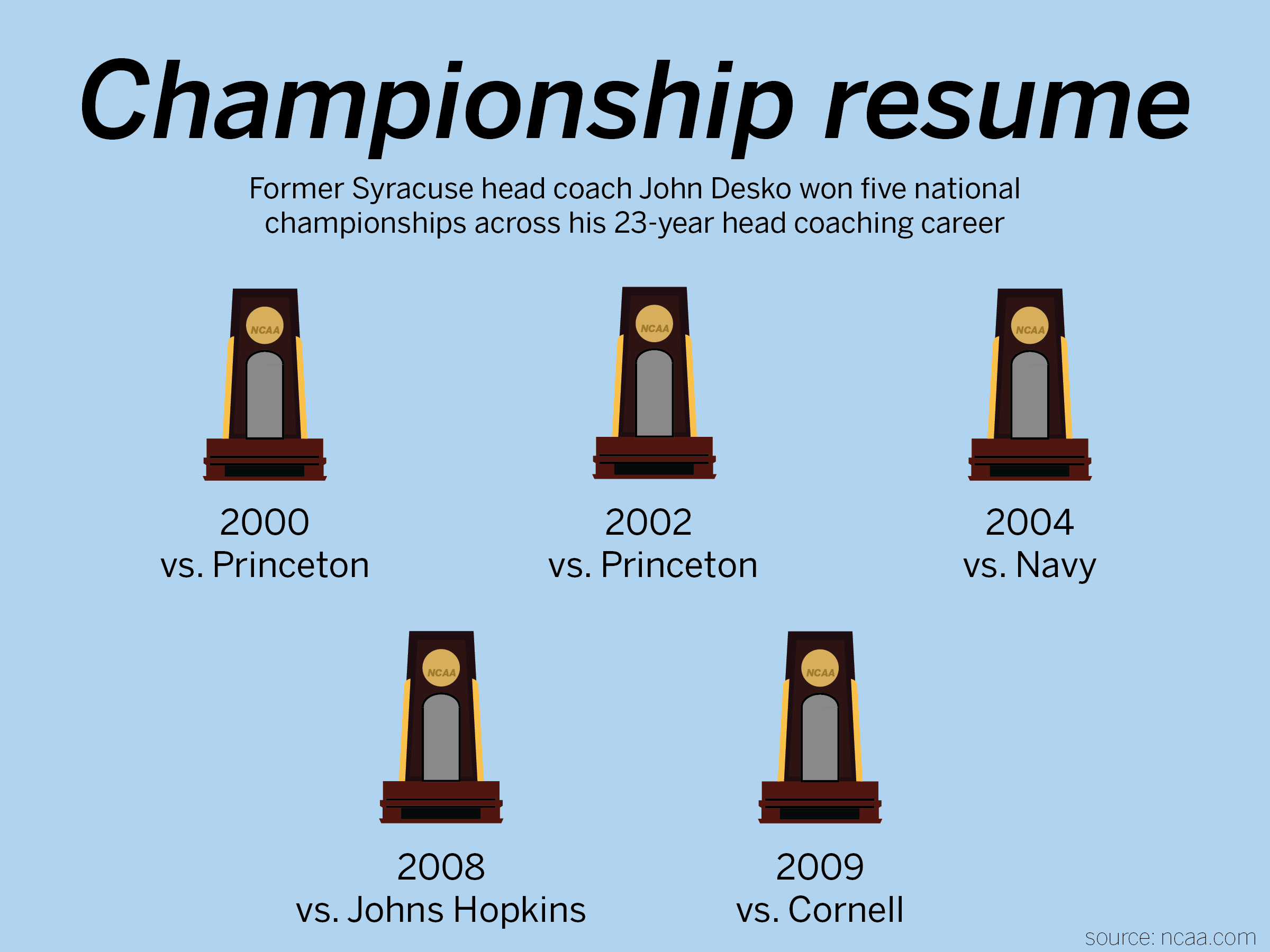
Desko’s resume speaks for itself. Ten national championships — five each as an assistant and head coach — with an additional one vacated by the NCAA. Twenty-six Final Fours. Two hundred and sixty-five career wins. Name any Syracuse icon, and Desko taught them. There aren’t many coaches in any sport, let alone in lacrosse, that hold a candle to him.
Come Saturday, Desko will be immortalized when he’s inducted into the JMA Wireless Dome’s Ring of Honor. He’s just the third lacrosse figure to achieve that feat, joining his mentor, Roy Simmons Jr. and Jim Brown.
“(It) never crossed my mind,” Desko told The Daily Orange, when asked about the accomplishment. “Not even for a second.”
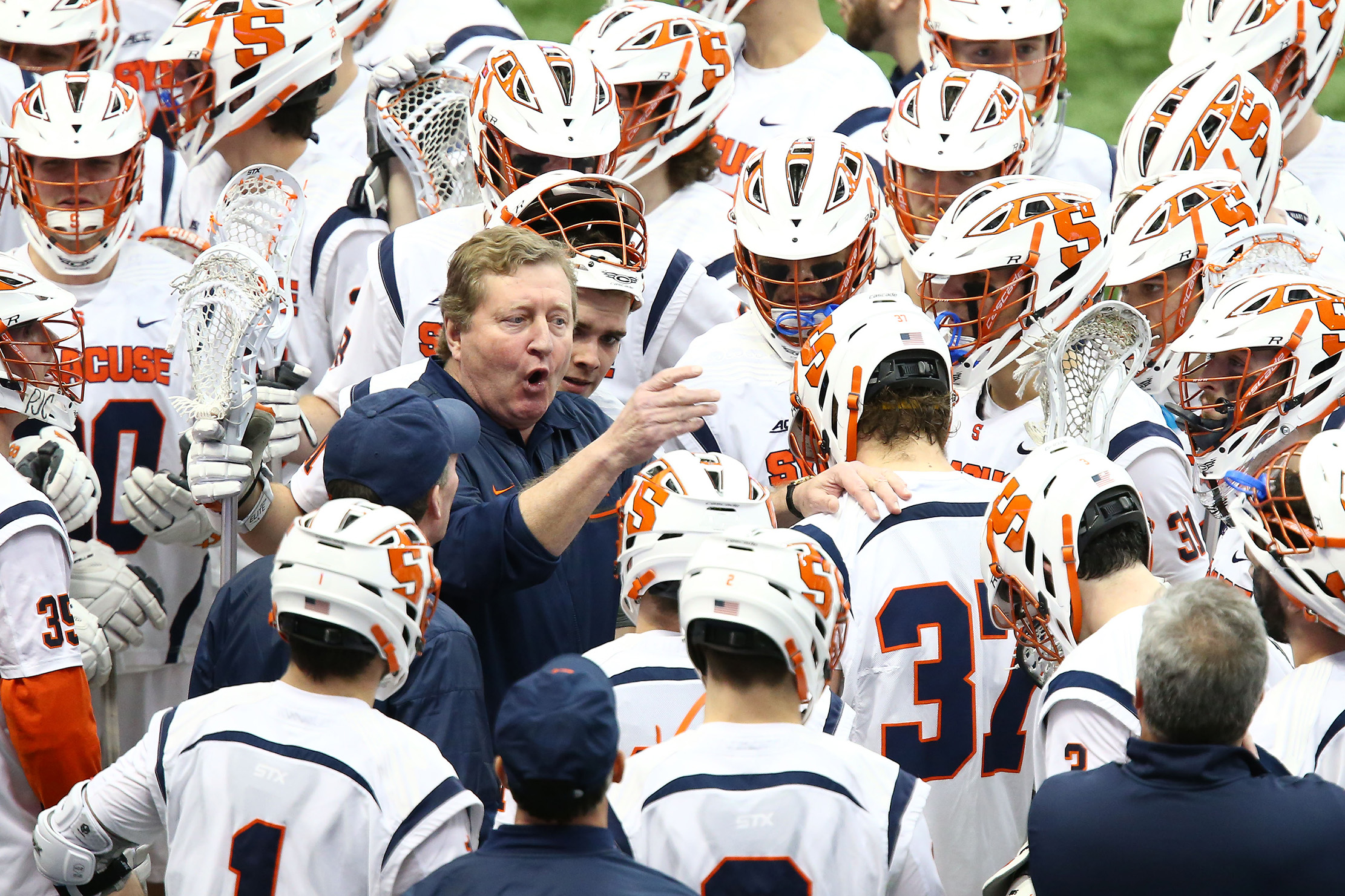
John Desko shouts at his players as they gather around him. Desko fostered a winning culture at Syracuse, earning his place in the JMA Wireless Dome’s Ring of Honor. Courtesy of SU Athletics
• • •
Everyone knows the look. The Crayola red-shaded face. Neck veins popping out. Maybe even a Tums chewable tab getting spat out in anger. Nobody wanted to be on the end of a Desko “head gasket,” said former SU midfielder and ESPN analyst Paul Carcaterra (1994-97).
“He was not the type of person you wanted to get mad,” Carcaterra said. “Because it’s like anything you hear about the teacher that never yells. When they yell, you take it seriously.”
Any former Desko player has a memory of a blowup. Many aren’t repeatable.
Jovan Miller (2008-11) shared one. After letting Loyola score on a man-down, Desko’s white-walker blue eyes bore down on him from the sideline, waiting to curse out the midfielder. Carcaterra remembers another, when he was a captain, and Desko blamed him for some players taking it easy on a conditioning drill. Then there’s Desko making Ric Beardsley (1992-95) run the Dome steps for an hour, punishment for having “too much fun” the night before a Saturday morning practice.
Desko’s blowups were rare. He allowed mistakes, letting players throw behind-the-back passes, push the pace and play with freedom. He never pulled players, trusting they’d clean up their mistakes. However, Pat McCabe (1988-91) said his anger never came at the expense of the fundamentals.
“He just held a high standard,” Miller said, “So, when you hold the high standard in general, it was easy for everybody else to fall in line because (Desko) already set the table.”
Desko’s standard mixed the most desirable coaching traits. The championship pedigree of UConn women’s basketball coach Geno Auriemma. The steadiness of former Alabama football coach Nick Saban or six-time Super Bowl winner Bill Belichick. The loyalty of former SU basketball coach Jim Boeheim.
Whatever the comparison, Desko’s greatness can’t be questioned. Yes, he could be cold at times. The lack of instant gratification after a good play left you yearning for a stamp of approval, per Miller. It was never going to come, but that was Desko’s secret sauce.
That game is the perfect example of what coach Desko is all about.Pat Perritt, former Syracuse men’s lacrosse midfielder
“He made sure our heads didn’t get too big,” said current SU head coach and former midfielder Gary Gait (1987-90). “We were always ready to do the work, and there was never a problem.”
• • •
When Simmons Jr. retired in 1998, Desko was the only person he wanted to replace him. Jake Crouthamel, then SU’s director of athletics, told Simmons Jr. they were legally obligated to advertise the job.
But, after watching Desko spend 18 years as his assistant, Simmons Jr. felt there was no need.
“Any coach in Division I right now would take my job if it were available,” Simmons Jr. recalled telling Crouthamel. “I don’t want it to be available … (Desko) had earned his stripes.
“I owed him.”
Simmons Jr. ultimately got his wish. In the late 1970s, Simmons Jr. only had one allocated scholarship due to financial limitations for non-revenue athletic programs at SU. So, he split the scholarship in two, despite the athletic department advising against it. He gave half to Desko and the other to his West Genesee High School teammate Tim O’Hara.
After spending the first two weeks of fall ball as a midfielder, Simmons Jr.’s first assistant, Jay Gallagher, recommended the then-junior move to defense. Two seasons later, Desko was a two-time All-American and a leader on Syracuse’s first-ever Final Four team.
When Desko graduated, Simmons Jr. offered him a spot as the freshman coach. The only compensation Simmons Jr. could give was the money Desko earned from working at Simmons Jr.’s summer lacrosse camps. In the evenings, Desko bartended and waited tables at R.J. O’Toole’s in Nottingham. He even painted houses in the summertime and substitute taught at high schools.
Because of the minimal compensation, Simmons Jr. worried Desko would leave for a head coaching gig. As a central New York native, Desko said he never considered leaving.
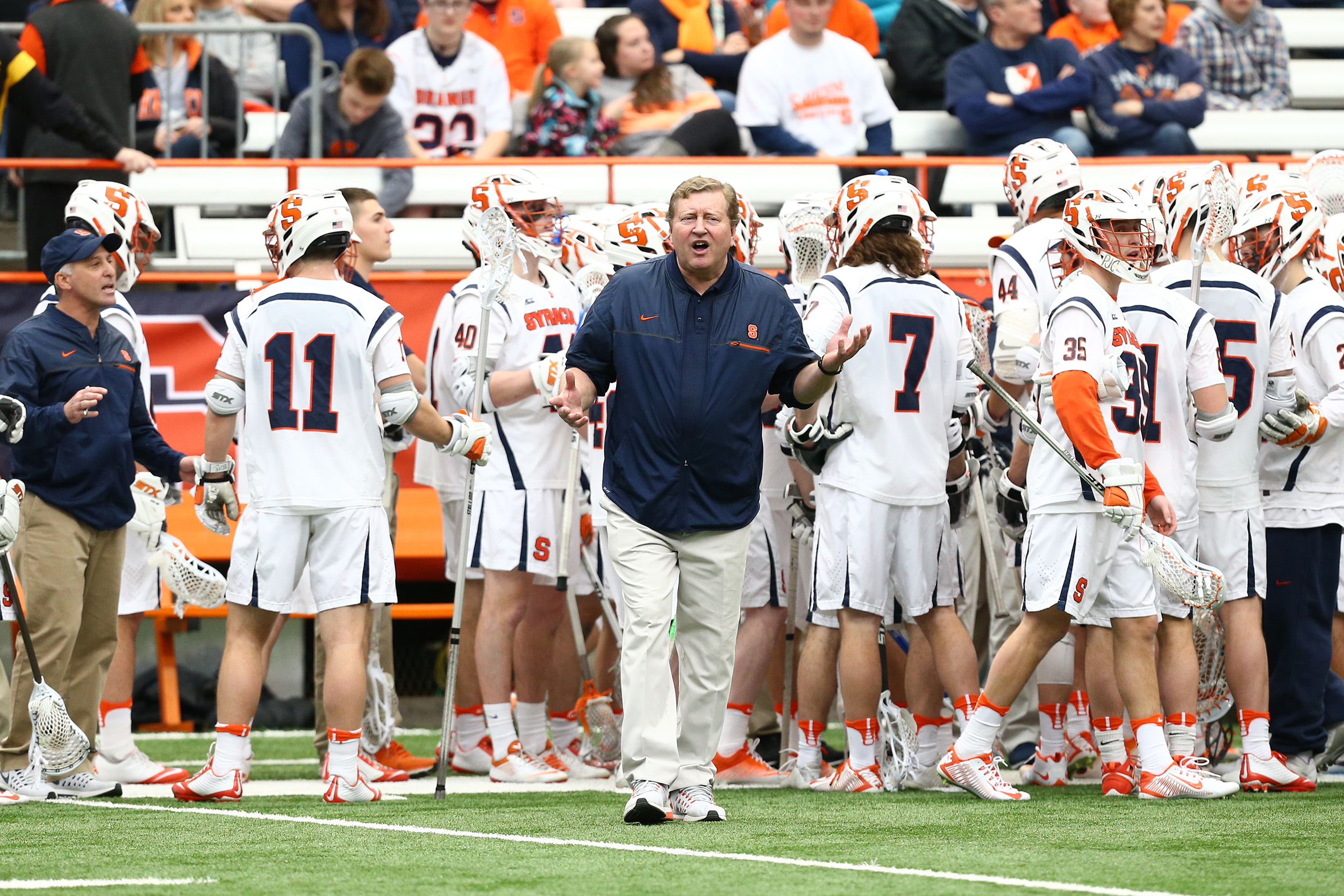
John Desko steps onto the field while his Syracuse team huddles behind him. Desko coached at SU for 42 years, 23 of which he spent as head coach. Courtesy of SU Athletics
“It’s definitely home,” Desko said of Syracuse.
He earned a reputation for his candor. With his love of art, Simmons Jr. was known for talking about anything but lacrosse. Desko was the opposite. X’s and O’s became his forte.
In his first season, Desko was coaching people he had played with the year prior. Even in his early 20s, Desko commanded respect. Mess around in practice, Simmons Jr. recalled, and he’d tell players to run up the Dome steps until he said they were done.
“They respected what (Desko) wanted,” Simmons Jr. said. “They weren’t always happy with it, but he was gentle.”
Eventually, Simmons Jr. decided it was time for Desko to take over. It never crossed Desko’s mind he could replace Simmons Jr. But, certain conversations gave him the idea that Simmons Jr. was nearing the end.
When Desko got the job, he knew he had a tough act to follow. But he also had Simmons Jr.’s full confidence. His only worry was Desko would unfairly get compared to him after 16 straight Final Fours and four national championships. Simmons Jr. watched how former SU football coach Frank Maloney crumbled under the weight of replacing its winningest coach, Ben Schwartzwalder.
The burden of upholding Syracuse’s reputation was immense. Championship weekends were guaranteed under Simmons Jr., and that didn’t change with Desko.
Does that mean he feared failure?
“No,” Desko said bluntly. “I was so confident that I wasn’t thinking about it.”
• • •
The championships obviously pop off the page for Desko, but many feel his lacrosse IQ gets overlooked. Simmons Jr. was the face of SU’s success in the 1980s and 1990s, while Desko lurked in the shadows.
Carcaterra said Simmons Jr. was more of a spiritual guru, whom players went to for life advice. Desko’s office was where players went to watch film.
Once he took over for Simmons Jr., Desko realized how little coaching the job actually entailed. It was much more man-management. Former SU goalie Dominic Lamolinara (2012-14) and faceoff man Chris Daddio (2011-14) described Desko as the “CEO of Syracuse lacrosse.”
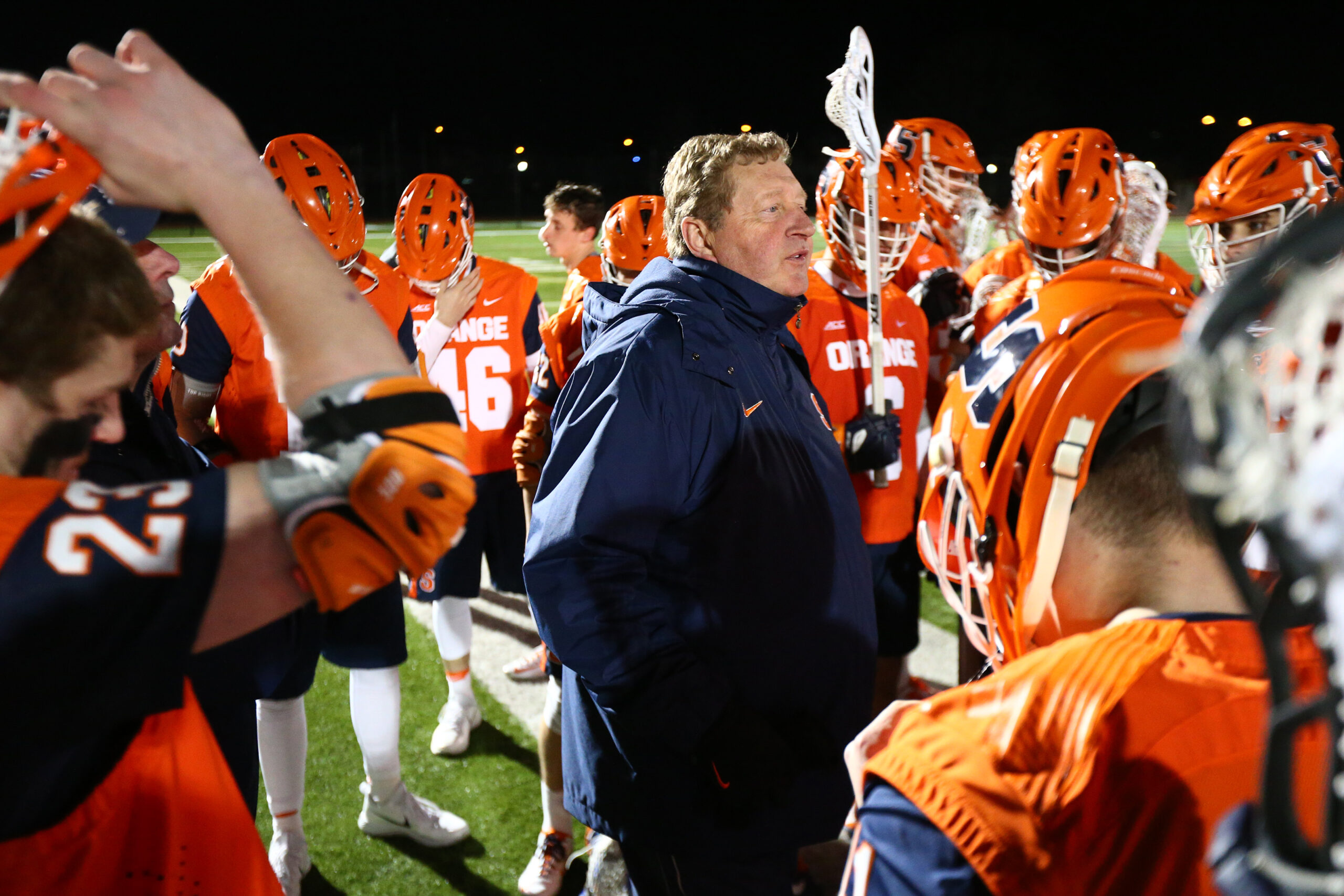
John Desko assembles his players during his coaching tenure at Syracuse. Desko spent 19 years as an assistant coach for the Orange before being promoted to head coach. Courtesy of SU Athletics
Like an executive, Desko knew when to step in. If Syracuse needed a goal, a clear or a defensive stop, he was the one designing the play, Tom Hardy (1999-02) said. It’s hard to recall a singular moment, though Tom remembers the big ones came on Championship Weekend.
“He could really take control of the game, set players up and put them in the right spots,” Tom said. And situationally, he could draw up a great play from a dead ball.”
Tom thinks people don’t give him nearly enough credit for that aspect of his coaching, and he doesn’t want Desko’s lacrosse mind to get overlooked. Syracuse has built an identity of playing fast and free. That doesn’t mean it wasn’t disciplined.
Desko instilled that with repeated work in practice. It’s why Syracuse’s run-and-gun style was so defined, even as he let stars such as Mike and Ryan Powell — along with Nims and countless others — play freely.
“(Desko) understood to just let them play, and they’ll start to figure things out, and they’ll build chemistry, and things will click,” McCabe said.
• • •
Desko felt his heart stop.
He’d already received one Gatorade bath following Syracuse’s 2008 National Championship win over Johns Hopkins. Then came an ice bath, courtesy of Anthony Bucco (2006-09) and Jack Harmatuk (2008).
While Harmatuk ran off in celebration, Bucco — who didn’t see the first cooler dump — was left to face Desko’s wrath.
“I think I was initially just upset, because I felt like I could have died,” Desko joked.
Katie Crews | Digital Design Director
He wasn’t going to let a mix-up spoil his enjoyment. The year before, Syracuse hit a nadir. The Orange finished 5-8 in 2007 and missed the NCAA Tournament for the first time since 1982. Two years prior, their 22-year Final Four streak was broken.
Desko hadn’t faced adversity like this at Syracuse. Abbott attributed SU’s down year to off-field issues and key player injuries. He said it acted as a reboot for the program. Desko shuffled his staff, moving Kevin Donahue from offense to defense, and Roy Simmons III vice versa.
Syracuse started working with strength and conditioning coach Hal Luther, whose strict workout plan got players in better shape. SU’s iconic recruiting class, featuring legends such as White, John Galloway, Miller and Josh Amidon, also helped. Miller wanted to prove that 2007 was a blip in the system.
“It lit a fire under guys, players on the team, as well as the coaching staff,” Abbott said. “It reinvigorated that (the) end result was not acceptable or what we all wanted, so we needed to do something about it.
“The results speak for themselves.”
• • •
Desko didn’t need a recruiting pitch for kids. The appeal of Syracuse was self-explanatory. Commit, and you get to compete for championships. That never changed. At the time, televised lacrosse games were rare, so Syracuse was a championship weekend fixture.
Every lacrosse-crazed teenager wanted to play for Desko. Central New York kids flocked to the Dome each weekend, and retaining local talent was easy.
“All he had to do was be somewhat of a nice guy, and all of us wanted to go,” Beardsley said.
We were always ready to do the work and there was never a problem.Gary Gait, Syracuse men’s lacrosse head coach
Desko built a pipeline. Whole families ended up at Syracuse. Abbott’s father, Tom, played with Desko in the 1970s. Tom’s father, William, played under Desko the decade after, which led him and his brother Dan to want to play for Syracuse. There was, of course, the Powells, who were split across Simmons Jr. and Desko, among many others. Desko even recruited Miller and Galloway, who were close with his son, Tim Desko, growing up.
No matter how close you were with Desko, meeting the man was intimidating. He rarely smiled, Daddio said, and Carcaterra said his presence loomed large over the rooms he was in. Sitting in his office as a wide-eyed 17-year-old was daunting.
Yet, Desko knew how to make people comfortable. The tension disappeared once lacrosse conversations started. Desko, much like everything, didn’t overcomplicate his plans. If he offered someone a scholarship, it was more than likely they’d commit in no time.
“Syracuse lacrosse and John Desko are synonymous with one another,” Carcaterra said. “I think that’s what’s special about the place.”
• • •
Life looks a lot different for Desko these days. There are no 95-degree summer days, sitting in lawn chairs watching club lacrosse. He doesn’t spend hours dissecting film, crafting detailed game plans.
Desko uses his free time with his family at his house on Lake Skaneateles. He travels to Sarasota, Florida, to escape Syracuse winters. Desko even took up golf, a sport he’d only played about 15 times before retirement. He isn’t very good. The 68-year-old “doesn’t pretend to get excited if he hits it straight once in a while.” He just enjoys the camaraderie with friends.
That autonomy was never there for Desko before Syracuse’s 18-8 loss to Georgetown in the 2021 NCAA Tournament. After that turbulent season, Desko knew he was done “fairly soon after.” His last decade in charge was mediocre by Syracuse standards. The Orange made the Final Four just once after the 2009 National Championship.
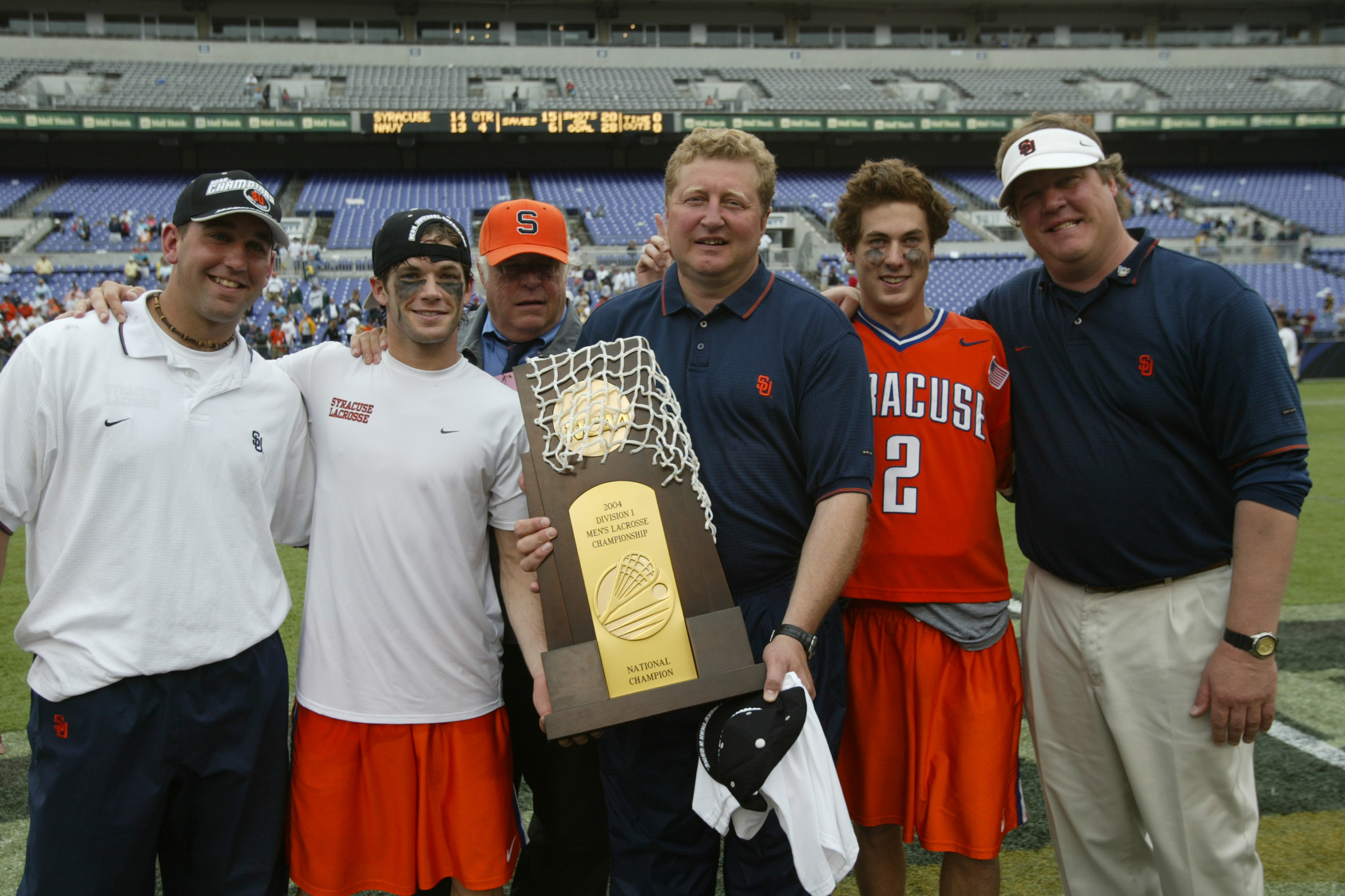
John Desko holds the 2004 National Championship trophy alongside Syracuse coaches and players. Desko was on SU’s staff during all 10 of its championship runs. Courtesy of SU Athletics
Underachieving seasons still bother Desko. He isn’t over the 2017 squad that saw its season end with an upset NCAA Tournament loss to Towson, or the 2020 squad that saw the COVID-19 pandemic ruin its five-game season-opening win streak.
“It was such a grind,” Desko said. “I was still enjoying it, but with the expectations and the 24/7-ness, it was about right.”
Five years removed from Gait taking over, Desko’s impact is still felt. Syracuse’s senior core of Joey Spallina, Michael Leo, Billy Dwan III and others were recruited by Desko. That group is trying to uphold the standard Desko set and win SU’s first national title since 2009.
He regularly attends Syracuse games, where it’s hard to stay incognito. It’ll be even harder Saturday, when Desko will be the center of attention.
Desko knows lacrosse has evolved since his heyday. The talent is more spread out. Syracuse, where Championship Weekend appearances were almost guaranteed, is no longer the dominant force.
At the height of Desko’s powers, Syracuse was a machine. Every year, the Orange were contending. The day after the seasons ended — whether that was with a national championship or not — Syracuse fans figured out the location of the next Final Four and booked hotel reservations.
It wasn’t cockiness or brashness. It was just the norm. The standard that Desko set.
“It was the kind of thinking we created,” Desko said.
Collage by Katie Crews | Digital Design Director
Photos courtesy of SU Athletics