Data dive: Metrics behind Syracuse softball’s 1-9 ACC start
Get the latest Syracuse news delivered right to your inbox. Subscribe to our sports newsletter here.
For three weeks, head coach Shannon Doepking watched her Syracuse softball team flail at the plate as it fell further into an 0-7 Atlantic Coast Conference start, the worst of her career.
When Doepking fielded a question on how the Orange could improve their timely hitting after a 10-0 loss to NC State — which capped Syracuse’s longest losing streak since 2008 — it’s natural that she had no desire to elaborate. After all, timely hitting implies there were opportunities to begin with.
“It’s tough to have timely hitting when you struggle to hit in general,” Doepking told 247Sports postgame.
The cat’s out of the bag. Doepking said it all. Syracuse logged 18 hits across a three-game series at Pitt the next week, and the Orange broke their skid. Midway through conference play, SU (12-16, 1-9 ACC) has a crucial series with fellow ACC bottom-feeder Boston College starting Friday.
Exit with two or more wins, and the Orange could qualify for the ACC Tournament. Exit with multiple losses, and they slide closer toward missing their back-to-back ACC Tournaments for the first time in program history.
Here are the stats that define Syracuse’s first 10 games in ACC play:
19.1% ACC BABIP
Take a look at the Orange’s conference-worst .231 batting average, and it would seem Doepking’s correct in saying her team’s offensive struggles stem from a lack of contact. SU hits less, so it scores less. But that’s a one-dimensional view of it. When observing what happens after bat meets ball, a different picture of SU’s ACC woes emerges.
Excluding homers, only 26.4% of the balls SU’s players have hit into play have resulted in a player reaching base, good for a .264 batting average on balls in play (BABIP). Contrasted with the conference average of 33.1%, SU players are 6.7% less likely to reach first than their ACC counterparts.
Syracuse finished preconference play with a 29.78% BABIP, much closer to the conference average, but that figure has cratered to 19.13% in ACC play. Despite finding hard contact — SU ranks in the 52nd percentile for isolated power — its hitters haven’t reached first as often.
Madelyn Lopez’s .254 batting average is a far cry from her .430 mark from last season, despite her impressively low 8.57% strikeout rate. She struck out just once in her 22 at-bats against Virginia, NC State and Pitt, but reached first only five times in that span.
“Madelyn Lopez has been a sleeping giant, right?” Doepking told 247Sports after SU’s doubleheader against NC State. “When she’s going to turn it around, who knows? But we anticipate at some point it’s going to wake up, right? And I think that’s just softball.”
Below average wRAA and wRC+
Syracuse was always going to be at a mathematical disadvantage when it comes to raw totals like hits, runs and bases. SU had 10 games scrapped due to weather and scheduling conflicts, which means it has sent 394 less batters into the box and played 10.5 fewer games than its average ACC opponent.
But pick out any offensive sabermetric, and the Orange still sit near the bottom of the ACC. SU’s hitters cumulatively score a 90.35 weighted runs created plus (wRC+), meaning they are 90.35% as productive as the average batter, and the lineup ranks bottom three in the conference with a negative-13.92 weighted runs above average (wRAA), per 64Analytics.
It reveals a rift. Yes, unfortunate cancellations skew cumulative hitting statistics and mathematically place the Orange far behind their conference. But when more than half the teams in the ACC have a wRAA over 40, and some — like Florida State — sit well over 80, the difference in production shows.
The Seminoles dispatched the Orange twice within five innings when they met in March. Syracuse lost the series by a combined score of 36-8, and only escaped a third consecutive run-ruling thanks to a Jadyn Burney fourth-inning grand slam.
Zoey Grimes | Design Editor
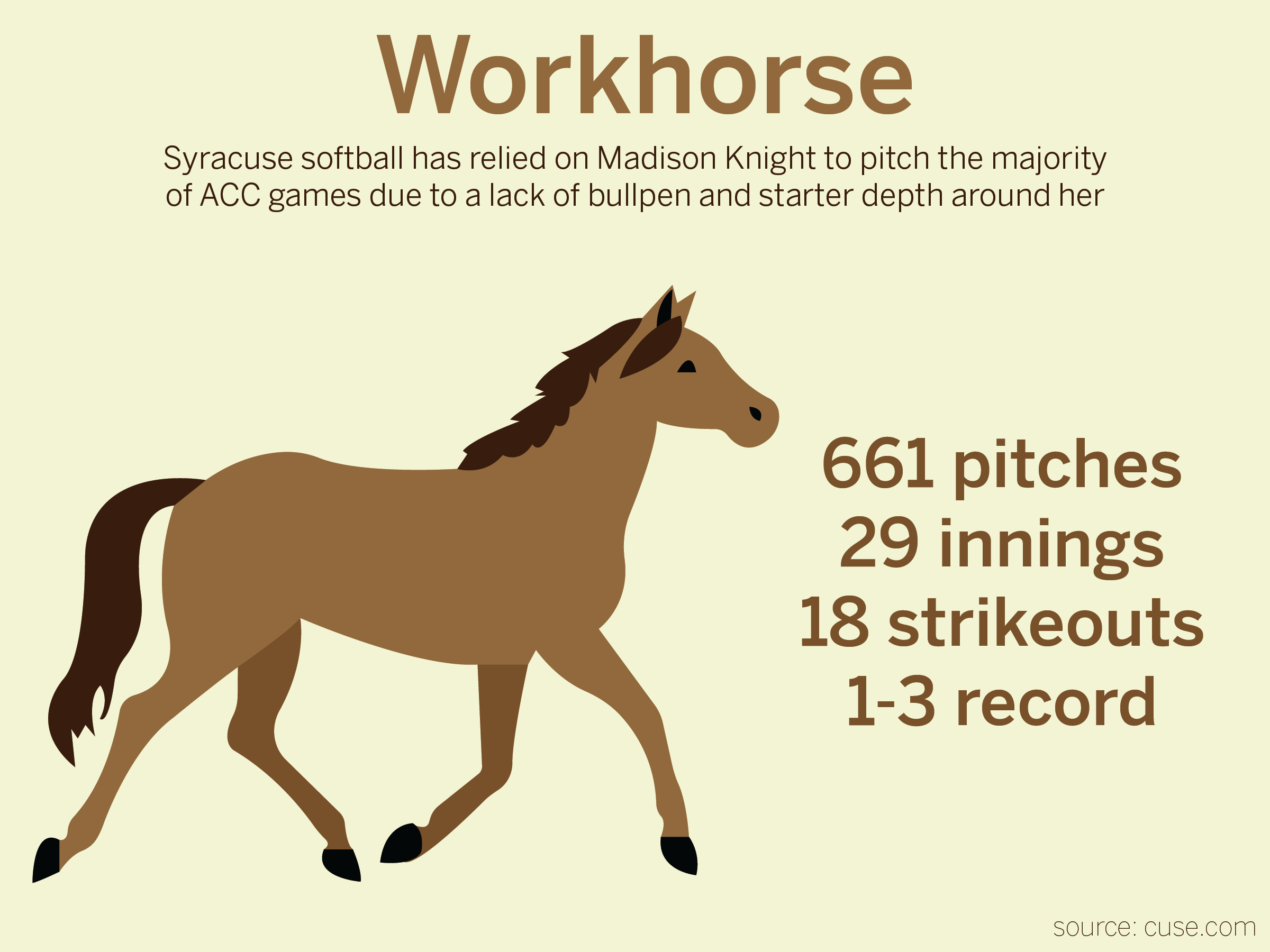
Madison Knight’s 661 conference pitches
Entering 2026, Syracuse’s one proven commodity was its pitching staff. Both Madison Knight and Julianna Verni were on the heels of reliable junior campaigns, where each kept below a 3.80 earned run average while starting every ACC game and pitching 250 innings combined.
Jackie Pengel’s return from injury, alongside Sydney Jackson and Rose Cano, seemed like more welcome signs SU would have a solid unit in the circle. But fast forward two months, and the Orange are basically solely reliant on Knight. Her 661 pitches account for 49% of SU’s conference total, and create a situation where SU’s defensive baseline relies purely on her performance.
The Orange’s three worst conference losses, 12-1 to Florida State on March 13, 13-1 to the Seminoles the next day and 10-0 to NC State on March 29, all saw carousels of three or more pitchers. The starter, whether Verni or Knight, allowed seven runs before their relief failed to stop the spiral.
Jadyn Burney’s 88th percentile OPS
After a junior year where she tallied just three extra base hits — all doubles — Burney has had a stellar start to her senior season. Her .375 batting average paces the Orange, leading Doepking to call Burney the “most consistency” the Orange have had all season.
Burney’s value comes from her versatility. She’s notched every type of multi-base hit, and she’s the only Syracuse player whose on-base plus slugging (OPS) ranks above Division I’s top 15%.
Burney homered to lead off Syracuse’s 9-6 win over Pitt, its only ACC win thus far, and set the stage for Kaimi Tulua and Erika Zamora’s homers later on. With two series against Boston College and Notre Dame next — SU’s last against teams who also have team batting averages under .300 — the Orange might see more positive results if they can follow Burney’s lead.
“We can’t win ball games with just Jadyn,” Doepking told 247Sports following Burney’s 2-for-3 performance against NC State. “She’s a hitter that is going to get herself on base, and we need somebody behind her to actually hit her in.”