Erika Zamora may be on cusp of breaking out after rebuilding her swing
Get the latest Syracuse news delivered right to your inbox. Subscribe to our sports newsletter here.
Sean Brashear has watched a lot of softball. As vice president of Firecrackers Softball — a national fastpitch organization — and architect of the Southern California-based Firecrackers Brashear youth pipeline, it comes with the job. He’s seen plenty of softball players with powerful swings. Erika Zamora stood out.
Zamora was a senior at Rancho Cucamonga High School (California) searching for her first collegiate offer. She and her family reached out to Brashear, inquiring if his 18-U Firecrackers team needed another infielder.
When older players contact Brashear about playing for him, he does his research. He talks to the player and their family and, of course, assesses their skills. What first caught his eye regarding Zamora was “the way she swings the bat.”
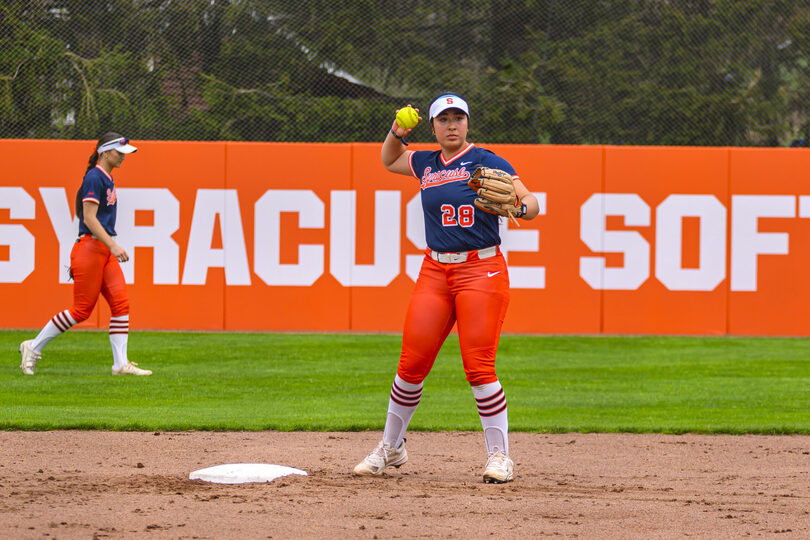
Zamora hit her way into a starting spot on Brashear’s team and an offer from Syracuse. Now, the sophomore infielder has started 20 of her 23 appearances this season at third base and shortstop. Although her .147 batting average and .324 slugging percentage don’t jump off the statsheet, she’s shown breakout potential at the plate, flashing upside to elevate her production in her next two seasons.
“She’s always had a really high ceiling,” said Darrin Smith, Zamora’s club coach at Athletics Mercado, where she played before joining Firecrackers Brashear.
Brashear and former SU assistant Will Loredo, who initially recruited Zamora, weren’t the only people to see something in her.
As she did to Brashear, Zamora stood out to Smith. But it wasn’t her swing that immediately impressed him. Instead, Smith remembers first watching Zamora patrol the left side of the infield early in her senior year of high school. He describes what sounds like an instruction manual for constructing the ideal infielder: An element of smoothness. Consistent posture. Clean footwork. Soft hands. A bullet arm.
But at the plate, Smith noticed a few “swing deficiencies.” A private hitting instructor, he offered help.
“It’s like building Legos,” Smith told Zamora. “It might not start as anything cool, but eventually, you’re a really cool castle or a pirate ship.”
Zamora embraced the reconstruction of her swing. It’s in character for her. When Zamora was in high school, her father, Eric, recalls her regularly working out well before he woke up. She watched hundreds of YouTube videos — backyard tee drills, 30-minute HIIT workouts and 20-step agility ladder progressions — she could complete at home. Zamora has always embraced discomfort and trained in the margins.
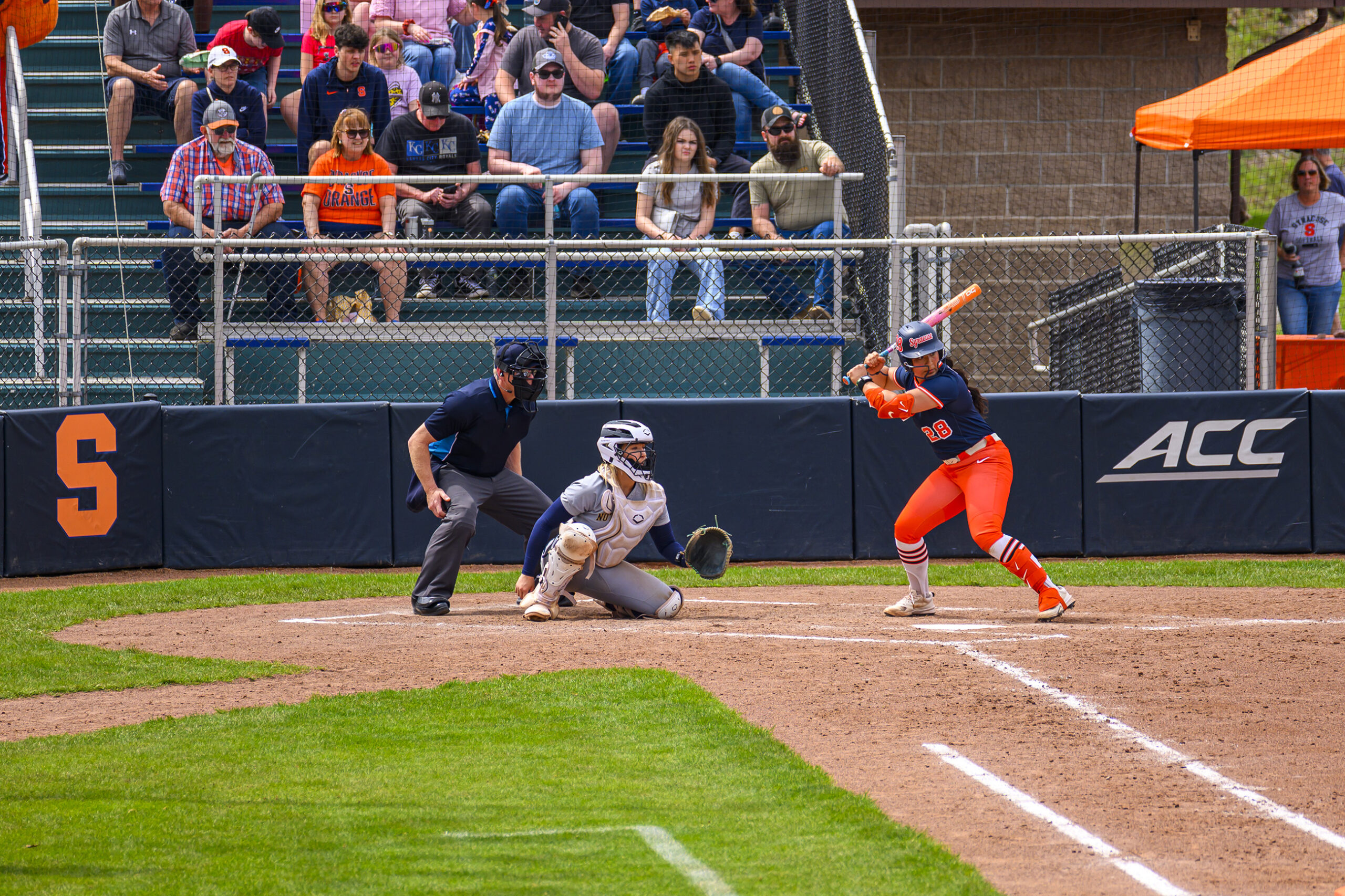
Erika Zamora awaits a pitch from Notre Dame during Syracuse’s 9-5 loss on April 18. The infielder never received a Division I offer until her senior year of high school but reconstructed her swing to catapult her level of play. Charlie Hynes | Staff Photographer
When she began working with Smith, he replaced her bat with PVC pipes, medicine balls and resistance bands. As fluid as Zamora was in the infield, she was stiff in the batter’s box. Rather than driving with her rear hip, her top half initiated the swing. Her shoulders rotated too much and her hips too little.
“It was a sequencing issue,” Smith said. “(We created) a more connected turn.”
The two reshuffled the order in which Zamora fired her body to generate the correct “feel.” They got her back hip going first, driving with her lower half and syncing her hips with her hands.
Nearly three years later?
“That’s where I feel she’s at now,” Smith said. “She’s starting to understand the whole process. Between the mental, the physical, the mechanical side and she’s just executing movement more flawlessly.”
Zamora’s progress is most apparent when she puts down the PVC pipes, medicine balls and resistance bands and picks up a bat again. Consider the HitTrax data Smith uses from private lessons in the batting cage to quantify his clients’ progress. Across four sessions this winter, Zamora nearly doubled her expected fly-ball percentage, almost quadrupled her expected extra-base-hit rate and improved her maximum exit velocity by more than five miles per hour.
It’s one thing to square up balls in a batting cage. It’s another to step into the batter’s box against Atlantic Coast Conference pitching and lay off a diving drop ball or sit on a pitch breaking outside and drive it the opposite way.
After making just two plate appearances as a freshman, Zamora was left out of Syracuse’s season-opening lineup on Feb. 6 against Binghamton. Her first action came on Feb. 13 at Texas. Ever since, she’s bounced in and out of SU’s lineup, slotting in the 7-9 spots all but two times.
I always watch how they step in and out of the box. How they look when they get beat. And what I liked was she had a look of commitment to succeed.Sean Brashear, Firecrackers Softball vice president
She took regular at-bats early in ACC play but went 0-for-3 at Boston College on April 10. Zamora didn’t step to the plate again until head coach Shannon Doepking removed then-leadoff hitter and starting shortstop Jadyn Burney from the lineup during SU’s Notre Dame series.
Yet, more offense could be on the way. Even though her hits have rarely fallen, Zamora has consistently reached base. Her .412 on-base percentage ranks third on the Orange, and she’s walked more times (14) than she’s struck out (11). She leads Syracuse in walk rate at 27.5%.
And Zamora doesn’t just lift the ball in the cage. Nearly half (45.8%) of her contact this season has resulted in fly balls. Her 18.2% HR/FB rate ranks third on Syracuse.
You can take it from Brashear. He hadn’t seen Zamora take a swing since she left his team almost three years ago. But he was in Pittsburgh in early April, the same time the Orange faced the Panthers in a three-game set. He sat in the stands of Vartabedian Field and watched Syracuse’s 9-6 win.
In the second inning, Zamora belted a ball over the left-field wall. It was the product of her adjustments three years prior.
“I always watch how they step in and out of the box,” Brashear said. “How they look when they get beat (on a pitch). And what I liked was she had a look of commitment to succeed.”