SU to ‘sunset’ 93 programs following academic portfolio review
Get the latest Syracuse news delivered right to your inbox.
Subscribe to our newsletter here.
Editor’s note: The Daily Orange is working to independently verify the statuses of each “sunset” major in the list provided by Syracuse University. The D.O. welcomes tips at news@dailyorange.com.
UPDATE: This post was updated at 1:08 a.m. on April 2, 2026.
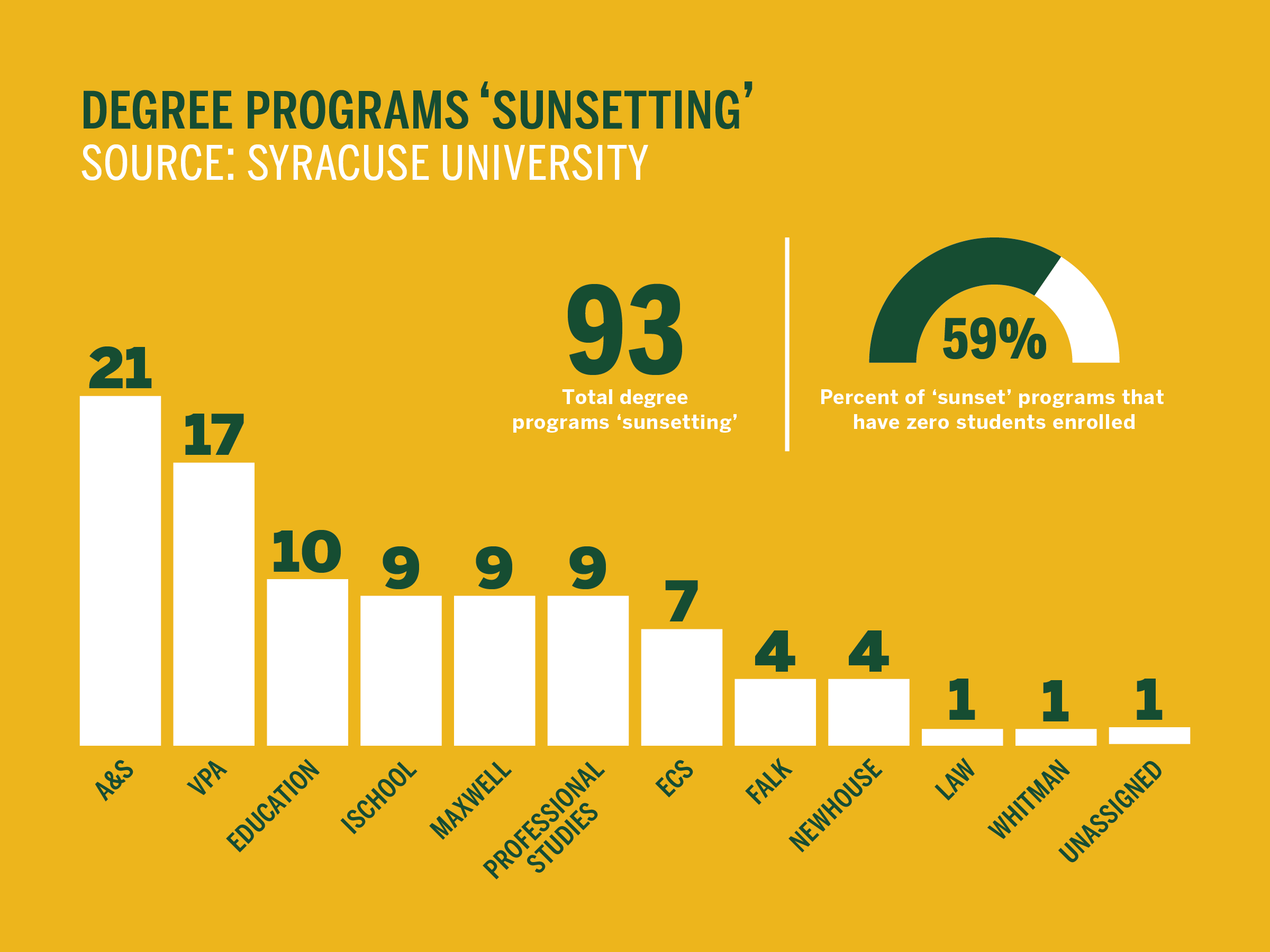
Syracuse University will pause or close 93 of its programs as a result of its academic portfolio review, Vice Chancellor, Provost and Chief Academic Officer Lois Agnew announced in a Wednesday campus-wide email.
Out of the affected programs, 55 have zero students enrolled and 28 are “advanced certificate programs” — specialized curriculum programs that supplement a graduate degree. Agnew wrote that SU offered approximately 460 programs at the time of the review, a number she called “well above the peer average” of 200 programs at other large universities.
In total, 258 students — roughly 1.2% of SU students — are currently enrolled in the closed or paused programs, Agnew wrote. Every student enrolled in the paused or closed programs will have the opportunity to complete their degree, she confirmed in the email.
No positions have currently been identified to be eliminated, she wrote. Deans of SU’s schools and colleges will work directly with faculty on teach-out plans, curriculum transitions and developing “reenvisioned” programs that “better position Syracuse for the decade ahead.”
Read more: Here are the results, by college, of SU’s academic portfolio review
In August, Agnew announced SU would perform a portfolio review of its 13 schools and colleges, with deans reevaluating their respective programs, degrees and majors throughout the fall semester.
Deans were provided “detailed data,” including enrollment trends, course data and faculty information to inform their recommendations, Agnew wrote in her initial review announcement.
The decision to “sunset” each program came from several factors, Agnew wrote. Some programs affected have already stopped producing graduates and some were “genuinely difficult choices” about programs with “dedicated faculty” but low student enrollment.
Other programs will face “significant curricular redesign” or combine with established majors to save resources, Agnew wrote.
Agnew wrote in the email that 34% of SU’s programs account for 80% of total student enrollment, while the remaining 66% of programs serve just 20% of students.
The results of the review were “not a cost-cutting exercise” or aimed at “eliminating departments or people,” Agnew emphasized. She added that every dean worked closely with faculty, department chairs and program leaders to review their programs against “student demand, academic quality and mission alignment.”
Students, faculty and staff of each home college will receive specific information about how the review affects their school, Agnew wrote. Curriculum changes that require authorization from the New York State Education Department or the University Senate are also underway, she added.
Agnew wrote that those with questions about the portfolio review results should contact the deans of their respective schools.
“This review is an important step in developing a portfolio that is more focused, more distinctive and more aligned with student demand,” Agnew wrote. “The outcomes position us to strengthen the University’s ability to attract talented students, support exceptional faculty and fulfill our mission as a leading research university.”
Sophia Burke | Digital Design Director
The announcement follows seven months of review across SU’s 13 schools and colleges, including significant restructuring within the College of Arts and Sciences, where 18 humanities majors were paused and later selected for closure, consolidation or “re-envisioning.”
According to a March 20 email from College of Arts and Sciences Dean Behzad Mortazavi obtained by The Daily Orange, nine undergraduate majors will be “sunset,” beginning in fall 2026.
Three majors — African American studies, music history and culture and religion — will be “re-envisioned,” and five additional programs will merge, consolidate or rebrand, according to the email. Current students in any of the affected majors can still complete their degrees. Courses in the majors will continue as minors, general education and/or interdisciplinary programs.
“I want to reiterate that sunsetting a major does not mean closing a program or abandoning an intellectual tradition — it means sustaining that tradition in the form that best serves our students today,” Mortazavi wrote in the email. “Students are intellectually engaged with humanities content but are not seeing themselves in the majors.”
Department chairs and program directors were given nine years of program data and participated in a series of meetings with associate deans and students, Mortazavi wrote. In some cases, he wrote, majors identified for closure averaged fewer than four declared students over 10 years.
After pausing admissions in September, departments were tasked with submitting stabilization plans in mid-December. Associate deans followed with recommendations for “low-declared” majors, and Agnew later extended the deadline for deans to submit their final recommendations to Jan 23.
Chairs in the affected departments said the pause surprised them, as they claim Mortazavi informed them of the decision in a meeting the same day they had been asked to present their own program evaluations.
In the months that followed, many students, faculty and alumni braced for “uncertain” futures as decisions remained pending through the fall and early spring semesters. Departments held listening sessions with students, surveyed alumni and looked for ways to boost enrollment.
The portfolio review has renewed concerns among faculty about their level of input on curricular decisions.
In October, SU’s University Senate passed a resolution calling for faculty and the senate to be involved in the review process. The combined faculty of A&S and Maxwell followed in February with their own resolution. Passing 185-51, the resolution stated that eliminating any program in their respective schools would require approval through the colleges’ curriculum committee and faculty body, philosophy professor and university senator Robert Van Gulick said.
“The administration’s view seems to be, ‘This is a purely administrative action, and the faculty have no official role whatsoever to play in this.’ The faculty obviously think otherwise,” he said following the vote.
USen’s Committee on Curriculum and Instruction is now gathering information from schools and colleges about their procedures for pauses and closures.
Enterprise Editor Samantha Olander contributed reporting to this story.
This article will be updated with additional reporting.