University Senate votes to pause ‘faculty workload policy’ implementation
Get the latest Syracuse news delivered right to your inbox.
Subscribe to our newsletter here.
The University Senate voted to approve a resolution calling for a pause and review of a proposed Syracuse University “faculty workload policy” at its final meeting of the year Wednesday.
The faculty workload policy — which aims to standardize teaching, research and service responsibilities across schools and colleges — would set clear expectations for instructional loads and class sizes.
Backed by more than a dozen senators and a faculty petition with over 100 signatures, the “resolution on shared governance and university policy creation” calls for an “immediate pause” on the policy’s implementation and retraction of related school or college-level teaching policies, including minimum course enrollment requirements.
Under the resolution, the policy’s implementation cannot move forward before the 2026-27 academic year. The resolution states it can only proceed after administrators provide “clear and documented evidence” that the proposed changes would improve teaching quality, faculty workload efficiency and conditions for research productivity.
It also states that any revised policy must align with the “principles of shared governance” and the university’s academic mission, describing the current approach as “a major departure from long-standing institutional practices.”
The vote passed with 62% of senators in favor, 26% opposed and 12% abstaining.
Associate Provost for Faculty Affairs Jamie Winders told senators her office paused the policy until the fall semester and plans to “post it for public comment.”
Robert Van Gulick, a philosophy professor and senator, said the resolution spoke to a broader concern about whether faculty have been adequately consulted on academic decisions.
“So one can have concern about the process independently of any of the particular criteria or standards that are being put down,” Van Gulick said. “It’s just as to whether or not faculty have been as fully involved as they should be.”
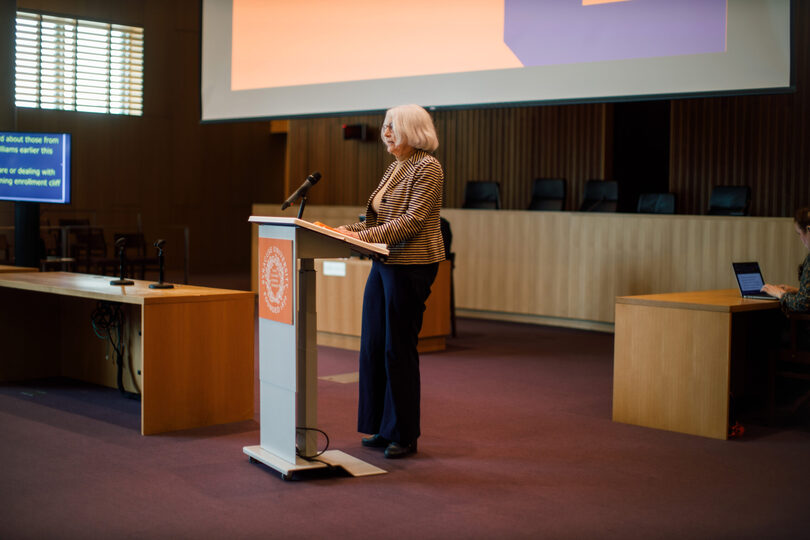
The monthly meeting, USen’s first in-person one of the semester, was held in Dineen Hall’s Melanie Gray Ceremonial Courtroom. The meeting came just hours after Chancellor Kent Syverud announced his brain cancer diagnosis in a campus-wide email. Syverud, who had been slated to deliver remarks, was not in attendance.
“I think we all came in this morning expecting one kind of meeting, and then the Chancellor’s email arrived,” Agenda Committee Chair Heather Coleman said. “We will attend our Senate business today. That is what the chancellor would want.”
Coleman briefly reflected on Syverud’s 12-year tenure, pointing to his role in strengthening the university’s finances and campus development. She also thanked Ruth Chen, Syverud’s wife and a professor in the College of Engineering and Computer Science, for her dedication to SU’s students, particularly its international student population.
“You leave this place better than you found it and that is no small thing,” Coleman said.
In her remarks, Provost Lois Agnew said the university is facing financial and enrollment challenges, including an anticipated “enrollment cliff” and increased competition for students, but said SU remains well-positioned compared to peer institutions.
“Over the past two years, you’ve heard Chancellor Syverud say we’re facing financial challenges like everybody else, but we’re still better off at Syracuse,” Agnew said. “A lot of people have said, ‘What does that mean? Are we better off? Are we facing financial challenges? What does that really mean?’ And I would say both are true. We are definitely facing financial challenges.”
Agnew credited Syverud’s leadership with preparing the institution for those pressures and said she looks forward to working with acting Chancellor Mike Haynie.
“We are hoping that we can collectively position the university to sustain our excellence in research and teaching,” Agnew said. “We believe that everyone here and across the university will play a critical role in that effort.”
Alongside the workload vote, senators approved the formation of a bylaws committee to evaluate potential changes to Senate structure and membership.
The motion, introduced by USen’s Ad Hoc Committee on Senate Representation, directs the Agenda Committee to form a Senate Bylaws Committee to review and potentially implement recommendations from the group’s report. The senate’s current composition includes 123 faculty members, 20 staff, 41 students and 17 ex official members, according to data presented by the committee.
Committee chairs Melissa Almeyda and Brice Nordquist said their findings — based on a survey of 465 faculty and staff and a review of peer institutions — show many respondents perceive the senate as too large, yet believe staff is “underrepresented.”
The committee recommended increasing staff seats by reallocating the number of chancellor-appointed positions. They also suggested reducing the number of senators to achieve “manageable committee sizes” and more active participation.
After opening the floor for discussion, Maxwell School of Citizenship and Public Affairs professor Tom Perreault, and chair of the Academic Freedom, Tenure and Professional Ethics committee, raised concerns about the current size of his committee, claiming that it’s understaffed.
“If we’re reducing the number of senators, we’re reducing the pool of people who are available to serve on committees,” Perreault said. “I don’t want my committee to suffer as a result.”
Director of Media Studies at the Newhouse School for Public Communications Nick Bowman countered that smaller senates force their members to be more active.
“My voice feels smaller here than it did there,” Bowman said, referring to the smaller senate bodies he’s worked on at past universities. “It’s not an inherent critique, it’s just a matter of structure.”
The senate approved the formation of the bylaws committee, which was already approved by the Agenda Committee, with 92% in favor.
Senators also voted to accelerate the timeline for the Ad Hoc Committee reviewing changes to the Idea, formerly IDEA, course requirements catalog language, moving the deadline from February 2027 to November 2026 after Harvey Teres, a humanities professor and senator, argued the original timeline was not prompt.
“At the last regular meeting of this body, we voted overwhelmingly to have the faculty vote on the merits of the idea requirement changes,” Teres said. “We expected that to be placed on the agenda for today’s meeting.”
The vote passed with 66% in favor, 27% opposed and 7% abstaining.
Other business:
- The Committee on Curriculum and Instruction reported a record 1,066 curriculum proposals across 11 schools and colleges this year, with the College of Arts and Sciences submitting the most at 377, followed by the College of Visual and Performing Arts at 163 and the College of Information Studies at 105.
- The Committee on Appointments and Promotions reported that it reviewed four tenure and promotion appeals this year and is currently working on a proposal to change the terminology for non-tenure-track faculty.
- The Committee on Employee Services, Fiscal Affairs and Operations presented an updated resolution from the Parking and Transportation Advisory Council calling for the creation of a permanent standing council on parking and transportation.
- USen voted unanimously to recommend the Board of Trustees confer degrees for this year’s graduating class, an annual procedural tradition.