After CNY upbringing, Lars Tiffany took a lacrosse stick and ran with it

Get the latest Syracuse news delivered right to your inbox. Subscribe to our sports newsletter here.
One day in late 1973, Bradford Tiffany opened the front door of his sprawling LaFayette farm. Onondaga faithkeeper Oren Lyons stood on his doorstep with a question for Bradford, the owner of a 250-acre former dairy farm about 10 miles south of Syracuse.
“What do you do with those buffalo?” Lyons asked.
“I’ve been patiently waiting for you to call,” Lyons remembered Bradford replying.
Bradford, a white former United States Marine and wealthy restaurant owner, had started buying buffalo. By 1971, he’d accrued 71, building the largest enclave east of the Mississippi River. He was happy to provide some to the neighboring Native Americans.
The two reached a deal in 1974. Eleven buffalo were handed over. The original plan was 10, but an extra buffalo slipped on Bradford’s truck, and he didn’t want to risk losing them all just to unload one. Six years later, the Onondagas agreed to return 11 buffalo to Bradford.
The treaty — which wasn’t recorded on paper — fulfilled Onondaga elders’ foretelling that the bison, which Lyons describes as a “spiritual force,” would return 300 years after their disappearance. The agreement also spawned one of today’s foremost figures in lacrosse, a sport created by the Haudenosaunee — which the Onondaga are part of — to honor nature, heal and foster community.
Bradford’s eldest son, Lars Tiffany, was 5 at the time. The cordial agreement led him to spend time with the Onondaga, attending their festivals, meeting their people and playing the game they created. That childhood set Tiffany on course to become the first white man to play for the Haudenosaunee (then called the Iroquois Nationals) internationally. It charted the path for him to coach the Haudenosaunee at the 2018 World Championships as an assistant and become the head coach for the 2023 tournament.
“He has a much deeper understanding (of lacrosse),” Lyons said. “That comes from being associated with us (Native Americans) for so long. You can’t teach that. That’s part of our cosmology, part of ceremony. It’s not just a game. I know it’s a sport, but it’s more than that.”
S.L. Price, who authored the book “The American Game” about lacrosse, said Tiffany “bridges” the lacrosse’s two major “strains”: the “prep school traditional caricature” of the sport and its “Native American roots.”
“Lars is a really important figure in American sports,” said Price, a former Sports Illustrated senior writer for 26 years. “He’s tying together these two strains, and showing the most dominant population on this continent that the respect for the indigenous forces on this continent, the Indigenous people on this continent, are something he takes great spiritual sustenance from.”
Tiffany has won two national championships as the University of Virginia’s head coach. When his No. 8 Cavaliers (7-4, 2-0 Atlantic Coast) take on No. 6 Syracuse (9-3, 1-1 ACC) Saturday, it’ll be a return home for Tiffany.
• • •
Despite “growing up in the shadows of the Carrier Dome,” there were no lacrosse sticks in Tiffany’s childhood home. His first exposure to the sport was during a fair on the Onondaga Nation reservation his family had been invited to. There was a carnival-style box lacrosse event there, where participants paid a quarter to take three shots.
“That looks impossible,” Tiffany thought to himself.
His whole life in lacrosse, Tiffany said he’s been a “fortunate bystander of geography.” Had Bradford Tiffany made the family home just a half mile away, Lars said he would have gone to Fabius-Pompey High School, which had no lacrosse and far fewer Native students compared to LaFayette High School.
“I was that close to never playing lacrosse,” Tiffany said in Price’s book. “Talk about being born in the right place at the right time.”
LaFayette introduced organized lacrosse when Tiffany was in seventh grade. Seated in the back of a classroom — an unusual spot for the self-proclaimed “nerdy” Tiffany — he watched many of his Native American classmates in rows ahead announce their desired role on the team.
Talk about being born in the right place at the right time.Lars Tiffany, Virginia men's lacrosse head coach
“All I’m hearing is attack and middie, which makes sense,” Tiffany said. “And so, by the time it gets to the back row, ‘Lars Tiffany, defense?’”
The Onondaga prefer to have a high-pace, aggressive, attacking style, so Tiffany thought he’d fill in on defense. Once his mother picked him up from LaFayette after that first meeting, he told her he might need a longer stick.
Tiffany’s closest friend on his first LaFayette teams was Onondaga classmate Joe Solomon. Joe’s older brother, Travis, went on to be a starting goalie at Syracuse.
In Tiffany’s freshman year of high school in 1983, he joined Joe on Syracuse’s family bus to the NCAA National Championship. In Piscataway, New Jersey, Tiffany witnessed the then-Orangemen comeback to upset their bitter rival Johns Hopkins 17-16. Tiffany was all in.
“I had those two connections. One, my dad giving us that relationship with the Native Americans, because of the gift of the buffalo. And then my friend, Joe Solomon, and the success of his brother,” Tiffany said. “So, those are two real driving the stake deep into building a connection with Syracuse lacrosse.”
• • •
Around that same time, in 1984, the Iroquois Nationals field lacrosse team was formed. The Haudenosaunee Six Nations (Mohawk, Oneida, Onondaga, Cayuga, Seneca and Tuscarora) that span upstate New York and Canada had only played organized box lacrosse at that point. But Lyons wanted to start a field lacrosse team to play in a Baltimore exhibition.
“I knew our field skills would be rusty, but the idea was intriguing,” Lyons said. “I took the question to our players, coaches and leaders. Their response was, ‘Why not?’”
By the summer of 1985, the still-incipient team needed a long-pole defender for an exhibition in Ottawa. Tiffany fit the bill. While Lyons said the Onondaga had to close their longhouse ceremonies to non-Natives to allow enough room for Native Americans, Tiffany was always welcome there — and on the national team.
That’s how he, at age 17, became the first white man to represent the team.
“He (had) more community with us,” Lyons said. “He grew up with us as a youngster. He’s not a stranger whatsoever.”
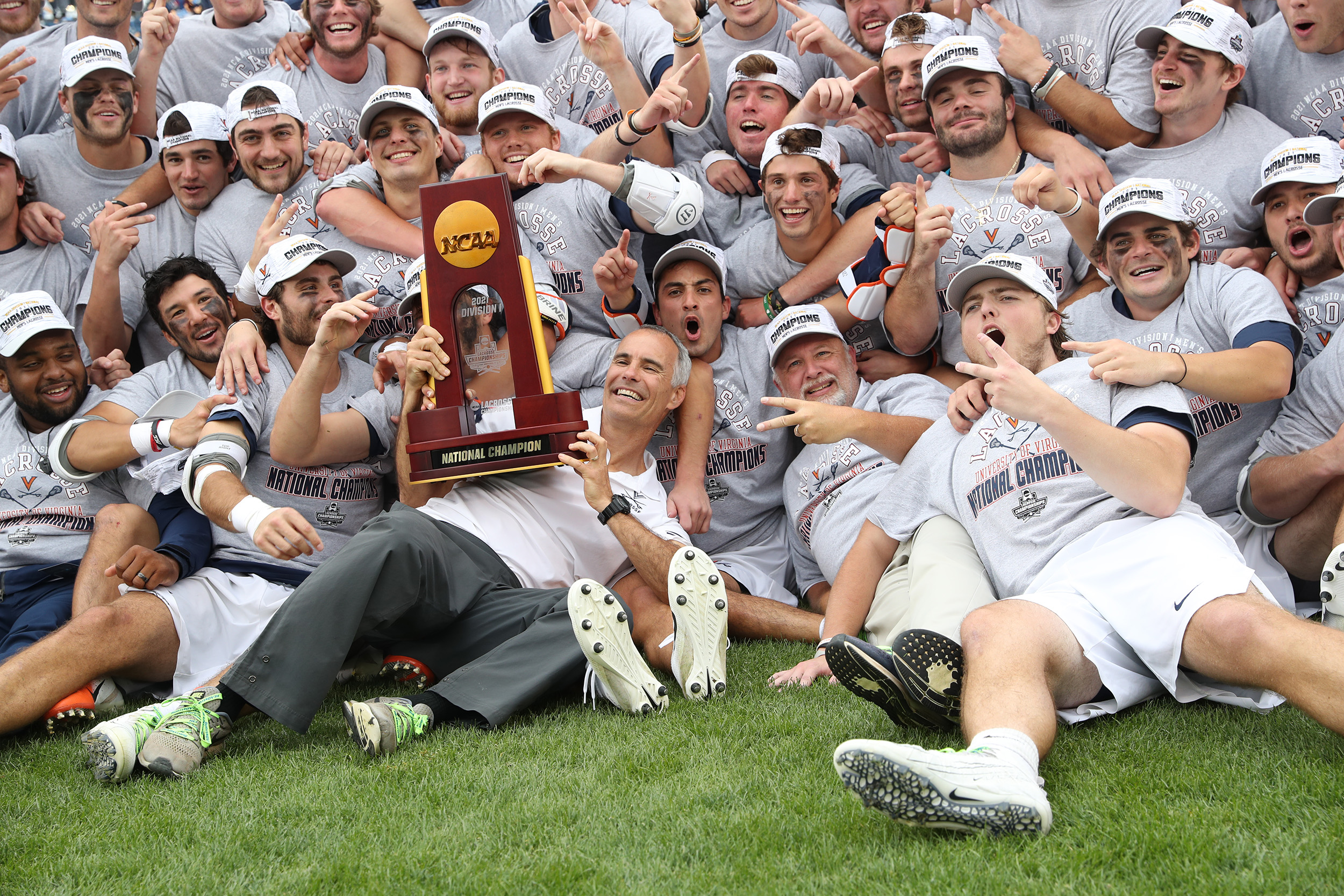
Lars Tiffany celebrates the national championship in 2019 with Virginia. Throughout the season, Tiffany carried the wooden lacrosse stick his father, Bradford, commissioned before his death. Courtesy of Virginia Athletics
As Tiffany recalls it, his friend Joe asked him to join the trip to Ottawa, and Tiffany wasn’t going to say no. He hopped in the flat bed of Travis’ pickup truck with Joe and former Syracuse great Mark Burnam for the 200-mile trip. He doesn’t remember anything about the game itself.
“How lucky am I, right?” Tiffany said, recalling the trip.
He represented the Iroquois again in 1993, when he was a biology teacher at a private school in Pebble Beach, California. The Nationals again needed some long poles for a three-game series in Santa Barbara. This time, Tiffany went under an alias.
Luke Warmwater.
Tiffany laughs about the pseudonym to this day.
“What an incredible honor,” Tiffany said of playing for the Nationals. “It wasn’t some sort of international event. No one was going to check our IDs and say if we truly were of native birth. But for me to be able to be a part of that was almost an affirmation that, ‘You matter to us. You and your family have been good to us, and we accept you into our family.’”
• • •
Brown head coach Dom Starsia came to central New York to recruit Joe. He left with Tiffany, who would become a longtime assistant and ultimate replacement at Virginia.
It was February 1986. Starsia couldn’t convince Joe; he chose to attend the Naval Academy instead. But at the end of his visit, according to Price’s book, Starsia asked Joe’s dad, Bo Solomon, if he knew any other promising locals.
Bo suggested Tiffany. That’s how he got to playing under Starsia at Brown, co-captaining the team to its first NCAA Tournament win in 1990. No. 1 seed Syracuse, though, eliminated the Bears in the quarterfinals.
With Starsia’s backing, Tiffany became Brown’s head coach in 2007. When Starsia retired in 2016, Tiffany replaced him at Virginia. He arrived to find a program in disarray, rampant with alcohol, drug use and tragedy. Everyone on the team had to try out to earn their spot.
“He came in with a bang and set his culture right away,” said Dox Aitken, a Virginia midfielder from 2016-21. “He made some tough decisions early, which was contentious at times, but it was about establishing what he wanted the program to be. He was always transparent and honest with players — about where they stood, what they needed to do, and what the expectations were.”
Through it all, Tiffany coached the way he learned the game without culturally appropriating the Natives, he said. He grew up five miles away from the Onondaga Nation, but he’s aware enough to admit he didn’t live on the nation and hence is no expert.
“It’s ever-present but never forced,” said Sean Kirwan, who spent two years at Brown and seven at UVA with Tiffany. “It just feels natural. Those reminders help players understand the history and the spiritual connection to the game.”
Still, Tiffany wanted to implement the “high-flying” offensive style he grew up learning with the Onondaga, Kirwan said, even before the shot clock was instituted in 2019.
“My freshman year, it was like an air raid — we just shot all the time,” Aitken said. “We were talented, but not always smart. (Tiffany) wanted us to take risks, but also learn which risks were the right ones. As we got older, we figured that out, and that’s when we really took off.”
Tiffany said the original Native American purpose of lacrosse was to turn boys into men. He seeks to do the same at UVA. He holds Cultural Thursdays, where the team selects a chosen book each semester and discusses it each week. Aitken recalls reading “Boys in the Boat” about the University of Washington crew team and “The Gates of Fire” about a captured Spartan soldier. They were always trying to take life lessons from the books, Aitken said.
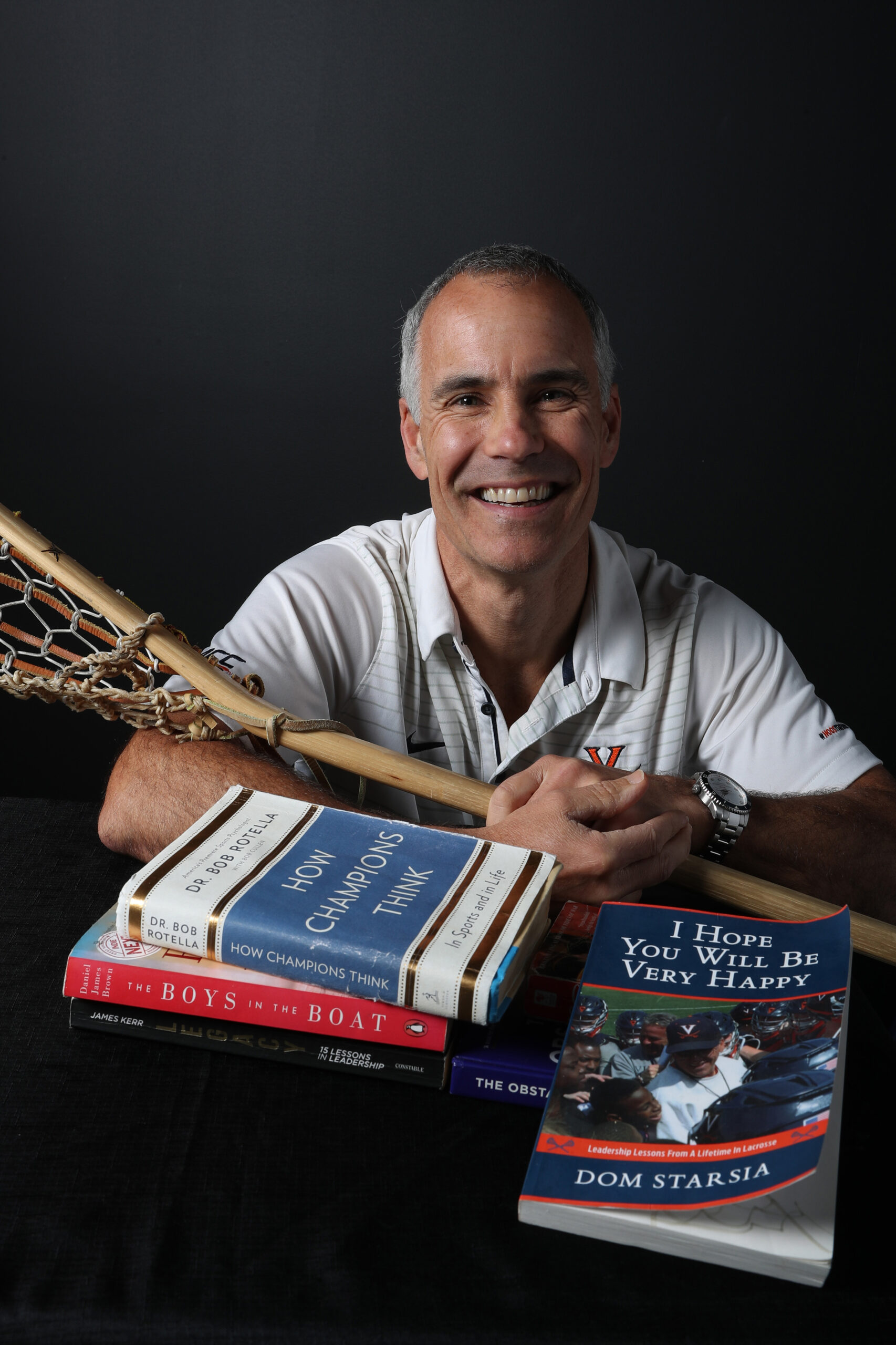
Lars Tiffany has attempted to coach the game the way he learned it from the Onondaga. His team reads books during the season, like “Boys and the Boat.” Tiffany also gifts his wooden stick to the player who performed best in practice or had the hardest hit in a game. Courtesy of Virginia Athletics
During the run to the 2019 National Championship, the Cavaliers abstained from alcohol for the duration of the season. Even after dropping two of their first three contests, the players stuck to the plan.
It paid off.
“That season felt like we had nine lives. Every comeback felt more possible than the last,” Kirwan said. “In the championship, we were ahead comfortably, and it felt strange because we weren’t used to that.”
The Gatorade got dumped, the Cavaliers dogpiled on the field, and there was a brief moment where Kirwan could soak the moment in. Tiffany used the Memorial Day platform to showcase the game’s Native roots. During the celebration, he held a traditional wooden stick, made by the late Onondaga stickmaker Alfie Jacques, a sacred item for the Haudenosaunee.
It was a gift from his father, Bradford, who died of a stroke on Jan. 28, 2019. Tiffany went to central New York for the funeral in early February. After the service, Tiffany went to a restaurant where Joe gave him the stick, which Bradford commissioned for Tiffany’s 50th birthday.
“‘(Bradford) wanted to create a wooden stick for you, and it’s finally finished,’ Tiffany recalled Joe telling him. “So there I was, receiving a gift from my father at his funeral. It was incredible.”
Tiffany originally wanted to hang the stick up on his wall, leaving it untouched for eternity. But Lyons insisted the stick was made to play with. So, Tiffany carried the stick during every game of UVA’s title-winning season and still gives the stick to either the practice player of the week or the player who records the hardest hit in its most recent game.
“The stick, it really held a power to him,” Price said.
As Virginia completed inexplicable comeback after inexplicable comeback to keep its season alive, the stick was along the way. Then, the tens of thousands of fans watching — both at Lincoln Financial Field and at home — saw the stick pregame and again in celebration when the Cavaliers overcame Yale to win the 2019 title.
With the stick in his hand, Tiffany celebrated.
He came in with a bang and set his culture right away.Dox Aitken, former Virginia men’s lacrosse midfielder
• • •
Tiffany wondered if the Haudenosaunee Nationals had read his letter.
After serving as the team’s assistant coach at the 2018 World Championships in Israel, Tiffany applied for the same role for the 2023 edition in San Diego, California.
After leaving home to play at Brown in 1986, Tiffany felt like he “was sent off on a mission” in his early 20s to learn the field lacrosse game, with the idea he’d someday come back to teach it.
He wanted to continue doing that in 2022 as an assistant. But in late September 2022, two weeks after applying, Nationals board member Vince Schiffert called Tiffany.
He wanted to offer him the head coach position.
“First of all, did you read my letter?” Tiffany asked him. “I asked to be the assistant coach. I really think a Haudenosaunee man should be the head coach.”
“‘We really want you to do this,” Tiffany recalled Schiffert telling him.
Tiffany couldn’t refuse. His stock was high coming off two straight national championships. The Onondaga faithkeeper Lyons said he was like “family” and knew the Haudenosaunee style.
“To me, Lars cares more about the Native culture than a lot of Native people,” Zed Williams, who played for Tiffany at Virginia and with the Haudenosaunee, was quoted as saying in Price’s book. “I don’t know who’ll get mad, because it’s a white guy and their whole race thing, but it’s true. Lars genuinely cares about Native people and will stand up for Native culture and Native people more than Native people in our own community. You can see it.”
Williams showed up to play field lacrosse for the Haudenosaunee for the first time since 2012. The 2020 Premier League Lacrosse MVP brought a long pole, volunteering to play defense. Williams even agreed to use Tiffany’s wooden stick in the first shift of games, even though it was heavy and fragile. It was meant to be played with.
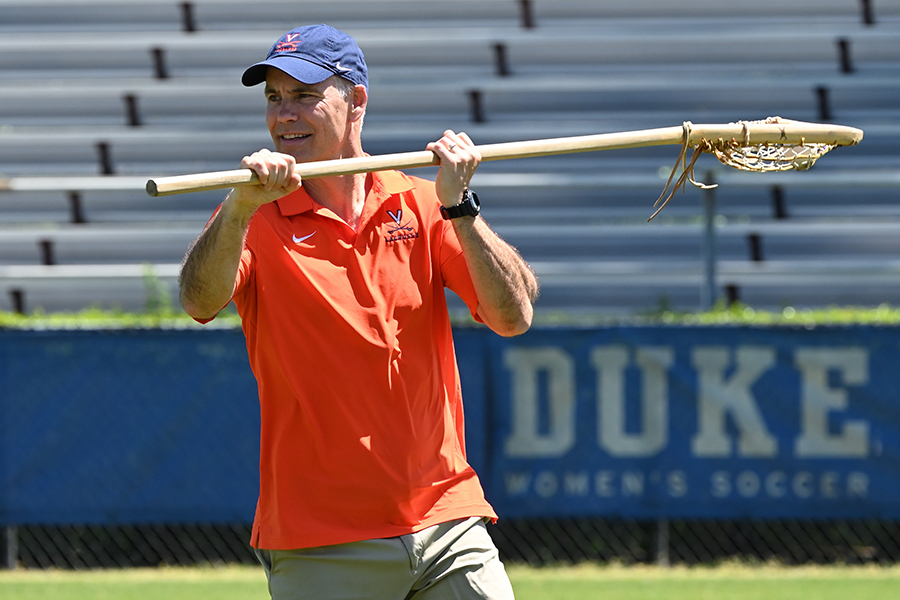
Lars Tiffany showcases the wooden stick his father commissioned for his 50th birthday. Thousands tuned in as Tiffany carried the wooden stick at every game during UVA’s 2019 title-winning season. Courtesy of Virginia Athletics
There was one vocal detractor to Tiffany’s hiring. Haudenosaunee attack Austin Staats tweeted: “One thing I can’t get my head around is having @HAU_Nationals have white peoples lead us.”
But the Haudenosaunee Nationals stuck behind Tiffany. On a conference call, the 11-person board told Staats it’d kick him off the team, Price wrote. Staats soon deleted his tweet.
The Nationals’ faith in Tiffany was rewarded. The Haudenosaunee finished third for the third successive tournament, but narrowly lost to Canada and the United States.
Price, who was at the tournament, remembers a moment after the Haudenosaunee’s 11-6 win in the bronze medal match, where Tiffany and Staats conversed in the locker room. The coach told his player, who scored a competition-high 30 goals in eight games, he could be the championship’s Most Valuable Player.
“They had their moments of tension where the team, like Austin, wasn’t listening during the tournament,” Price said. “It didn’t matter, he still played incredibly.”
The two men hugged. Staats thanked Tiffany. The coach, ever-sunny, walked away grinning.
• • •
The story of the Tiffanys gifting the Onondaga 11 buffalo has passed down generations. The hand-painted deerskin treaty, done by Lyons shortly after the agreement, now sits on display at the Onondaga Historical Society.
But what about the promise to return those 11 buffalo?
Six years passed. None came back.
For years, both sides believed something different. Tiffany and his family admitted they never received any buffalo back. Lyons believed they had. The record, like the deal itself, lived mostly in memory.
Late in his life, Bradford reached an understanding with Vincent Johnson of the Onondaga buffalo medicine society. He’d redistribute the buffalo to other tribes.
Bradford told no one about his decision. The Onondaga spent 42 years aiming to redistribute the buffalo. It was Price who informed the Tiffany family recently after speaking to Johnson.
“I wish they had told me that,” Tiffany said, jokingly.
In 2021, the Onondaga sent 20 buffalo to the Seneca. More followed in the years after. Their own herd grew, too — now more than 80.
“That’s a heck of a seed to plant on this planet,” Tiffany said.
Tiffany still carries that connection to his upstate New York upbringing through coaching the way he learned from the Onondaga, helming the Haudenosaunee team and prizing the wooden stick his father gave him.
He learned the stick was never meant to hang on a wall. It was made to be used. He still carries it. And like the offense he learned and aims to emulate, he’s moving at a fast speed.
“(I’m) a guy who was lucky enough to grow up in LaFayette, New York, and to learn the game from the Onondaga people, and his Onondaga friends,” Tiffany said. “And really lucky to have a father and a family who pushed a relationship with the Onondaga, and shared the bison from our ranch.
“I’m just a fortunate bystander of all that, taking the stick and running with it.”