Opinion: Embrace side quests to relieve internship, job pressure
Get the latest Syracuse news delivered right to your inbox.
Subscribe to our newsletter here.
On March 19, The New York Times Opinion section published a discussion with 12 white-collar job seekers in their teens and twenties. When asked to describe the job market in one word, one interviewee called it a scam. Another, a 28-year-old tax associate named Orrel, described it as unfair.
“You can never have enough experience, even for entry level, because entry level is not entry level anymore,” Orell said.
Scholars and journalists argue that the bottom rung of the United States job ladder is broken. Some attribute this to artificial intelligence, while others blame employers’ reluctance to invest in training new hires. Increasing conglomeration is another cause within various industries, making entry-level positions more competitive and hiring processes much less personal.
Let this reassure you that you’re not alone if you don’t have any great job leads right now.
There’s an expectation in the U.S. that a bachelor’s degree will lead to a decently compensated job with opportunities for advancement. There’s also an assumption that pursuing a job outside one’s desired field, or a role that doesn’t require a degree, signals stagnation, disrupting the linear career path that is so valuable.
The reality is, many of us will have jobs that aren’t ideal at some point — because although the job market is bleak, we still need to make money.
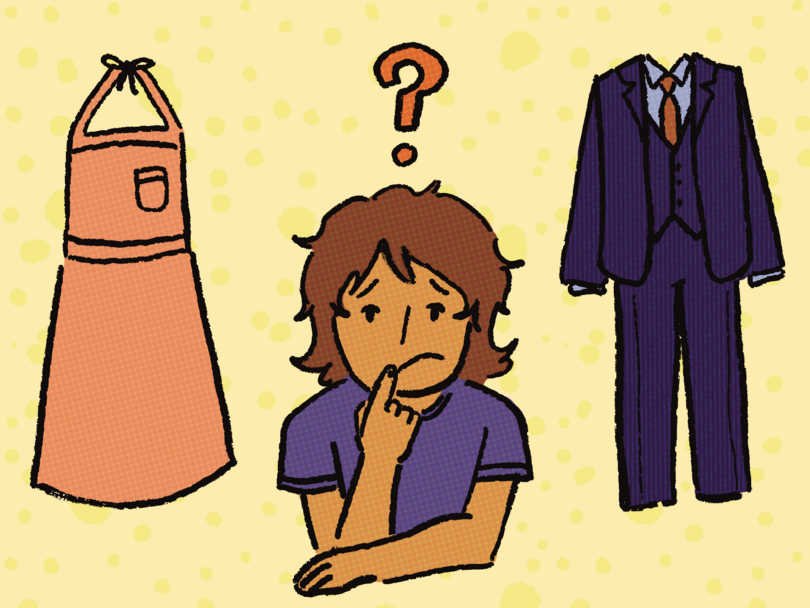
But this doesn’t have to be viewed as a negative. Rather, it may give you the chance to capitalize on a unique experience. If your career path isn’t progressing in a straight line, it doesn’t mean you’ve failed. It just means you’re due for a side quest.
In video games, side quests sharpen skills and make the mission easier as the player familiarizes themselves with the game’s design. When the main task feels impossible, side quests revitalize the excitement you might’ve lost about the game. The same can be said about side quests in real life.
Entering the real world shouldn’t conjure dread, even if job culture makes it feel that way.Maya Aguirre, Personal Essayist
A side quest doesn’t need to be groundbreaking to be worth pursuing. You don’t need to go overseas and teach, apply to grad school or become a social media influencer — but there’s nothing wrong with trying these things, either. Whatever it may be, a side quest is most fulfilling when it excites you and reminds you of the agency you have over your life.
I’m no stranger to a side quest. When I returned to SU this past fall, I was prepared for my journalism professors to ask what internships we’d worked over the summer. As a fourth-year student, I anticipated my classmates’ answers. Almost all had worked in communications jobs or internships.
When my turn came, I told my peers I’d been a sales associate at a makeup store, sporting a fun, pink jumpsuit as my uniform. I’d talked to so many interesting people while working, and each night, I’d go home and jot down ideas for stories about the beauty industry, which I’d known nothing about months prior.
I revitalized my interest in journalism by existing in the world in this unfamiliar way and learned how to shade-match foundation while I was at it. I wasn’t ashamed of falling behind, because I hadn’t. I found something new.
A few weeks ago, I called one of my childhood friends for a check-in. An ice cream truck had parked down the street from her house.
I asked my friend what she was looking for, in reference to her choice of ice cream. With both of us near graduation, the question came off philosophical. Our mindless talking devolved into a heavier conversation about our futures.
We don’t often question what we want from life once we’ve seemingly established an answer. Many of us pick what we want to do in our teens or upon declaring our majors at college. We set goals and adjust them only when necessary. We crave success, but we infrequently question what success means to us, because changing our answer can be scary.
The modern career ladder assumes moving vertically is the only path to success. This neglects the fact that obstacles thrown our way don’t need to stop us from growing laterally.
In searching for an answer to the ice cream question, I sat beside another friend to write a list of 10 current goals on a sheet of composition paper. Among some of mine: garden and grow flowers. Learn how to code. Make a perfectly ratio-d Manhattan. Work on a farm. Drive a truck. Be a journalist.
It’s my dream to be a journalist. But I think what I actually mean by this is I’d like to be a great listener, someone so ravenous to learn that I’m humbled by what I don’t know. My career goals and side quests in the interim are just the supporting evidence.
Entering the real world shouldn’t conjure dread, even if job culture makes it feel that way. At a major crossroad like graduation, we deserve to feel excited about our futures. To do so, allow yourself the space to recognize what you want to do in the current moment — it might just be worth pursuing.
Maya Aguirre is a senior magazine news and digital journalism and history major. She can be reached at msaguirr@syr.edu.