Syracuse’s special teams failures define Final Four defeat to Notre Dame
Get the latest Syracuse news delivered right to your inbox. Subscribe to our sports newsletter here.
CHARLOTTESVILLE, Va. — Syracuse, somehow, had signs of life.
Second-best all day, it’d got within two goals of Notre Dame as the third quarter wound down. Then, the Orange’s greatest weakness Saturday bit them again — and it came with two seconds left on the shot clock for the Fighting Irish.
ND’s talented dodger Matt Jeffery tried to create something in the final ticks before the clock expired. He charged into the teeth of SU’s defense, where he was met with a stick to the neck from the Orange’s Louis D’Agostino.
The punishment? A two-minute unreleasable penalty.
With the man advantage, Notre Dame put the game out of reach. To begin the fourth quarter, Brady Pokorny clanged a behind-the-back goal in. ND led by three, and the extra-man continued. Thirty seconds later, Josh Yago whistled a goal below goalie Jimmy McCool. Still, 38 seconds left on the man up. Enough time for Luke Miller to add a third right as the penalty expired. A five-goal cushion. Game all but out of reach for SU.
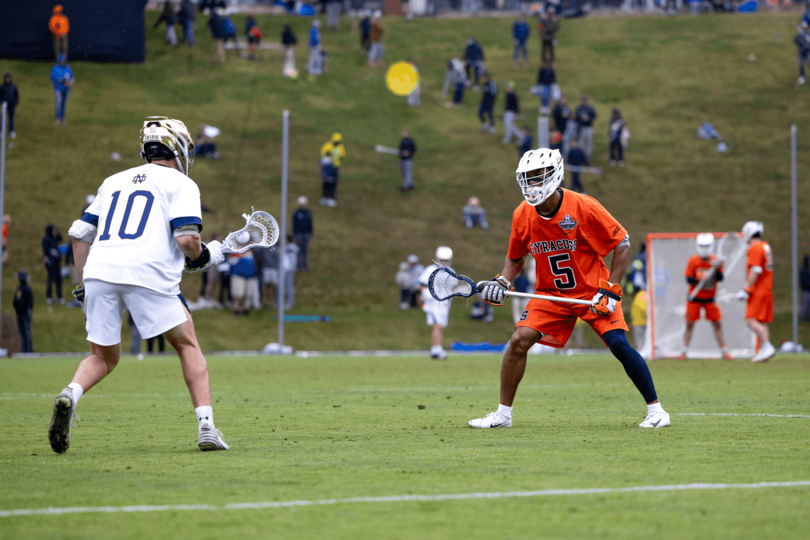
That penalty undoubtedly changed the game — allowing No. 2 seed Notre Dame (13-2, 3-1 Atlantic Coast) to pull away from No. 6 seed Syracuse (13-6, 2-2 ACC) in its 15-7 Final Four win Saturday. But it was part of a larger trend that keyed the comfortable win. The Fighting Irish utterly dominated the special team categories. They went 5-for-6 on extra-man opportunities and held the Orange scoreless on their five man-up chances.
“That’s a fine line, and we talked about it a lot, and we did a pretty good job during these playoffs of being smart about playing tough, playing physical,” Gait said, trying to explain balancing aggressive defense and penalties. “We lost both the special teams battle and the man-up, not finishing at our end, and then giving up five goals on the other end, man down.
“Their goalie play was outstanding, their man up was outstanding, they shot with conviction,” Gait continued. “We had plenty of opportunities, and unfortunately, just didn’t hit the gap when we needed to, and that’s the way the ball goes sometimes.”
Notre Dame’s man-down defense was one of its few weaknesses entering Saturday. It sat 64th out of 75 Division I teams with opponents scoring off 44.1% of extra-man plays. Its man-up was a middling tied for 36th with a 36.4% conversion rate, below Syracuse’s 42.2% in 17th that went 0-for-6 in its quarterfinals victory against No. 3 seed North Carolina.
In the season’s most crucial matchup, you can throw the preconceived notions out the window.
“For us to do what we did on man-up and man-down today is huge,” ND head coach Kevin Corrigan said postgame in his opening statement. “I mean, it’s probably the difference in the game, right? And especially in the first half, when we’re fouling a little too much, and we got away with it, because our man-down played so well. Credit to these guys, and to Thomas (Ricciardelli) in the cage.”
In victory and surprise success in those categories, Corrigan admitted “the proof is in the pudding, we’re just not that good at that (man-down) this year.” So, he and defensive coordinator Ryan Wellner implemented changes to the man-down game plan before Saturday. With the national championship still upcoming Monday against No. 1 seed Princeton, Corrigan wouldn’t share the intricacies, but he was intent on addressing that area with some experimentation.
“Let’s not just stand pat on a bad habit,” Corrigan said. “Let’s keep trying new things, and to our guys’ credit, like even the first day we did it, and the guys weren’t great, like most things when you try something new.”
ND could have given up there. It had a Final Four game to prepare for, but the Fighting Irish stuck with it. And it paid off.
The first litmus test of the man-down unit Saturday came when ND’s Thomas Porell was called for an illegal body check at the 12:51 mark of the second quarter. A two-minute locked-in penalty awaited.
Joey Spallina fed a pass into Greg Elijah-Brown, who saw his bid saved. The Orange had two more chances before coughing up the ball. Notre Dame marched downfield and didn’t just kill the rest of the penalty — it scored a man-down goal.
“I feel like we got the looks we wanted on man-up,” Spallina said. “Their goalie made some incredible saves.”
Elijah-Brown had another look on another second-quarter Porell penalty, this time a one-minute man-up. It again ended with no Orange goals.
“Anytime we’re able to kill a penalty, especially when it’s locked in or two minutes locked in, it’s a ton of energy, because one, you’re not necessarily supposed to make that stop every time,” Tewaaraton finalist ND defender Shawn Lyght said postgame.
Lyght added killing those penalties builds confidence and takes confidence away from the opposition.
“Sucks the energy out of them,” Lyght said. “Great energy, great swing.”
The Orange stopped the bleeding on two third-quarter penalties of their own. It allowed Syracuse to trim the deficit to 9-7 before committing that detrimental, game-changing penalty to end the third. On the other end, ND cleaned up its play. It was fortunate the early ill discipline didn’t come back to bite like it had all season.
“We fouled too much,” Corrigan said. “It was as simple as that. We’re fired up, we’re keyed up, we’re making aggressive plays, and we fouled too much. And there was no question about that.”
“I thought we just put ourselves in a bad situation, particularly in the first half,” Corrigan continued. “We played with a little more poise and a little more discipline in the second half, but I don’t think any less aggressiveness, which is good.”
For Syracuse, Spallina didn’t have any regrets about how it handled the five man-up chances it couldn’t capitalize on. He remembered specific shots from each opportunity. He thought they all were looks SU wanted to get, he said.
Spallina kept returning to the same phrase postgame, trying to comprehend how Syracuse’s season — with the decorated, now-departing 2022 recruiting class at its center — unraveled. It came in the part of a game that can turn a result. It did so significantly Saturday.
“We got the looks that we wanted to,” Spallina said. “We just didn’t score. It’s just the way that it goes sometimes, and that’s just sports and life.”