Analyzing numbers behind Syracuse softball’s 18-26 campaign
Get the latest Syracuse news delivered right to your inbox. Subscribe to our sports newsletter here.
For the second straight year, Syracuse’s season is over one week into May.
The Orange concluded their 2026 campaign on a six-game losing streak and finished second-to-last in the Atlantic Coast Conference, three wins shy of the conference tournament.
SU didn’t stumble down the stretch; it was never in contention. It sat below .500 from March 21 on and started conference play with seven consecutive losses.
Now, for the first time in program history, the Orange missed the ACC Tournament in back-to-back seasons.
Here are the stats that defined Syracuse’s (18-26, 4-18 ACC) abysmal 2026 slate:
10 game cancellations
There are no palm trees in Syracuse. Twice at home and eight times on the road, there was no softball played. The Orange’s 10 cancellations were their most in a season since 2015 — excluding 2020, when 35 games were canceled due to COVID-19.
Due to inclement weather, Syracuse postponed its March 20 home opener and canceled its March 22 series finale against then-No. 18 Virginia. The next weekend, SU didn’t play its first two scheduled games against NC State because of cold temperatures.
Even in Syracuse’s early-season nonconference tournaments in South Carolina and Texas, the clouds followed the Orange. Eight games on SU’s nonconference slate were canceled.
The missed contests put Syracuse at a disadvantage. When the Orange met then-No. 10 Florida State to open conference play on March 13, the Seminoles had played eight more games. SU’s hitters had taken 188 fewer at-bats than the average ACC team, and its pitchers had logged 45 fewer innings.
Still, Syracuse head coach Shannon Doepking told 247Sports, “We’re used to it.”
The weather misfortunes almost worked in SU’s favor. The Orange weren’t mathematically eliminated from the ACC Tournament until the second-to-last day of the season because they played fewer games than NC State. A potential six-win Syracuse season would have produced a higher winning percentage than a six-win Wolfpack season.
But NC State won its seventh Saturday, and Syracuse, which dropped its final two games to Virginia Tech, was sent packing for good.
43 different lineups
Consistency, or a lack thereof, was a season-long theme for Syracuse. Doepking shuffled the Orange’s order all year, constructing 43 different lineups in 44 games.
By the season’s end, nine players had hit between the first and third spot of SU’s lineup, 15 between fourth and sixth and 14 between seventh and ninth.
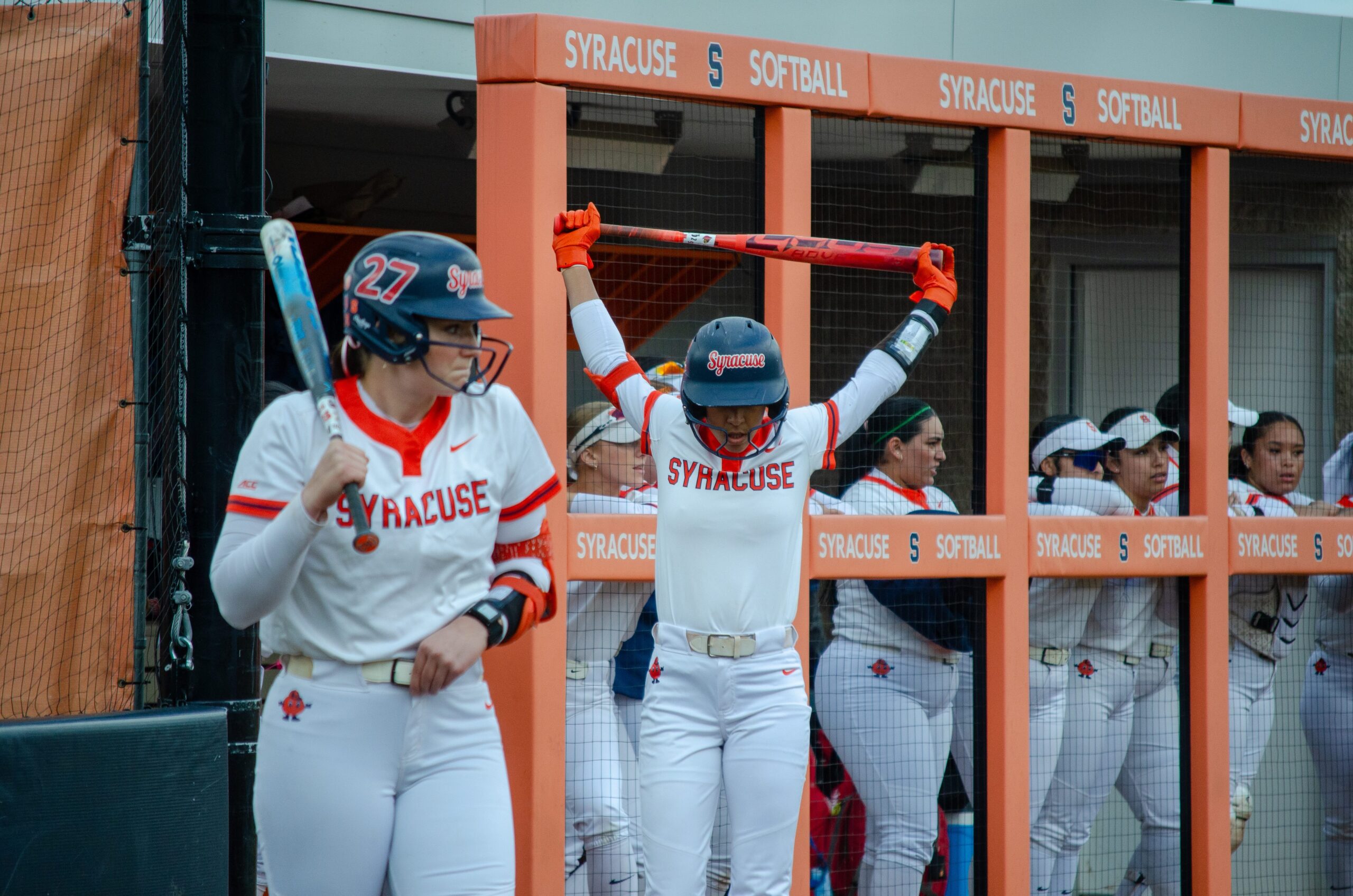
Madison Knight (27) and Jadyn Burney (back) prepare for at-bats in Syracuse’s loss to Virginia Tech on May 1. Although SU tried 43 different lineups this season, Knight and Burney were mainstays. Keenan Sawada | Contributing Photographer
Nothing clicked. Syracuse finished with the ACC’s fewest runs in conference play (75), 17 fewer than NC State’s second-worst tally.
“Essentially, the only consistent hitter we’ve had is Jadyn Burney most of the year,” Doepking said after Syracuse scored one run across two losses to NC State in March. “We’ve got to figure out a way to be a lot more consistent one through nine.”
But even Burney, who led the Orange in batting average (.321) and stolen bases (20) and tied for the team lead in runs scored (28), faltered at times. Her batting average dropped from .389 to .320, and her on-base percentage plummeted from .489 to .343 in the nine games after Doepking’s remarks.
The graduate student hit 3-of-25 (.120) during that stretch, and after batting leadoff in 25 straight games, Burney was bumped to fifth in the Orange’s order on April 17 against Notre Dame.
The shortstop eventually figured it out, stringing together a five-game hitting streak in late April, but it was yet another shuffling of the deck.
96 pinch-hit plate appearances
Syracuse’s two losses to NC State during the last weekend of March were an inflection point of its season.
In the 23 games before the Orange’s series with the Wolfpack, Doepking used 1.8 pinch hitters per game. After that series, her pinch-hitting usage increased to 2.6. Syracuse used five-plus pinch hitters four different times after that series as opposed to just once before.
Doepking turned to pinch hitters most during the climax of SU’s conference slate. She used seven batters off the bench against NC State, seven at Pittsburgh in early April, 12 the following weekend at Boston College and 13 — including a season-high six on April 19 — versus Notre Dame.
But Syracuse’s offense never came to life, no matter how much Doepking tried to jumpstart it. The Orange won four of those 11 games.
Of note, though: Syracuse’s batting average when pinch hitting — 22-of-80, .275 — was significantly better than when not — .235.
-106 run differential in ACC play
The ACC is competitive but not parity-ridden. There are good teams and subpar teams. Good teams often beat subpar teams to a pulp. That was apparent in Syracuse’s season, finishing with a minus-106 run differential in conference play. The Orange were run-ruled seven times in ACC games and swept in five conference series.
Syracuse’s first ACC season was in 2014. In 12 seasons since, its lone winning record in conference play came in a three-game COVID-19-shortened 2020 season. SU is 99-179-1 against ACC opponents all-time and 55-118-1 in Doepking’s eight years.
There’s always been a separation between the Orange and the ACC’s top teams, but it’s never been this pronounced. In three consecutive seasons that ended in ACC Tournament losses from 2022-24, Syracuse’s run differential improved each year.
But in the last couple seasons, it dipped. SU’s 2025 mark (minus-78) was 254% worse than its 2024 mark (minus-22). Its 2026 tally is over 35% lower than last year’s.
“I just didn’t feel it was competitive,” Doepking said after a 13-2 loss to Virginia Tech Saturday.
586 at-bats, 263.2 innings pitched departing
Syracuse’s offense and pitching staff weren’t just top-heavy in 2026, but also senior-heavy.
More than half (53.6%) of SU’s at-bats were taken by seniors or graduate students. That includes Madison Knight (124), Burney (120), Vanessa Flores (108) and Madelyn Lopez (105), Syracuse’s only players with over 100 at-bats. SU’s seniors were responsible for its runs, too, driving in 91 of 162.
The Orange’s seniors played an outsized role in the pitcher’s circle. Knight, Julianna Verni, Jackie Pengel and Rose Cano combined for 263.2 innings, a whopping 93.9% of Syracuse’s defensive innings.
Knight, Cano and Verni made contributions both at the plate and in the circle.
Knight’s were especially crucial, leading Syracuse in slugging percentage (.694), OPS (1.103), home runs (15) and RBIs (38). Her 15 homers tied Alexis Switenko for the third most in a single season in program history.
In the circle, Knight led SU pitchers with nine wins and was the only Orange hurler to record an ERA below five (4.96).