FIFA features big artists but lacks identity in stale 2026 World Cup album
Get the latest Syracuse news delivered right to your inbox.
Subscribe to our newsletter here.
I was 6 years old when I first watched Shakira’s “Waka Waka” music video, the 2010 World Cup anthem.
Even with global soccer stars like Lionel Messi and Gerard Piqué making appearances throughout the video, they never caught my attention. What stayed with me was how the music captured the distinct unity shared by soccer fans across the globe, introducing me to the World Cup.
Alongside GRAMMY-winning Colombian singer Shakira, “Waka Waka” featured South African band Freshlyground. The music video encapsulates the spirit of millions of fans cheering on their nation’s team. And with Shakira’s Colombian roots and Freshlyground contributing lyrics in the Fang language from Cameroon, “Waka Waka” highlights what the World Cup is all about — a bridge between different nations and cultures.
Unfortunately, this year’s official World Cup album fails to live up to that same ethos.
Since 1994, FIFA has released official music albums to accompany each World Cup. On Friday, FIFA Sound continued this tradition with the release of an 18-track album. With a 58-minute runtime, the album attempted to embody the three cultures of the World Cup’s host countries: Mexico, the United States and Canada. Instead, the album was a banal attempt to capture those identities.
This year’s World Cup, which will take place from Thursday to July 19, will be the biggest one yet. Not only is it the first time three countries will host the competition, but the tournament was expanded from the usual 32 countries to 48. From New Jersey to Guadalajara, 16 cities will host 104 matches this year.
Successful World Cup songs of the past, like “Wavin’ Flag,” “La Copa de la Vida” and “Dar um Jeito (We Will Find a Way),” share the same unifying spirit as “Waka Waka” — a collection of songs that capture the energy of die-hard soccer fans around the country.
For example, “We Are One (Ole Ola),” released for the 2014 World Cup in Brazil, is very synonymous with Brazilian culture. Featuring Miami’s Pitbull, New York City’s Jennifer Lopez and Brazil’s Claudia Leitte, the song heavily borrows from the samba genre, using traditional instruments like the cuíca, surdo and tamborim.
This is what most of this year’s World Cup album lacks — a true embodiment of Mexican, American and Canadian culture.
The 2022 and 2014 World Cup albums, which were held in Qatar and Brazil respectively, represented the two nation’s cultures successfully. However, this year, FIFA has to put in three times the effort to represent the host nations. To capitalize on this, big name artists, like Future, LISA and the Rolling Stones, were used to maximize their reach to a global audience. While most songs this year featured non-English lyrics, mainly Spanish, the album is musically a complete misunderstanding of what a World Cup song should sound like.
Take 21 Savage’s “Three Nations” featuring Natanael Cano and French Montana. While the lyrics are about chasing wins, the song is edgy and gritty rhythmically, which doesn’t reflect the typical triumphant and electric passion of soccer fans.
However, this doesn’t mean it’s a bad song. It’s on brand with the rest of 21 Savage’s discography — sharp, hyped-up rap. If “Three Nations” was released as a single not associated with the World Cup, the track would be a class act.
The same can be said about the majority of the album. When Jelly Roll’s World Cup country song “Lighter” was released on March 20, it received an overwhelming amount of backlash from fans for drifting away from World Cup songs’ typical high-energy rhythm. If there’s one thing soccer isn’t synonymous with, it’s country music.
With most of the genre’s listeners concentrated in the U.S., the song reminds me of Friday night football rather than the global sport of soccer.
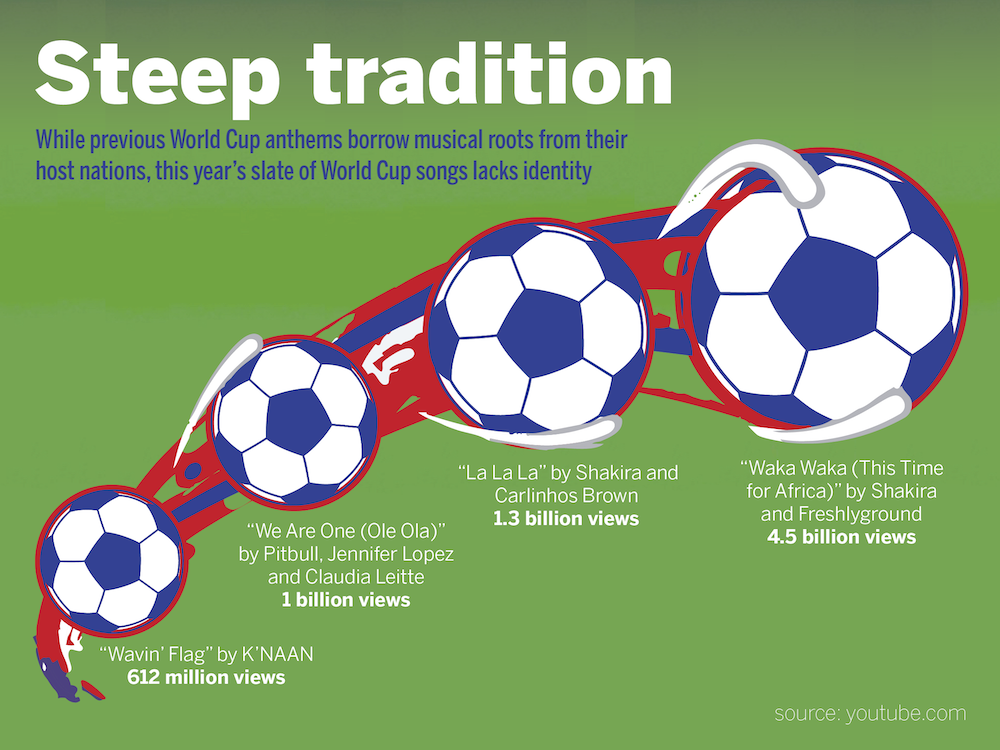
Abigail Aggarwala | Digital Design Director
Similarly, when Shakira and Burna Boy released “Dai Dai,” it felt like a misrepresentation of the tournament — which is a travesty considering Shakira’s history of successful World Cup songs. Once again, the track is a phenomenal Afrobeats song; it centralizes a laid back, beachy sound that talks about the hard work players put in before and during the tournament.
However, having a more relaxed song representing the World Cup misconstrues the ardent passion of both fans and players. There was little passion displayed in “Dai Dai” — and most of the album.
Despite the misrepresentation, there are some redeeming qualities in the album. Songs like “Por Ella” (translated to “For Her”) and “Mi Mexico Lindo” (translated to “My Beautiful Mexico”), which represent Mexico, are the album’s saving grace.
“Por Ella,” by Mexican musicians Los Ángeles Azules and Belinda, feels authentic to the nation. Los Ángeles Azules brought the Mexican Cumbia genre to the global forefront while Belinda’s lush vocals intertwined traditional Mexican and modern pop music.
Similarly, Alejandro Fernández’s “Mi Mexico Lindo” is rooted in mariachi music. The song is a love letter to Mexico — Fernández’s home country — and from first listen, its connection to Mexican culture is unmistakable, making it one of the album’s more successful songs.
Ironically, the album’s best song is from Twitch streamer IShowSpeed.
The hallmark of an iconic World Cup song is crowd chants in the backing tracks to emulate the fervent stadium pulse you hear in a soccer game and lyrics that reflect the same spirit. Throughout the song “Champions,” IShowSpeed calls on fans around the world to stand up for their country. The crowd chants are commanding, making you want to cheer from the stands of a soccer stadium.
“Let’s go, we the champions / ‘Cause this is the World Cup / Put your flags up in the air / Put your hands up in the air,” IShowSpeed sings.
In a way, IShowSpeed making the album’s best song is a full-circle moment. A little over five years ago, IShowSpeed knew nothing about the sport, only focusing on streaming video games like NBA 2K and Fortnite.
But once IShowSpeed expanded his reach to soccer, he became attached to the sport, embarking on a world tour where he was always spotted wearing a soccer jersey — likely Cristiano Ronaldo’s. Currently, IShowSpeed mainly covers soccer content, which not only ushered in a new wave of soccer fans, but also created what I think deserved to be this year’s World Cup anthem.
Aside from “Por Ella,” “Mi Mexico Lindo,” “Champions” and other honorable mentions, like “Echo” and “No Place Like Home,” FIFA’s attempt to represent the U.S., Mexico and Canada was in vain.
The album featured artists connected to the three host countries including Canada’s Nelly Furtado and Mexico’s Carín León, while also pulling in major Latin music figures like Puerto Rico’s Daddy Yankee. However, by collaborating with big names instead of focusing on authenticity and identity, it resulted in a bland and disappointing effort at gathering excitement for the competition.
Discovering and adding new World Cup songs to my playlist has become a personal tradition I look forward to every four years. Instead, this year’s slate was overshadowed by stale and generic tracks — like watching a nil-nil draw.