Pixar’s ‘Toy Story 5’ channels nostalgia but fails to revive trilogy magic
Get the latest Syracuse news delivered right to your inbox.
Subscribe to our newsletter here.
“Toy Story 5” opens with a shipping container washed ashore on a remote island, carrying dozens of “Hi-Tech Edition” Buzz Lightyear action figures. These brand-new toys evoke the nostalgia and familiarity of the delusional space ranger audiences first met in 1995. Despite their upgraded features like four wings equipped with propellers, they lack the maturity and heart of the Buzz (Tim Allen) we know and love.
Likewise, Andrew Stanton and McKenna Harris’ “Toy Story 5” transported me back to childhood — when my name was written on the feet of my Woody and Buzz figures — but fails to match the ambition or emotional resonance of the beloved original “Toy Story” trilogy.
Released on Friday, “Toy Story 5” picks up where the fourth installment left off: Buzz, Jessie (Joan Cusack) and the rest of the animated ensemble remain with their owner, Bonnie (Scarlett Spears), while Woody (Tom Hanks) chooses to stay with his love interest, Bo Peep (Annie Potts), as ownerless toys.
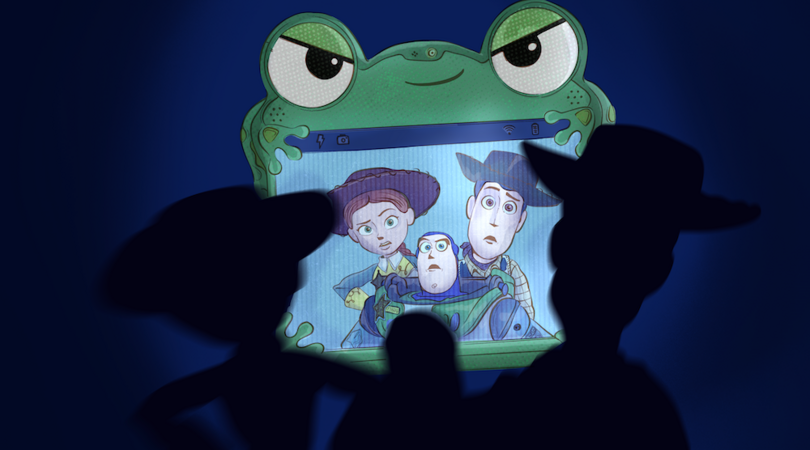
As the only kid on the block without an electronic device, Bonnie’s parents hesitantly gift Bonnie — now 8 years old — a green tablet with frog-like features named Lilypad (Greta Lee). Bonnie becomes fixated on Lilypad (sound familiar?), choosing the device over toys. But Lilypad allows Bonnie to connect with girls from her dance class, something her toys can’t do, and Bonnie gets invited to her first-ever sleepover.
Jessie, concerned about Bonnie’s lack of interest in her toys, consults Woody by walkie-talkie. Woody mistakenly thinks Jessie needs him to return to Bonnie’s house, resulting in his reunification with the gang.
Before Bonnie leaves for the sleepover, Jessie and her trusty horse, Bullseye, sneak into her suitcase. On the way there, Bonnie opens her suitcase and discovers the two toys. When Bonnie arrives at the sleepover and introduces Jessie and Bullseye to her “friends,” they laugh at her, which makes Bonnie tell her dad (Jay Hernandez) to drive Jessie and Bullseye home.
Jessie and Bullseye escape from the moving car, but they’re found on the sidewalk by an older couple. After noticing an address written on Jessie’s pant leg, the couple brings them to the childhood home of Jessie’s original owner, Emily. While Jessie and Bullseye attempt to return to Bonnie, Woody and Buzz are on a mission to find them.
For the first time in the series, Jessie is the lead — not Woody or Buzz — and it was refreshing. Cusack’s high-spirited voice acting fills Jessie with an incredible sense of adventure.
In potentially my favorite scene, Jessie and Bullseye encounter a full-sized horse, Daffodil, upon arriving at Emily’s former home. The moment is brilliant. Bullseye interacts with his real-world counterpart, and the audience gets a glimpse into Pixar’s 31-year evolution of “Toy Story” — going from the bare-bones animation style of Scud the dog in the original film to featuring a visible vein on Daffodil’s face. And Jessie belts out her exuberant trademark, “Yee-haw!”
It may seem disheartening that Woody and Buzz take more of a backseat role, but co-directors Stanton and Harris still make our esteemed sheriff and space ranger pivotal to the film with their attempt to rescue Jessie.
The heartbeat of “Toy Story 5” is Jessie processing the trauma of Emily donating her, which Jessie first described in a soul-crushing montage in “Toy Story 2.” When Jessie and Bullseye reach Emily’s former home, Jessie notices the words “Jessie was here” carved into the bark underneath the tire-swing tree where Emily used to play.
Jessie then unearths a lunch box that contains childhood keepsakes and a photo of grown-up Emily and her daughter, who she named after Jessie. It’s a more than worthy addition to the list of tear-jerking “Toy Story” scenes and the film’s only moment that matches the original trilogy’s emotional weight.
Though Stanton and Harris achieve incredible emotion, it takes roughly an hour of buildup, whereas “Toy Story 2” only needed a three-minute montage to give you a reason to grab a box of Kleenex.
To be fair, “Toy Story 2” is my pick for the greatest animated movie ever, but reopening Jessie’s past trauma led to some disjointed sequences.
Blaze (Mykal-Michelle Harris), the child who lives at Emily’s former home, finds and plays with Jessie and Bullseye — something the toys haven’t experienced since Lilypad arrived. With help from three of Blaze’s outdated electronics — Smarty Pants (Conan O’Brien), Atlas (Craig Robinson) and Snappy (Shelby Rabara) — Lilypad receives a photo of Jessie and Bullseye’s whereabouts. Bonnie and her mom (Lori Alan) take a trip to retrieve them, but because of Bonnie’s friends’ mean remarks, Bonnie tells Blaze to keep the toys.
When Bonnie and her mom drive away, the distraught Jessie has a flashback to Emily leaving her. After being donated, Jessie didn’t know what her future held (it could’ve been a landfill). When Bonnie decides she doesn’t want Jessie and Bullseye, the toys still have Blaze, who genuinely enjoyed playing with them.
Stanton and Harris frame Bonnie leaving as equivalent to when Emily donated Jessie, and it simply isn’t. That’s the problem with “Toy Story 5.” Stanton and Harris emulate the charm of the original trilogy, but they consistently play it safe. Though their writing is well executed, the plot often feels underwhelming and lacks risk-taking.
“Toy Story 5” serves as an effective cautionary tale on the dangers of overusing electronics for adults and children. The movie constantly shows characters glued to their screens — someone in my theater was, too — and we see Bonnie’s social anxiety and isolation grow after she receives Lilypad. The problem? Lilypad is predictably portrayed as one of the heroes in the end.
After Lilypad realizes the emotional damage she’s caused Bonnie by connecting her with judgmental friends, Lilypad tries to donate herself. However, Jessie thinks Lilypad can help make Bonnie a friend by sending a message to Blaze. The gang retrieves Lilypad from the donation truck with help from the Hi-Tech Edition Buzzes, which fly the toys to safety.
Stanton and Harris don’t provide anything new by showing Lilypad as a hero; the 180-degree shift only dilutes a clever setup. Even if the goal was to show that technology isn’t entirely bad, that message is already achieved through Smarty Pants, Atlas and Snappy. And while the social commentary is generally great, these new characters further prove why the franchise should’ve concluded on its perfect ending with “Toy Story 3.”
“Toy Story 4” introduced Forky (Tony Hale), and although I dislike the existential-minded spork, his useless role in “Toy Story 5” was more disappointing. Now, we’ve been granted more one-note characters that will become throwaways, including the Hi-Tech Edition Buzzes that were mere plot devices. It’s a shame considering “Toy Story 2” introduced Jessie and Bullseye, characters who spearheaded this movie 27 years after their debut.
I have plenty to nitpick about “Toy Story 5,” but it’s because I hold these films to a high standard given the incredible original trilogy.
Even if “Toy Story 5” doesn’t live up to that standard, its nostalgic callbacks, breathtaking animation, relevant themes and development of Jessie and Bullseye make it a worthy entry in the franchise.