Q&A: ECS interim dean discusses new AI programs, goals for school’s future
Get the latest Syracuse news delivered right to your inbox.
Subscribe to our newsletter here.
As artificial intelligence begins to impact industries worldwide, Syracuse University, along with over 350 institutions across the country, are rapidly introducing programs aimed at preparing students for the constantly evolving job market.
After introducing a few programs last academic year, the list of faculty-led AI majors, minors, online degrees and certificate programs at SU is now 14, including specialized uses on policy, business and data. The list reaches six different schools – College of Engineering and Computer Science, Newhouse School of Public Communications, Whitman School of Management, School of Information Studies, College of Professional Studies and Maxwell School of Citizenship and Public Affairs.
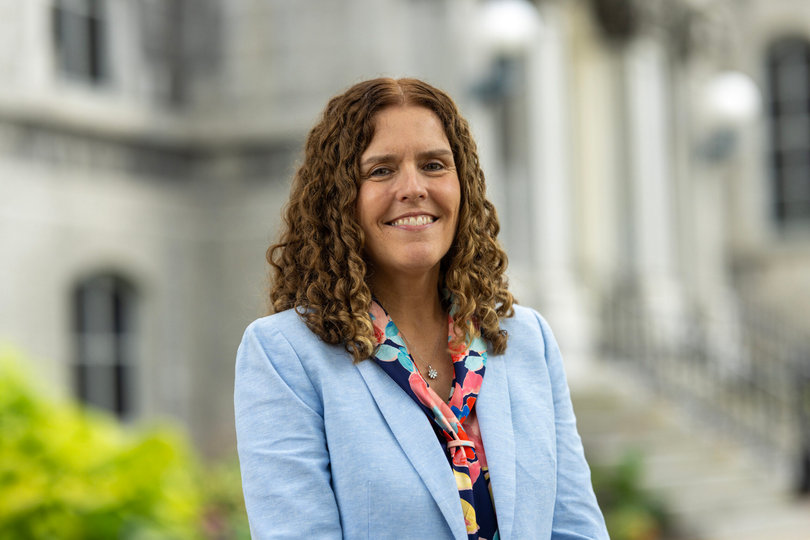
Arriving at SU 26 years ago as an assistant professor in biomedical engineering, Associate Provost for Academic Programs and ECS Interim Dean Julie Hasenwinkel heard from ECS and iSchool faculty firsthand about their interest in creating AI programs at SU. Through her work with ECS and university administration, Hasenwinkel gained unique insight into the process for introducing new programs, as well as gaining approval from the New York State Department of Education.
As interest in the programs increases, The Daily Orange sat down with Interim Dean Hasenwinkel to provide a glimpse into AI’s newfound presence on campus as students begin their classes this fall.
The D.O.: What are your thoughts on the influx of AI programs university-wide?
Hasenwinkel: We’ve approached it from the strategic standpoint of having a technically based AI program, which is ECS, and then having the AI program in the iSchool that’s really more the integration of technology and society. There are minors that have popped up in many of the schools and colleges, and I expect that to continue to grow, and those minors are incorporated in the integrative AI program.
I think our overall strategy was to not create AI majors everywhere, but (instead) ‘let’s have two programs that are different and distinctive that could give any student with an interest an opportunity to study AI.
I think a lot of students will choose to do minors that are related to AI and add them on to other majors. And I think there’s also a lot of faculty (who) are starting to incorporate aspects of AI into their teaching at the course level to help students develop those skills or to understand how AI is impacting the particular field of study that they’re working in. There’s the degree level, the minor, the course level and recognizing that creating opportunities for our students to be educated, both in the usage of AI, but also in the critical thinking around how to use AI. What should we develop? How far should we push the boundaries? What kinds of policies should be put around it? All of those things, I think, are important for areas for us to give students an opportunity to be educated in.
The D.O.: What does student interest and enrollment look like for these AI degrees and minors?
Hasenwinkel: The nature of the development of the programs and the approval process was such that we couldn’t actually advertise them until they were approved by the state, which didn’t happen until this summer. So, these programs were not on the Common App last year. Students can’t apply to them. No students have been admitted into them yet.
This year is really a year where we are starting to teach the courses in the programs and trying to attract students into them, and now starting to heavily advertise them for the next recruitment cycle.
The D.O.: Has the university hired any new ECS or iSchool faculty or staff members to work on the new programs?
Hasenwinkel: No, we actually haven’t hired any new faculty or staff for either program because there was a good nucleus of faculty already here that are able to teach in both programs.
But I think there’s a lot of research interest building in the AI space, both in ECS and more broadly at the university. And so I think down the road it’s an area that we look to grow, and as these programs grow, if they really blossom and take off, then that will be a good case for hiring additional faculty in these areas.
WHAT YOU SHOULD READ NEXT
SU’s AI degrees aim to responsibly prepare students for evolving job market
As part of its “larger AI push,” Syracuse University is introducing three new AI degree programs, all available to students this fall.
The D.O.: Have you received or heard about any pushback from any faculty or staff about these programs?
Hasenwinkel: Not that I’m aware of, but I have primarily been working with people that have been involved in building it. I think there’s always concern about new things and where we’re placing our resources. I would say there’s probably been a little more pushback on the student side.
AI is polarizing, but we also got some great student feedback on the integrative AI program while we were in the process of developing it. That was really helpful for the faculty to incorporate and think about feedback. I think that’s something that we should get in the habit of doing, like involving our students in the process of building our curriculum to understand their perspectives and what is attractive to them (and) what kinds of things they’re looking for in programs.
The D.O.: How does ECS plan to balance regulating unauthorized AI use among students while also offering the degree and minor programs?
Hasenwinkel: I don’t think that’s just an ECS issue. In the degree programs, it’s less about learning how to use AI and more about learning how to design the systems that are the foundation for AI.
We have an academic integrity policy at the university that spells out what students are allowed to do in certain courses, and as you might imagine, it’s challenging to enforce that. I think what we really should be focusing on is educating students on the ethical use of AI, giving them opportunities to learn how to use it, embedded in coursework and also in academic programs and also creating opportunities for students to demonstrate their own authentic learning in ways that they can’t use AI to do it.
It’s not unlike any other tool that has emerged over time, like the internet, the smartphone. There’s always a way to cheat or use unauthorized aids if you want to. But we also want to incentivize our students that the end goal here is really learning, and you’re cheating yourself from a learning opportunity if you’re relying on AI to do your work.
The D.O.: What goals do you have for the future of the AI programs?
Hasenwinkel: I think the main goal is that these programs flourish, that they attract students, that we have really strong applicants. When you attract a lot of applicants, then you can be selective and take the best ones.
Right now, we have a couple years before we’re producing graduates, and so the focus is on getting students in the door and starting to educate them. But it’s also our responsibility to prepare them so that they can be successful and so that they are able to get good jobs or go on to graduate study or whatever their goal is.
The D.O.: What are you looking forward to this fall semester?
Hasenwinkel: I’m most looking forward to being able to help ECS continue to build and strengthen. I think there (are) so many great things that go on within the College of Engineering and Computer Science, and sometimes we don’t do a good enough job telling our story and making (sure) students within the university, prospective students outside of the university, really understand what’s special about us, and so we are working on that.
So, being able to play a part in that as the interim dean is something that is particularly motivating for me.