SU must underscore professional development across all majors

Get the latest Syracuse news delivered right to your inbox.
Subscribe to our newsletter here.
Last April, I took an immersion trip to New York City. The trip was hosted by Syracuse University’s Bandier Program and Whitman School of Management.
Over three days, my group was tasked with building a business pitch from the ground up. We presented our ideas to investors who offered industry-level feedback.
When we weren’t working in groups, students networked with senior professionals across industries, spanning investment banking, venture capital, independent and major music labels and other media fields.
On the bus ride back to Syracuse, I kept wondering why I’d never experienced anything like this through my home college, the College of Arts and Sciences.
My psychology major has its own immersion opportunities, but my three days in NYC felt different. I wasn’t simply learning about careers — networking was built into the experience. Throughout my four years at SU, I hadn’t experienced anything comparable through the Arts and Sciences program.
That made me wonder whether students across SU are really being given equal opportunity to become career-ready.
So, I started asking. I reached out to 14 university offices and programs. Eight responded.
I found that schools at SU are giving their students the tools to succeed post-grad. Internships, experiential learning, capstones, portfolio-building and other forms of professional development exist throughout the university.
In the College of Visual and Performing Arts, internships are required in several programs. Music education students complete student teaching, and many visual arts students develop portfolios.
Newhouse School of Public Communications students can graduate with clips, reels and campaigns created for real clients, while Falk College programs incorporate experiences ranging from capstones to clinical internships and supervised placements.
The College of Engineering and Computer Sciences has also created a formal structure for experiential learning through its Experiential Learning Milestone program. According to ECS, 87% of students completed at least one milestone, most commonly an internship. Those experiences are strongly encouraged, though not yet required across the college.
The Maxwell School of Citizenship and Public Affairs and Arts and Sciences aren’t without resources either. CareerReady offers advising, immersion trips, alumni connections, job shadowing, internships and other opportunities. But in some programs, more of the burden falls on students to find those experiences themselves.
Students from different home colleges don’t all benefit from these programs the same, though.
Over a month ago, I published a questionnaire asking SU students, alumni and recruiters across various fields to offer insight into how they view career readiness. I asked students how their home colleges prepare them for their industries, and I asked recruiters what they value in new graduates.
Amaya Saintal, a 2026 graduate who studied in the School of Education and Maxwell, didn’t have to find all of her professional experience on her own, she said. Two practicums were required for graduation. Saintal rated her program’s career preparation a five out of five and said her practicum was the most valuable part because it showed her how the field actually operates.
Abigail Aggarwala | Digital Design Director
Gavin Morales, a junior studying in the School of Information Studies, experienced a mix of institutional support and initiative. Emails from his adviser helped connect him to a Deloitte apprenticeship and Synchrony externship, while he pursued entrepreneurship and side projects independently.
Morales rated his program’s career preparation a four out of five, but said a lack of connections remained his biggest barrier. He wanted more opportunities for students to interact directly with employers and recruiters.
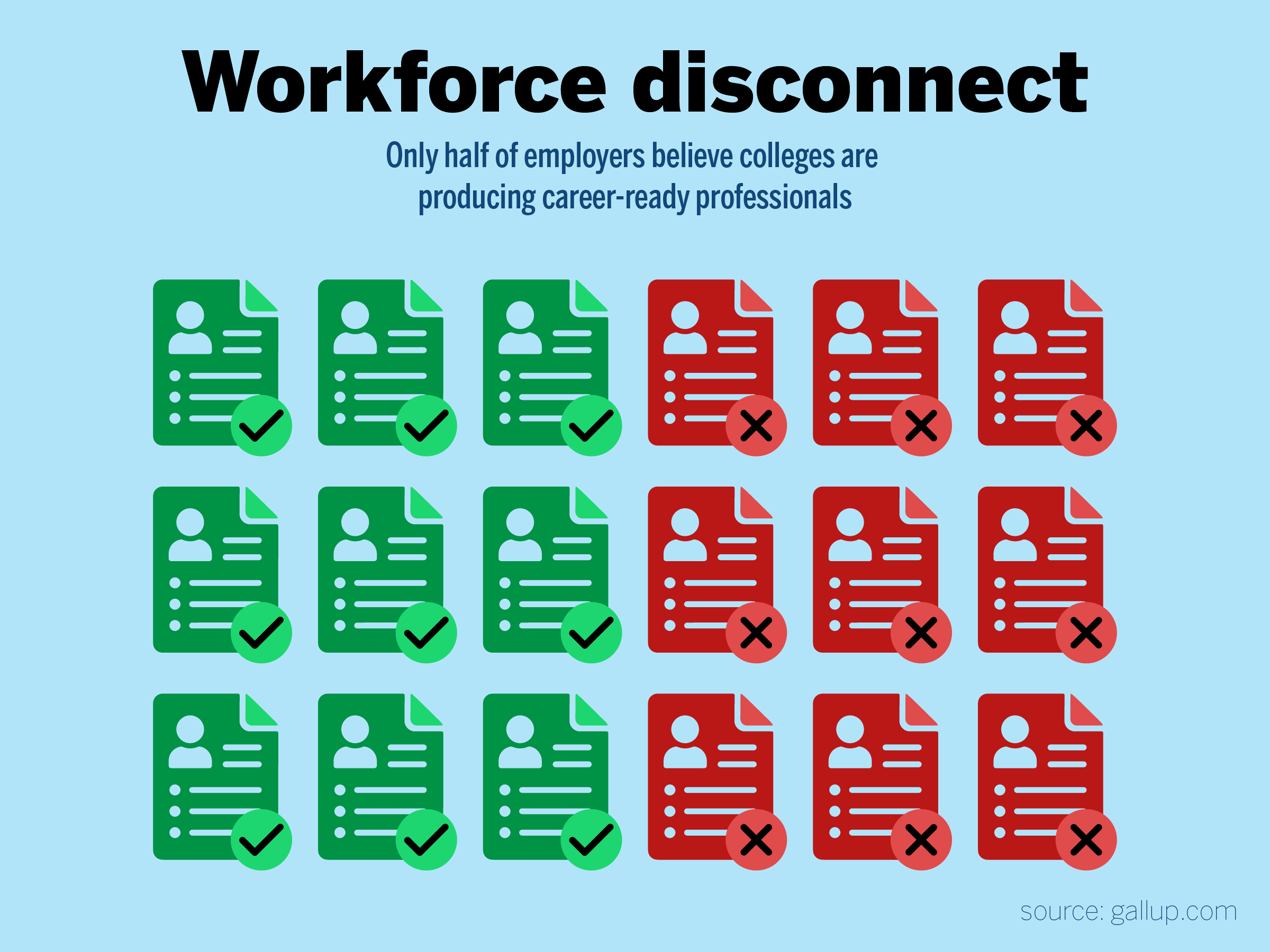
But whether students feel prepared is only one side of the equation. Employers ultimately decide what preparation is valuable once students enter the job market.
To understand career readiness from the other side of the hiring process, I surveyed five recruiters, founders and hiring professionals. Despite their different backgrounds, their answers indicated they value similar qualities: communication, initiative, adaptability, judgment, networking and a candidate’s ability to demonstrate their own experience.
Melanie Vernoia, an SU alum and co-founder of Stacker, a digital media company that produces data-driven journalism and distributes the stories to news outlets, told me that when evaluating recent graduates, intelligence, attitude, communication and interview performance can outweigh extensive professional experience. Resumes and internships still matter, but Vernoia heavily emphasized that relationships and how candidates present themselves can matter even more.
Arianny Mercedes, founder and principal consultant of Revamped, a career and workplace consulting firm, defined career readiness as the ability to articulate one’s value and turn experience into demonstrated capability. She also cautioned employers against confusing accumulated opportunity with underlying potential, arguing that career preparation should begin early and be built throughout college.
That distinction matters because students don’t enter college with equal access to professional opportunities. As a first-generation college student, I’ve had to create much of my own roadmap. I didn’t arrive at SU already knowing how internships, networking or professional relationships worked.
Other hiring professionals raised similar concerns about access. Talent acquisition professional Tiffany Pitts pointed to unequal access to paid internships, mentorship and employer connections, while Jodi Swaby, an executive recruiter with The People Studio, identified finances, geography and institutional networks as factors that can shape a student’s professional opportunities.
This is where SU’s uneven approach to career preparation becomes consequential for students. Telling students that internships, networking and professional experience matter assumes that every new student knows how to find those opportunities — or has the time, money and connections necessary to pursue them.
When professional development is built into a degree, students enter the workforce with a head start. A practicum, client project or structured networking experience puts students in situations where they can begin developing those skills. When these experiences are optional, students become disadvantaged.
SU doesn’t need to make career preparation identical across every school. Television, social work, engineering and psychology students are all preparing for different professions.
Their experiences should reflect that.
But every student should graduate having completed at least one meaningful experience that requires them to apply what they’ve learned beyond a traditional classroom assignment — whether through a practicum, research project, portfolio, client project, internship or another form of experiential learning.
Students should also receive structured opportunities to learn how to network, articulate their skills and navigate the hiring process before senior year.
On that bus ride back to Syracuse, I reflected on the immersion trip. I went into the experience not knowing much but left grateful, feeling like SU put me into a position to succeed.
Every student doesn’t have the same route to success, but they all deserve a clear path to it.
Trayson Blain is a senior majoring in psychology. He can be reached at tblain@syr.edu.