To improve on 2025, SU’s forwards must provide more attacking potency

Get the latest Syracuse news delivered right to your inbox. Subscribe to our sports newsletter here.
All things considered, Syracuse men’s soccer had a solid 2025 campaign.
Following a season without an NCAA Tournament appearance, Ian McIntyre’s side secured one after reaching the Atlantic Coast Conference Tournament Semifinals. While the Orange sputtered out late, there were clearly identifiable areas of the pitch that explained Syracuse’s success. Its forward line wasn’t one of those areas.
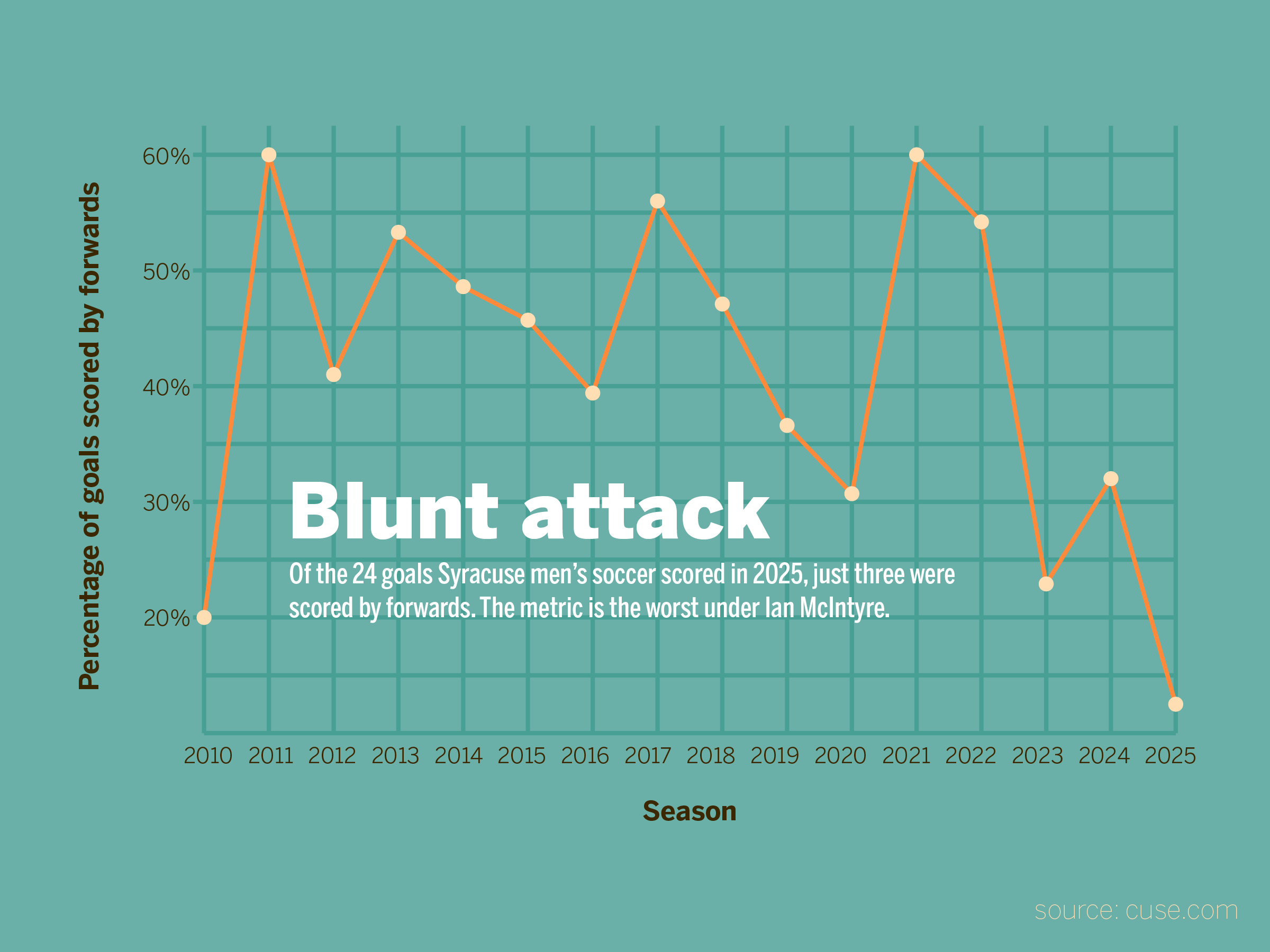
Syracuse’s five forwards — Michael Acquah, Bright Nutornutsi, Emanuel Cappello, Callum Lugton and Sachiel Ming — combined for just four goal contributions (three goals, one assist) in 2025. That wasn’t only SU’s worst mark in McIntyre’s 16-year tenure, but the fewest in the ACC by six, behind Clemson’s 10. To address the lack of front-line production before the 2026 season, which begins Thursday against UConn, McIntyre added three strikers.
Jordan Grey, Dakota Jonke and Pedro Gulli were involved in Syracuse’s three preseason matches, with Grey and Jonke scoring in wins over Marist and Mercyhurst. Though some of its exhibition results have been “flattering,” McIntyre has learned more about his team and his new No. 9s each match.
“If we get good service into these players and put talented players around them, I think all of them can score goals,” McIntyre said.
Grey, a 6-foot-6 striker from Ajax, Ontario, played his first collegiate season at the University of Toronto. With the Varsity Blues, Grey scored nine goals in 11 starts and was named the Ontario University Athletics East Rookie of the Year.
Abigail Aggarwala | Digital Design Director
The sophomore is a threat anywhere near the 18-yard box, especially when the ball is on his left foot. In the OUA Championship Semifinal, the ACC Tournament equivalent, Grey scored twice — on a header off a corner and a driven left-footed finish just outside the 18 — to help Toronto advance to the final, which it won.
Syracuse recruited Grey out of high school and kept tabs on him at Toronto. With Syracuse, he’s started strong after scoring a penalty versus Marist and a well-taken poacher’s goal against Mercyhurst.
McIntyre said Grey’s athleticism and size give him “a very high ceiling” at SU.
Jonke, by contrast, is a plug-and-play acquisition. The only one of the three with U.S. college soccer experience, Jonke has “always been a difficult player to play against,” McIntyre said.
The 6-foot-2 Avon, Ohio, native played Syracuse in 2025 with Duquesne and in the 2022 NCAA Tournament Sweet 16 with Cornell. Across his four-year college career, he’s totaled just 11 goal contributions, as his role significantly decreased in his second year at each school.
Still, Jonke is an instinctive finisher who can score from open play — as highlighted by his first SU goal — and dead-ball situations with both feet. His ability to make darting runs between the full back and center back fits SU’s style of playing through the middle of the pitch.
“Having that experience coming back as a fifth-year player is vital,” McIntyre said.
Gulli was another experienced Canadian player that Syracuse followed last year. A McGill University alum, Gulli scored three goals in nine matches for the Redbirds in 2025. His sheer pitch presence, accentuated by his 6-foot-3 stature, rapid pace and nifty footwork, adds another “dangerous dimension” to McIntyre’s attack, which suits Gulli’s will to press from the front.
Most importantly, the three give Syracuse depth to rotate up top. While midfielder Carlos Zambrano almost acted as a striker, Landon Darko and Ming were the most potent and dangerous attacking forwards last year. But if that well dried up, the Orange’s scoring also did. Five of SU’s nine wins in 2025 came by one, and it often relied on defenders Tim Brdaric and Chimere Omeze to score frequently and importantly.
Syracuse may not have multiple forwards with 10-plus goals as it did in 2022 with Nathan Opoku and Levonte Johnson. But if they provide more of an attacking threat in 2026, McIntyre’s squad should improve.
“It’s going to take a little time to develop relationships to get the best out of this attacking group, but it’s been a good start,” McIntyre said. “Let’s see how it goes.”