The decades-long partnership that transformed Syracuse men’s soccer

Get the latest Syracuse news delivered right to your inbox. Subscribe to our sports newsletter here.
Over the last 16 years, Jukka Masalin and Ian McIntyre have figured out exactly where they fit best.
Masalin has sharpened Syracuse’s goalkeepers after playing the position professionally in Europe. He’s an integral part of SU’s recovery and fitness, drawing on his experience as an exercise science major at Lander University. As a youth coach for Syracuse Development Academy, washing pinnies and setting up cones are second nature to him.
Masalin’s flexibility has made him the ideal associate head coach. But he’ll leave the spotlight for his longtime coaching partner and good friend McIntyre.
“If I’m honest with you, I’d rather be the supporting guy,” Masalin said. “I’d rather work in the background.”
“It’s like being a married couple,” McIntyre said of his relationship with Masalin. “You get used to one another and how that individual can support you and challenge you. That relationship has developed and changed.”
Every fall since 2010, McIntyre and his “right-hand man,” Masalin, have shared the sidelines at SU Soccer Stadium. They both admit there’s no one without the other, and their players admit there’s no Syracuse men’s soccer program — at least not one that’s as good as it is — without both of them.
They’ve reached the pinnacle of Division I soccer, winning a national championship in 2022, and they’ve spent years as cellar dwellers, posting five wins across 2010 and 2011 as they tried to spark a paling program. And they have.
“They’ve really turned (Syracuse) into a national title contender year after year,” said D.C. United goalie Alex Bono, who played for SU from 2012-14. “The fact that they’ve been able to sustain the success they’ve had speaks to the character of both of them.”
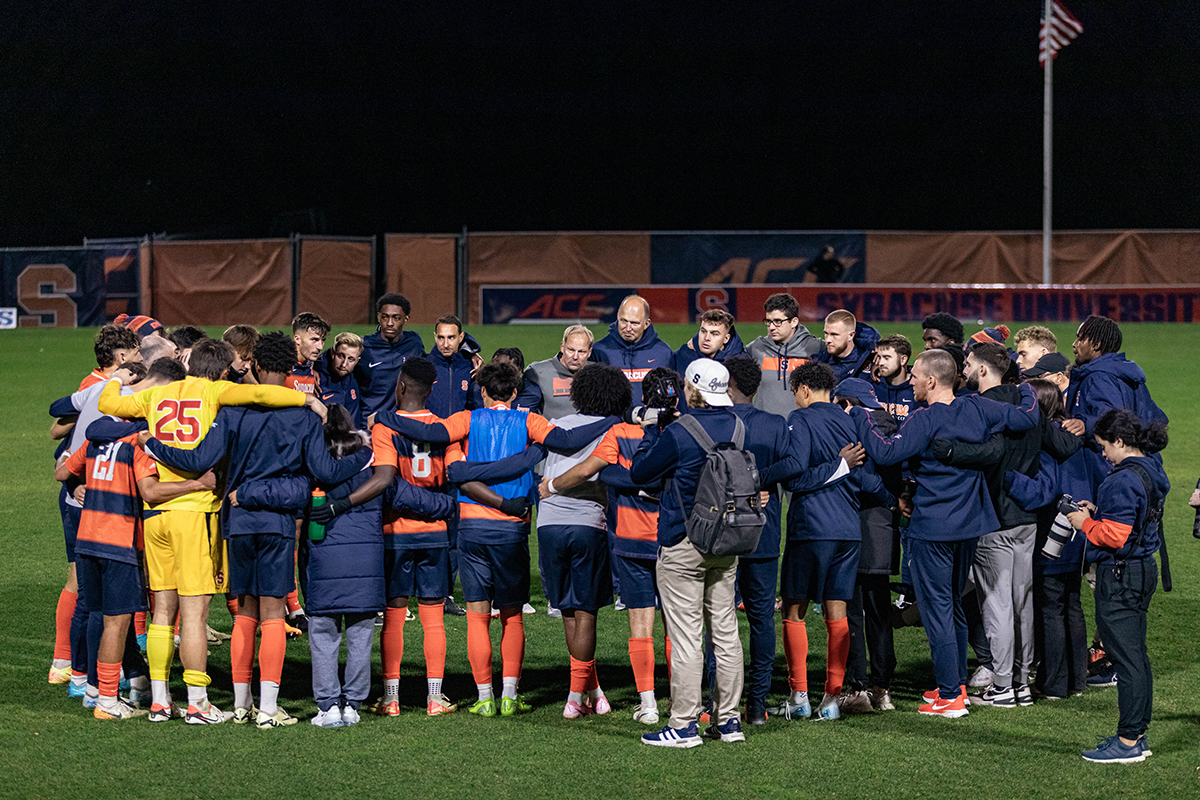
Syracuse men’s soccer groups together on the SU Soccer Stadium grass. Led by Ian McIntyre and Jukka Masalin, the Orange have gone 148-107-53 in 16 seasons. Joe Zhao | Daily Orange File Photo
Syracuse is 148-107-53 in McIntyre and Masalin’s 16 seasons. The coaching pair were part of the 2022 United Soccer Coaches National Staff of the Year and the 2012 Big East Coaching Staff of the Year. They’ve become so close that McIntyre says he speaks “Jukka,” a language full of “Jukkarisms.”
With their 17th season at Syracuse — and 19th together — beginning Thursday against UConn, the duo is focused on leading the Orange to their fourth winning campaign in the last five years. Ask them to reflect on their time together, though — even just those five seasons — and they’ll pause. The words don’t come immediately.
“I think we’ve both grown and evolved,” McIntyre hesitates. “The years go pretty quickly.”
Nineteen years ago, the two were supposed to meet on opposite sidelines. But one dire phone call from Masalin to McIntyre laid the groundwork for their future together.
In 2008, Masalin’s Rochester Rhinos were scheduled to face McIntyre’s Hartwick Hawks in the preseason. McIntyre was a Hall of Famer at Hartwick, a D-III program in Oneonta, New York. He played four seasons with the Hawks before coaching for seven.
Masalin’s Rhinos were a member of the USL First Division, a professional league in the United States’ second tier — just below MLS. Not long before their matchup, Masalin shared some unfortunate news with McIntyre.
“Listen, we are canceled. Sorry man. We have no players, no more club existing.”
The Rhinos declared bankruptcy. Masalin lost his job. He expected a simple response and maybe some condolences from McIntyre. Instead, he virtually received a job offer.
“What are you doing now?” McIntyre asked.
“I’m going to find a job, and let’s move on.”
“I need an assistant coach. You want to drive down and have a chat?”
Three hours from Oneonta, Masalin barely hesitated.
“I’ve never done anything else in my life except soccer,” Masalin said. “The game is my passion.”
The two talked for hours in McIntyre’s Hartwick office. They discussed the possibilities of joining forces. McIntyre described the interaction as a step outside of his comfort zone, having previously hired coaches he played with or met along the way. But Masalin “brought in a different pair of eyes, a different philosophy and a freshness that challenged me,” McIntyre said.
Masalin returned home, discussed the meeting with his wife Carmen and accepted McIntyre’s offer.
“When one door closes, another one opens,” McIntyre said. “We were so fortunate to pick up Jukka.”
Two years and 17 wins later, McIntyre left Hartwick for Syracuse. And with him came Masalin. Their journey with the Orange hasn’t been as easy. McIntyre wasn’t a local legend like at Hartwick, and at a D-I program, the coaches’ roles and resources expanded.
I think we’ve both grown and evolved. The years go pretty quickly.Ian McIntyre, Syracuse head coach
When they arrived at SU, Masalin carried a clicker, the old-fashioned kind baseball umpires often use to count pitches. He paced the sidelines every game, clicking the button for each completed pass. Over a decade later, he says the analytics have improved, but he and his partner remain as busy as ever.
“We wore many hats,” McIntyre said. “We still wear many hats.”
Their first two seasons at SU were challenging, but they shared future goals. They wanted to keep central New York kids in Syracuse. They wanted to connect with the community. They wanted to bring a winning culture to the Orange (SU had finished above .500 once in the previous 10 seasons).
Bono remembers the calls, when McIntyre insisted wins were coming. Being from Syracuse, Bono had no reason not to believe him.
“It’s a leap you have to take. You have to believe that what they’re saying is actually going to happen and you want to be a part of the solution,” Bono said. “And that made it a lot easier to join the project.”
Bono posted three All-American campaigns before forgoing his final season of eligibility to join MLS’ Toronto FC. As he watched Syracuse from afar, he missed conversing with Masalin and McIntyre. Masalin, a former international goalie, worked closely with Bono, who gravitated to Masalin’s “comfortable intensity.”
“Coach Mac is the stern parent, and Jukka is the one you ask to stay over at your friend’s house and let him soften the blow to the one you’re more afraid to talk to,” Bono said.
More than anything, Bono regrets missing his senior dinner, an annual meal hosted by Masalin with the team’s graduating class. It’s often dubbed the “Jukka Dinner.”
Carmen cooks “amazing Cuban food,” said Andre Cutler-DeJesus, who played for Syracuse from 2023-24. Max Kent, an SU defender from 2020-21, said there was lots of food, drinks and conversations with coaches-turned-friends.
“When you get to Syracuse, you have to know you’re entering Mac’s team,” Kent said. “Jukka is the mastermind next to him who’s thinking about how to get the best out of his players, physically, mentally, emotionally, so they can execute as a group.”
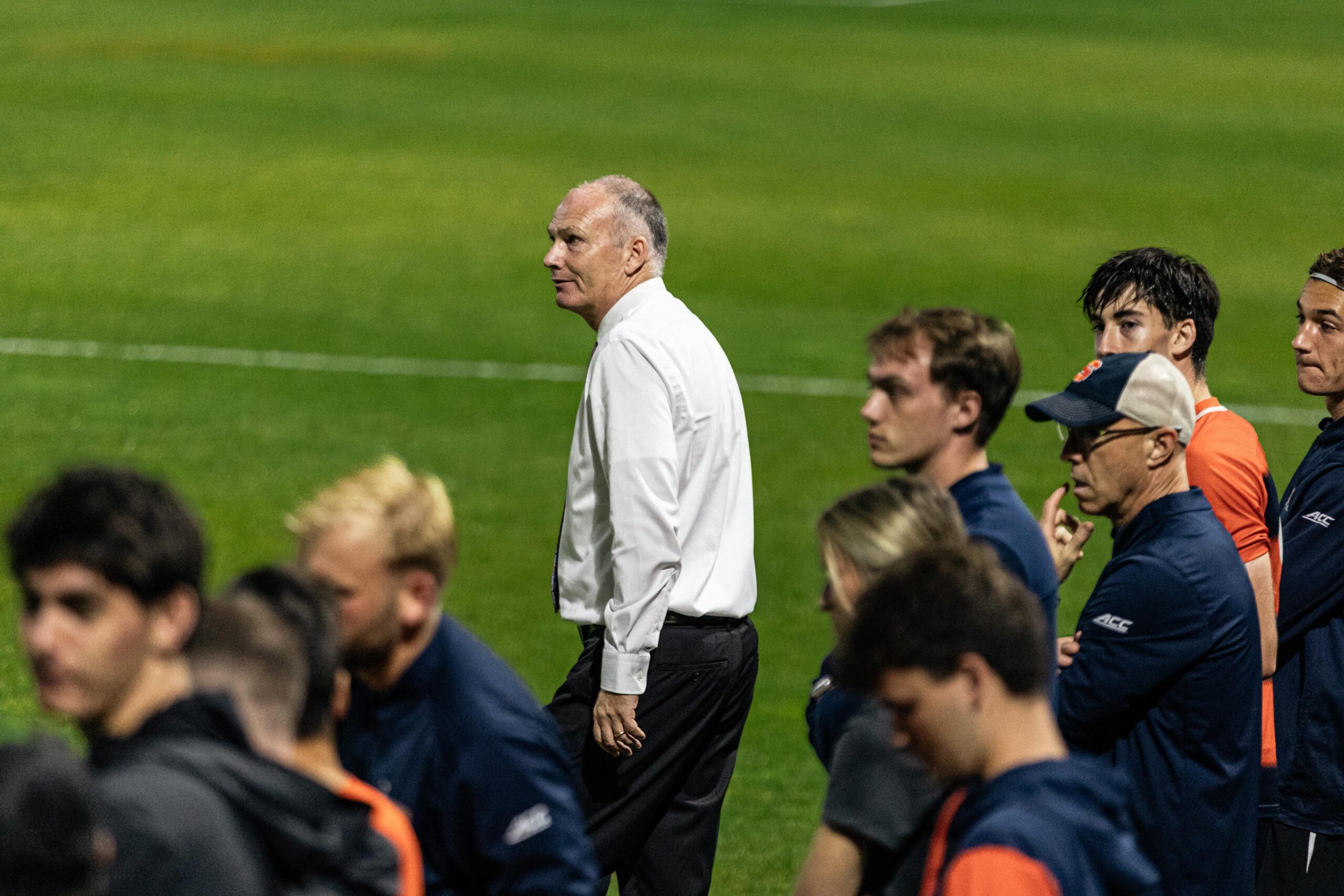
Ian McIntyre eyes the field during Syracuse’s win over Colgate on Sept. 23, 2025. McIntyre began his head-coaching career in 1998 and moved to SU in 2010. Joe Zhao | Daily Orange File Photo
Masalin’s approach includes being blatantly honest. Sometimes that means serious conversations, like when, at one of those dinners, he told Cutler-DeJesus he received head coaching opportunities elsewhere but declined them to remain with the Orange. Other times, his blatant honesty is a simple gesture after an enthusiastic McIntyre halftime speech.
“I’ve never seen someone who’s been able to understand a person more than Jukka understands Mac,” Cutler-DeJesus said. “Seeing their relationship, how they’ve been able to grow teams, grow players, it’s unbelievable. You can just tell they’re a perfect pair.”
Bono can’t recall the specifics, but in a nonconference match early in his career, he remembers solemnly walking across the pitch to the Orange’s makeshift halftime locker room. The gameday locker rooms in the fieldhouse weren’t built yet, so Syracuse entered a 12-by-12 canvas tent, lined with string lights and support beams to withstand inclement weather.
SU was trailing 2-1 to what Bono called an “inferior opponent.” As McIntyre stepped in, his whiteboard in hand — which Bono said he brought everywhere — he rattled off a passionate speech. McIntyre dropped the whiteboard, kicked it across the tent and nearly hit a player.
The board landed against the side of the tent. McIntyre’s yelling continued.
When the speech finally concluded, Bono looked to Masalin. There he was, leaning against the support beams, nodding his head in agreement before raising his eyebrows and shrugging at Bono as if to say, “What the f-ck did you expect?”
Syracuse came back to win.
“(McIntyre has) always been that very stern, that tough voice, that driving force that holds the standard at Syracuse because that’s what the program has thrived on for over a decade now,” Bono said. “But you might walk home with a little bit of anger in your heart for Jukka at the same time.”
That frustration, Bono says, never lasts long. The next morning, McIntyre and Masalin will reconvene at the field. McIntyre jokes he doesn’t know Masalin’s schedule, but it’s practically ingrained in his mind at this point.
Players will trickle in shortly after, and the two coaches will fall into the same shorthand they’ve followed for years. From there, Masalin and McIntyre split into separate directions. They lead separate groups doing separate tasks.
Neither one needs to check on the other. Masalin stays in the background. McIntyre takes the spotlight — it’s an unspoken agreement. They’re right where they belong.