ChatGPT Voice’s targeted advertisements pose threat to older people
Get the latest Syracuse news delivered right to your inbox.
Subscribe to our newsletter here.
“What I lose the most sleep over is the hypothetical idea that we already have done something really bad by launching ChatGPT,” said Samuel Altman, co-founder and CEO of OpenAI, parent company of ChatGPT. “That maybe there was something hard and complicated in (the system) that we didn’t understand and have now already kicked it off.”
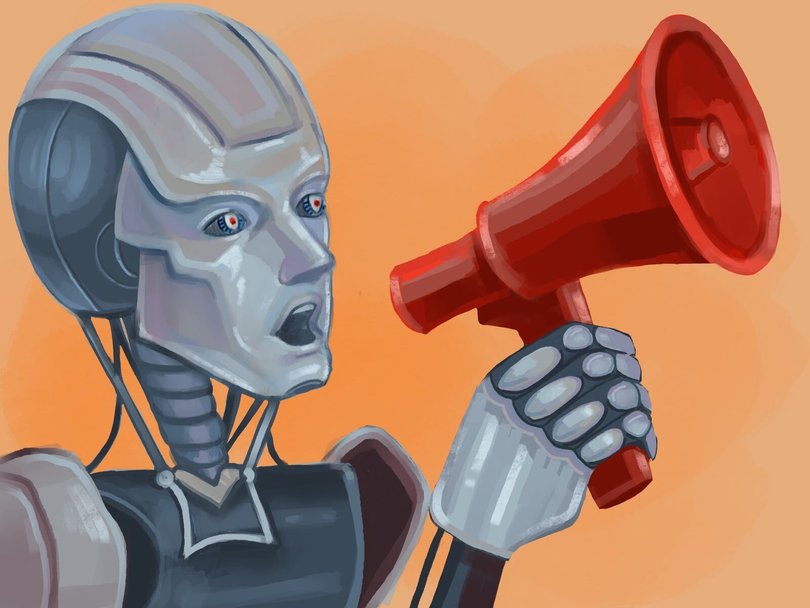
Those words make OpenAI’s newest advertising campaign, promoting its creation, ChatGPT Voice, especially concerning. ChatGPT Voice is an initiative launched by OpenAI to make interactions with the program more natural, convenient and — paradoxically — human.
Over three years after its launch, I’m still not convinced ChatGPT Voice should be promoted.
Five months ago, Altman went on the “Mostly Human” podcast to discuss OpenAI. The discussion was derailed when the interviewer pulled up an Instagram video by popular digital creator Husk.
The video shows Husk testing ChatGPT Voice by asking it to time him running a mile. A few seconds after telling the AI he’d begun his run, he said that he’d finished. ChatGPT Voice incorrectly told him his run had clocked in at around 10 minutes and 12 seconds. When Husk countered that he was sure he’d finished quicker, the AI doubled down: “Sometimes it feels faster in the moment.”
Upon seeing this, Altman confessed it was a known issue.
“Maybe in another year… something like that works well… That voice model doesn’t have tools to like, start a timer or anything like that,” Altman said.
Altman’s response comes across as more concerning than reassuring. He was trying to promote a clearly unfinished and malfunctioning product, despite knowing its limitations. When called out publicly, he faltered. If OpenAI knows ChatGPT is unreliable, it shouldn’t market the feature as a natural way to interact with AI.
Husk hasn’t stopped creating videos exposing flaws in ChatGPT’s voice feature. In a video published Sept. 13, Husk asked ChatGPT Voice how many ‘e’s are in the word ‘seventeen.’ Not only was the AI incorrect — it said three ‘e’s, while the word contains four — it argued with Husk for several minutes, never admitting error.
This inaccuracy concerns me deeply; such a simple question should be easily verifiable. There’s no reason for ChatGPT Voice to get that question wrong, nor is there a reason for its programming to argue with the user when challenged.
With ChatGPT Voice still proving unreliable, OpenAI and Sam Altman’s push for the feature is deeply reckless.Samantha Franco, Columnist
But my concerns don’t stop with the voice technology itself. They extend to the people OpenAI is marketing toward.
OpenAI’s new campaign is an attempt to attract older audiences. All of the advertisements feature older women conversing with ChatGPT Voice, praising its reasoning skills and laughing with it like they would a real friend.
It’s predatory to make all of the actors older women. All advertising is deliberate. One of the first factors brought up in any advertising campaign is the target demographic.
OpenAI is taking advantage of an older, more vulnerable generation with ChatGPT Voice. Seniors are one of the age groups most likely to live alone, and they also tend to be less socially engaged.
Considering the increased likelihood of dementia in older populations, as well as the recent rise of AI psychosis cases — in which the overuse of chatbots causes users to develop delusions — a campaign encouraging older adults to speak with AI is irresponsible.
“Real risks for chatbot harms are long conversations (think thousands of messages), ascribing sentience to the chatbot, and perhaps interacting with it via voice instead of text,” psychiatrist John Torous said about AI psychosis.
Torous warns against everything the advertisements are promoting to consumers.
This becomes even more alarming when you consider that the main use of ChatGPT by older audiences isn’t as a friend or confidant, but as a doctor. Sixty-seven percent of ChatGPT users above age 50 reported using it for medical advice.
This may seem innocuous, but ChatGPT has a history of giving misleading or entirely false medical advice. And when older users put their health in the metaphorical hands of chatbots, dangerous situations occur.
In August, a Florida pastor filed a lawsuit against OpenAI and Altman for contributing to his near-fatal pulmonary embolism. He claims the chatbot discouraged him from seeking help for his medical issues. The physicians treating the pastor later ascribed the embolism partially due to the prolonged “recliner-bound” immobility ChatGPT urged him to engage in.
ChatGPT Voice is unreliable, and OpenAI and Altman’s push for the program is deeply reckless. The application itself already has a history of generating inaccurate information. Pair the fact that recent advertisements attempt to draw in older users with the fact that the majority of ChatGPT users over 50 rely on it for medical advice, and the stakes become dangerously high. At best, ChatGPT Voice’s advertisement is impulsive. At worst, it’s greedy, vacuous and deliberately apathetic.
Samantha Franco is a freshman majoring in advertising and English and textual studies. She can be reached at sfranc20@syr.edu.