Common Council’s 2025 recap: Budget cuts, $1 billion affordable home project
Get the latest Syracuse news delivered right to your inbox.
Subscribe to our newsletter here.
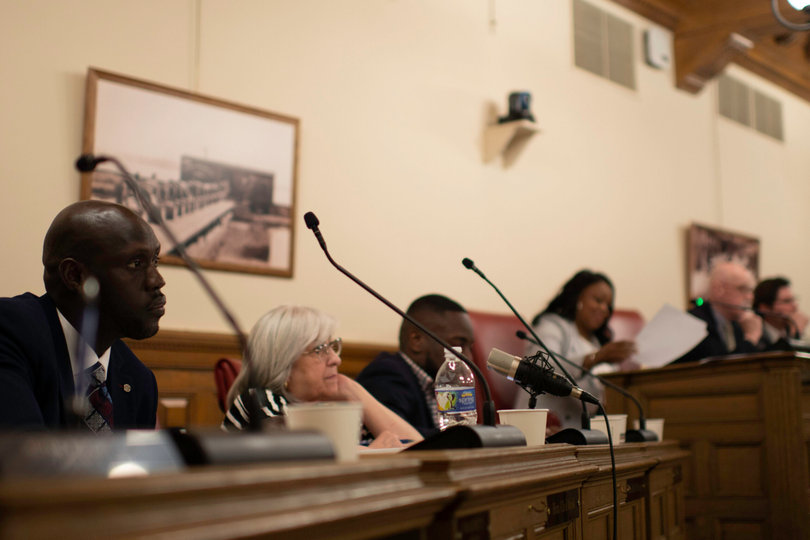
Syracuse Common Council released its first “Legislative Year in Review,” which included an overview of 2025 budget proceedings, laws passed and corresponding recommendations for the year to come.
During 2025, the council held 25 voting meetings, preceded by two “study sessions,” alongside 52 committee meetings and 34 budget hearings, meaning councilors met 213 times, according to the report. 1,400 pieces of legislation were considered and just over 1,000 of them were passed, including eight local laws and 15 resolutions.
The goal of the report is to help Syracuse residents better understand what the Common Council does, Syracuse City Auditor Alexander Marion wrote in its introduction.
“The Syracuse Common Council is a critical part of our local government. But I am often asked by members of the community: “what does the Common Council…do?,” Marion said in the report. “That’s never asked with disrespect, but genuine curiosity and a desire to better understand their local government. I often find myself asking the same question, and this report was born out of seeking those answers.”
Budget proceedings
Every year, the mayor creates a proposed budget which is presented to the council for approval. The council then holds hearings with individual departments and a later public hearing on the budget.
The council proposed the most changes to former Syracuse Mayor Ben Walsh’s $348.4 million proposed budget for 2025 in its history, resulting in a $16 million budget cut. Cuts included almost $3.7 million from the Department of Public Works, $3.5 million from the Syracuse Police Department and $2.4 million from the Syracuse Fire Department.
WHAT YOU SHOULD READ NEXT
Syracuse common council recognizes community leaders for service
Syracuse Common Council chose to recognize the community service of Fr. James Matthews and the late Mark Cass in Monday’s session.
Local laws passed
The council passed eight local laws in 2025 and Marion noted three as the most significant in the report.
A law was passed to begin construction in the East Adams neighborhood as a part of a city revitalization project. The $1 billion “neighborhood transformation” encompasses part of the historic 15th Ward area and is intended to “reconnect” the neighborhood ahead of the demolition of I-81, according to the City of Syracuse.
The plan aims to create 132 modern and affordable homes in the area, and construction began on Dec. 3, 2025, as of the last update.
Additionally, under Walsh, a land transfer agreement was reached between the city and the Syracuse Housing Authority. The land acquired by the city allows it to begin the redevelopment of the Eastwood Heights neighborhood, according to a March release.
The neighborhood has been an “important housing resource for older adults,” and SHA intends to upkeep the affordable senior housing, according to a release.
The council also approved a 2% tax on all occupied hotel rooms in the city of Syracuse. The tax is added onto Onondaga County’s existing 7% tax on occupied hotel rooms, CNY Central reported.
Councilor changes
Council President Helen Hudson, Councilor-At-Large Amir Gethers and Second District Councilor Pat Hogan are no longer a part of the council. Hudson’s term ended, Gethers did not gain re-election and Hogan made a run for mayor and lost.
Their successors include President Rita Paniagua, who ran unopposed and has served as a councilor-at-large since 2019, Hannah Ehrenreich, who was elected to the at-large seat and Donna Moore, who was elected to the second district councilor seat.
The auditor’s recommendations
At the end of the written report, Marion proposed four key recommendations for the council’s future:
- Councilors should request justification from administrations when waivers are requested, to ensure “transparency when spending public dollars.”
- There should be more meetings at night and weekends to accommodate working councilors and encourage “public engagement.”
- Councilor positions should be reworked into full-time jobs, including limits on external income.
- Non-partisan special elections should be used to fill vacancies rather than succession.
“It is my hope that this report can serve as a guidebook for citizens looking to better their understanding of government but also for those civic-minded individuals who may one day want to run for office and serve as Common Councilors,” Marion said in the report.