SU’s Creator Economy class talks social media business amid center expansion
Get the latest Syracuse news delivered right to your inbox.
Subscribe to our newsletter here.
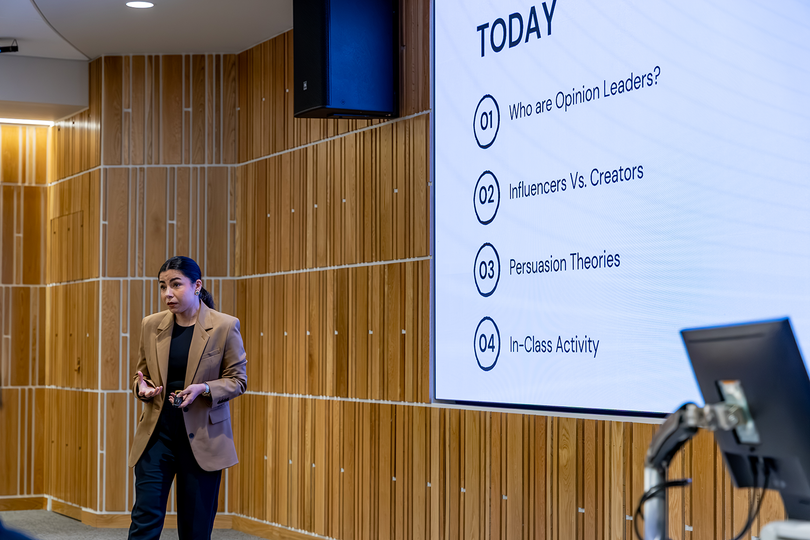
Three well-known figures projected on Professor Faren Karimkhan’s classroom screen: Kim Kardashian, tech YouTuber Marques Brownlee and TikTok makeup artist Mikayla Nogueira. Karimkhan asked her students to identify the celebrity, influencer and content creator.
This lesson is a part of one of the first classes for Syracuse University’s new partnership between the Newhouse School of Public Communications and the Whitman School of Management – the Center for the Creator Economy.
The CCE launched a university-wide minor at the beginning of the fall 2026 semester, including two new courses launched specifically for the program: MMI 211 Introduction to the Creator Economy and SOM 277 Business Toolkit for Creators.
The program serves as a first step in teaching students how to break into a $500 billion industry, Ryan Schram, the executive director of the CCE, said.
Although becoming a content creator can prove to be financially smart, Schram said the industry extends “far beyond” influencers on social media, with a growing need for people working behind the scenes.
“Oftentimes, the jobs in greatest demand are the supporting team that you may not see in front of the camera or behind the mic of your favorite podcast,” Schram said.
CCE’s arrival comes amid other institutions offering social media programs as a way of attracting prospective students. On July 21, Arizona State University announced a new Content Creation degree program, which many have criticized.
Schram said CCE is the “antithesis” of ASU’s new major and is taking a different approach.
“What we want students to walk away with is the business, creativity and communication angles of this creator economy,” Schram said.
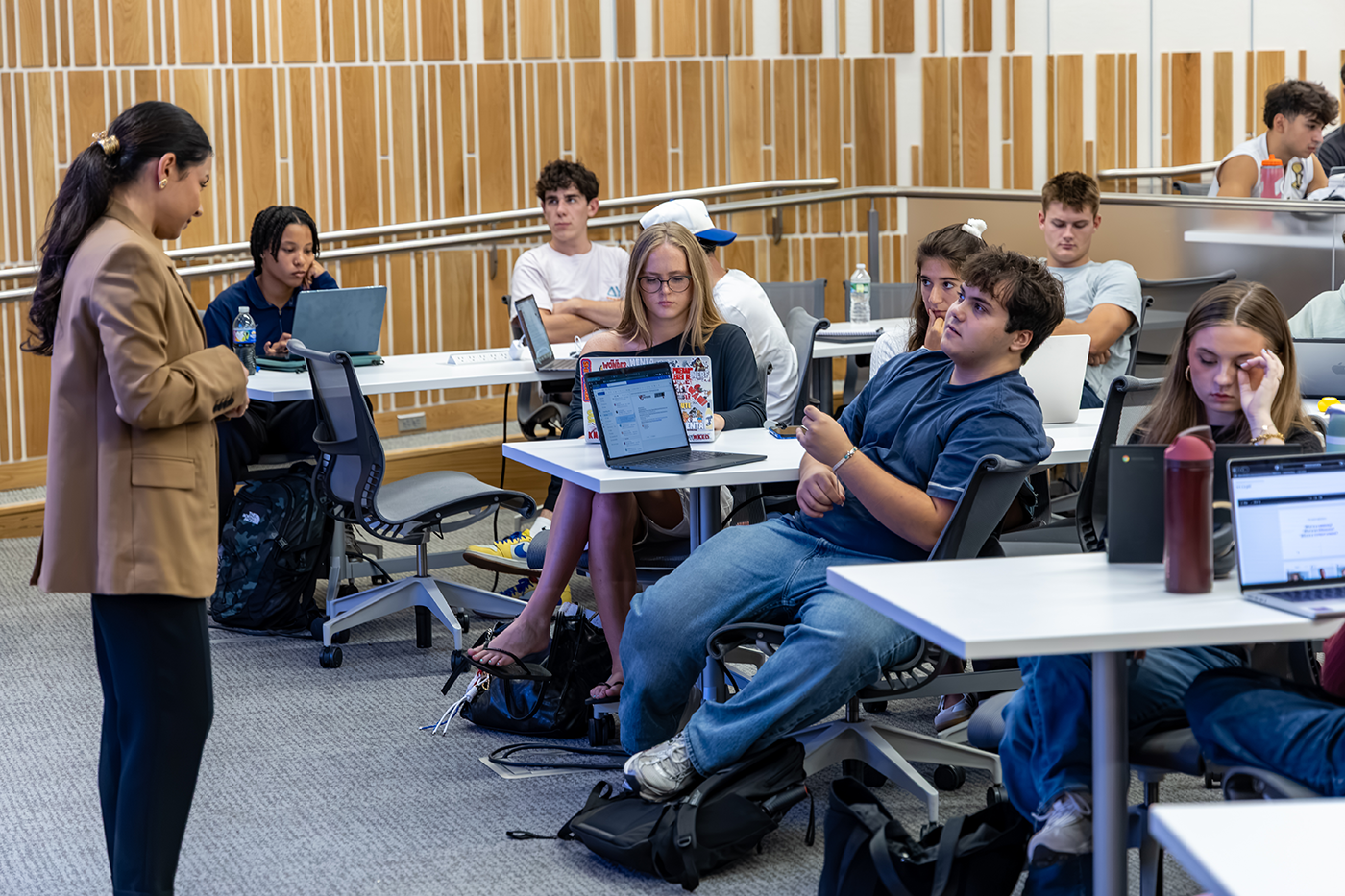
Karimkhan speaks to a student about the difference between a celebrity, influencer and content creator. This lesson is part of an MMI 211 class held on Sept. 1. Paul Hakimian | Contributing Photographer
Another member of CCE’s leadership, Thomas O’Brien, the program’s project coordinator, said the center is designed to give students an understanding of the industry, regardless of what they choose to do in it. O’Brien added that the creator economy is for everyone on campus, even those with majors not connected to communications.
“You could be a chemist who’s done research that you’re super excited about,” O’Brien said. “A well-thought-out social media campaign could be the difference between that research becoming a reality and getting the funding that you need.”
During an MMI 211 class, Achilles Santiago, a sophomore economics major, said it’s helping him understand how he might be able to turn his interests in fitness, gaming and reaction content into a potential career or side business.
The creation and popularity of artificial intelligence influencers was thoroughly discussed throughout the class. Example accounts shown during the class had millions of followers and struck sponsorship deals with companies including BMW and the Coachella music festival.
“Believe it or not, but audiences have responded very positively to AI content creators,” Karimkhan said during the class.
George Geisert, a sophomore majoring in television, radio and film, said he didn’t understand why anyone would follow an account that generates photos of an influencer instead of following a real person.
“I don’t understand how a human being can follow or be influenced by someone that you know is not real on social media,” Geisert said. “It’s straight slop.”
The discussion of AI influencers was one example Karimkhan used to show the evolution of social media platforms. Addy Brooks, a freshman visual communications major, said she didn’t enroll in the course to understand how to become big on social media, but rather to see how social media is changing advertising and marketing.
“I think what’s super important right now is recognizing that … everything that’s happening in the marketing world is transitioning from what we used to know as traditional to everything you now see being an ad on Instagram and TikTok,” Brooks said.
WHAT YOU SHOULD READ NEXT
Center for the Creator Economy legitimizes SU as influencer breeding ground
Numerous successful influencers have come out of Syracuse University, making it a breeding ground for content creators.
In addition to MMI 211 and SOM 277, students are also required to take an entrepreneurship course through either Newhouse or Whitman, O’Brien said.
Many students in the introduction course said they’re interested in using the skills they learn in class in future entrepreneurial projects down the road. Sheldon Birthwright, a freshman television, radio and film major, said he enjoyed the class because he felt he was learning about all areas of the industry.
“The social media world is evolving every day,” Birthwright said. “I feel like the creator economy can help me understand every aspect of it, so in the future I won’t go in blindly.”
To allow students to create their own content, Schman said the CCE lets students rent out cameras and microphones university-wide, separate from Newhouse’s CAGE facility. The CCE has also invested in new podcast booths in Newhouse 3.
O’Brien and Schman said the center is looking for additional ways for students to gain experience through a planned registered student organization, the Creator Crew.
The group will give students opportunities to work on content, whether it be filming or editing, while also involving “analytics and strategy,” according to its website.
The center will host its second annual CUSE Creator Con in late October, bringing in social media executives and brands to campus.
When Karimkhan’s class broke off into discussion, students weren’t instructed to talk about the best strategy to go viral – instead, they talked about how to communicate with businesses to promote products using the creator economy.
“The idea here isn’t how do you buy the ideal ring light or what smartphone is best for you,” Schram said. “It’s recognizing that by definition, whether it’s a side hustle or whether you make it a full-time career, being a creator is a small business.”