ECS students test flight simulator despite recent technical difficulties
Get the latest Syracuse news delivered right to your inbox.
Subscribe to our newsletter here.
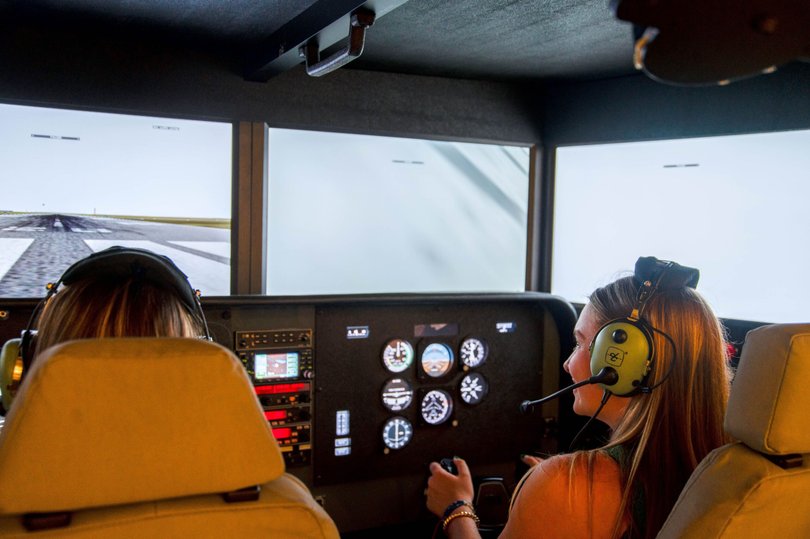
On Friday, Syracuse University’s Renée Crown Honors Program hosted a tour and demo showcasing a seldom known tool — SU’s College of Engineering and Computer Science’s fully-equipped, six-degree motion flight simulator inside Link Hall.
The simulator, donated in 2008 by SU alum William Frantz, is one of few academic-owned flight simulators in the country, ECS professor Kasey Laurent said. The simulator, mainly used for aerospace engineering students, provides an opportunity to test out flying with all controls and motion replicated from real aircrafts.
Laurent uses the Fidelity MOTUS 622i Flight Simulator to teach students in her Aircraft Performance and Dynamics class how to pilot an aircraft. Throughout the semester, students work in rotating teams, taking turns as pilot, co-pilot and data recorder while conducting test flights.
Students first start the class with “basic maneuvers” before learning how throttle changes might impact aircraft behavior. Once students grasp common moves, Laurent said she gradually teaches turns, climbs and explores “advanced concepts” including stability and aircraft design.
However, the software allows the simulator to change its settings at will to reflect a broad range of different aircrafts. The simulator can recognize specific aircrafts and settings created by X Plane, a software sold on the widely-used video game platform Steam.
“What we do throughout the course is we modify a Cessna (aircraft),” Laurent said. “We’ll change where the weight goes, the size of the tail, size of wings, and then students can feel how those changes affect the handling of the aircraft.”
Nicholas Lewis, a senior aerospace engineering student, said the simulator helped him “bridge gaps” that many other students may experience while learning aerospace engineering.
“Before using the simulator, a lot of the concepts we covered in class were fairly abstract,” Lewis said. “You can read about how a control input affects the aircraft, but actually sitting at the controls and seeing what moves what, made it click in a way the lecture couldn’t.”
Lewis said he believes future students will “absolutely” use the simulator.
However, Samuel Roth, an operator for the simulator and senior aerospace engineering student, said he’s more concerned for future technical difficulties as the age of the simulator starts to eclipse the age of those using it.
As renovations in Link Hall are underway for new laboratories and systems, Roth said he’s noticed the impact on the building’s electrical systems has resulted in multiple issues with the simulator in the “past few weeks.”
At the time of acquisition, the model was considered state of the art, with a certification as a pilot training device by the Federal Aviation Agency, Laurent said. Although it’s not used to train pilots, the device could be used to log hours toward a piloting license.
The simulator is frequently used during tours and campus events, where prospective and current students outside the ECS program are often invited to try out the cockpit.
The simulator holds an important legacy in Link Hall, as the building is named after the Link Flight Trainer, which was used in World War II to train military pilots, Roth said. The creator, Edwin Link, would later receive an honorary degree from SU and have his original model housed in the building.
“Many students don’t know it, but Link Hall has an important and surprising connection to the history of flight training devices,” Roth said.