Financial aid covers college, but not every aspect of college life

Get the latest Syracuse news delivered right to your inbox.
Subscribe to our newsletter here.
When universities and politicians discuss making college more affordable, they usually focus on tuition. They debate financial aid packages, scholarship amounts and federal grants. These conversations are important, but they overlook a less visible reason students struggle to complete their degrees: even after tuition is covered, they still have to afford the ordinary — and often unexpected — costs of living.
A student may have enough aid to register for classes but not enough money to repair the car that gets them to campus. Another may be able to pay tuition but can’t replace a broken laptop in the middle of the semester. A sudden medical bill, a rent increase or the loss of just a few work shifts can destabilize a student whose financial aid package appeared sufficient on paper.
These expenses may seem small beside a five-figure tuition bill. For a student living without savings or substantial family support, however, a $500 emergency can force them to miss class, work additional hours or leave school altogether.
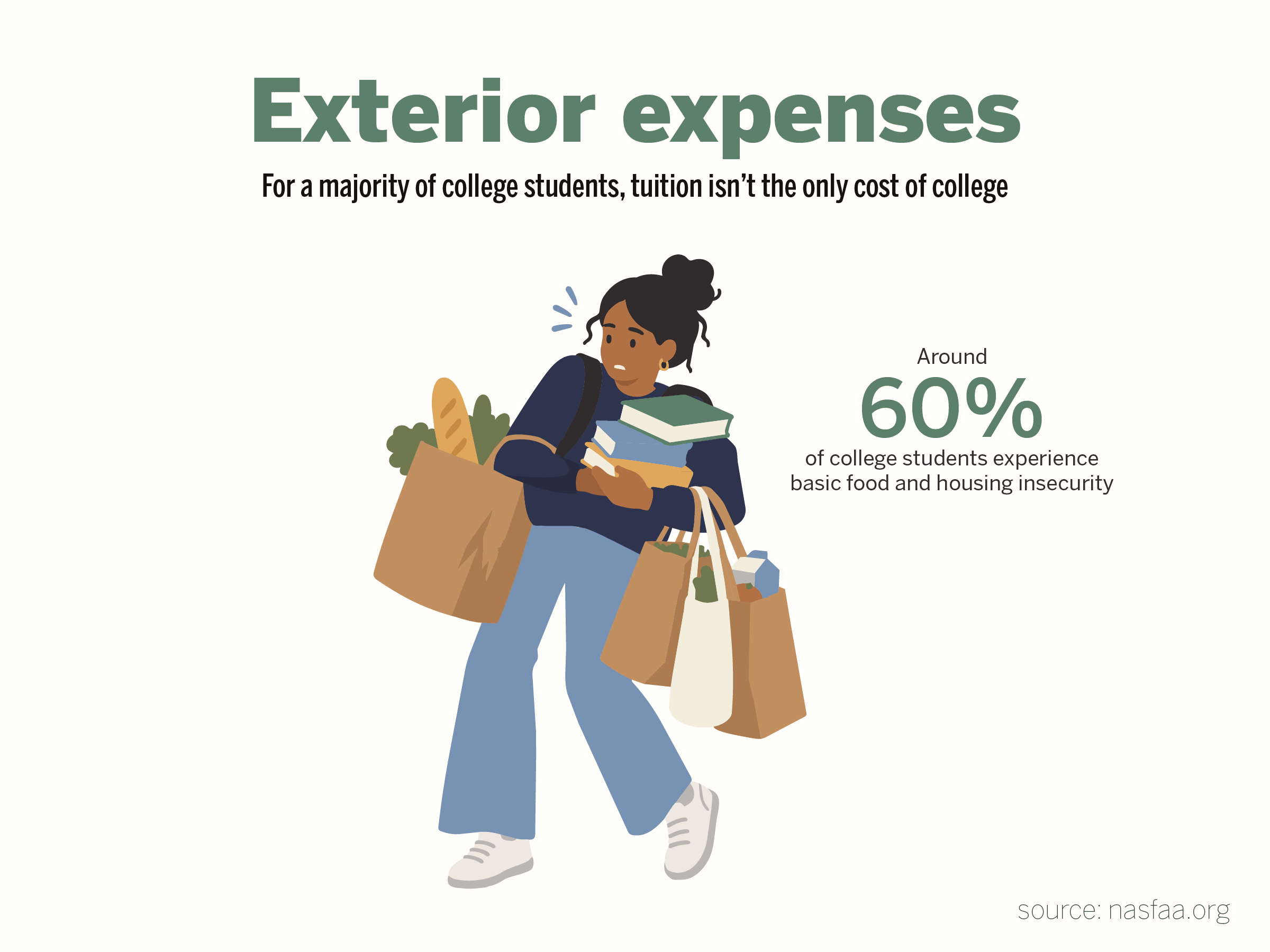
Students are frequently told financial aid makes college accessible, only to encounter a long list of expenses that aid doesn’t fully address. No single expense necessarily looks large enough to attract public attention. Together, they can price students out of college entirely.
State University of New York’s newly expanded emergency aid program deserves attention. On Sept. 2, SUNY announced that $600,000 allocated in New York state’s 2026-27 budget will establish emergency aid programs across all 64 SUNY campuses. Emergency funds had previously been available at 47 SUNY colleges and universities. The expansion means that every student in the system will have access to emergency aid funds.
The grants are intended for circumstances like car breakdowns, housing situations, medical crises, deaths in the family and technology failures. SUNY also announced that foster youth and students struggling with living conditions will receive college essential kits containing items such as extra-long sheets and other basic residence-hall supplies.
According to a national student financial wellness survey cited by SUNY, a majority of college students can’t afford an unexpected $500 expense. That exposes a limitation in the way institutions measure affordability. A financial aid office may calculate that a student has enough money to attend college, but that calculation can’t guarantee the student has adequate financial flexibility.
An education isn’t truly affordable if one emergency can interrupt it. Emergency funds protect the much larger investment already made by the student, their family, the college and the state.
SUNY’s expansion is promising change in how public institutions think about affordability. It acknowledges that student finances don’t always align with the criteria universities use to administer aid.
Still, $600,000 spread across a 64-campus system is a modest beginning. If it were distributed evenly — which SUNY hasn’t specified — it’d amount to less than $10,000 per campus. The program’s success will depend on whether campuses contribute additional resources, make applications accessible, approve requests in a timely manner and ensure students know assistance is available.
Abigail Aggarwala | Digital Design Director
Syracuse University’s own emergency resources are inadequate for students facing financial hardship.
For the 2026-27 academic year, SU estimates an undergraduate living on campus will face a total cost of attendance of $95,676 without health insurance. Tuition accounts for $69,180 of that figure, while housing, food, transportation, books and personal expenses account for much of the remainder. The university’s own estimate recognizes that attending college requires students to pay for far more than classes.
SU provides enrolled students with one-time emergency assistance of up to $500 for certain unforeseen expenses. Hendricks Chapel’s Student Opportunity Fund also offers “mini-grants” generally ranging from $300 to $500 for needs including food, clothing, emergency travel and health care.
These programs can make an important difference, but they also reveal how narrowly colleges define an emergency. For example, SU’s primary emergency aid program doesn’t cover what it deems to be “regularly anticipated expenses,” such as rent. The Student Opportunity Fund can be requested only once per academic year, and applications for its next round open for just two weeks in October.
An expense doesn’t have to be unexpected to become an emergency. Rent, groceries and transportation are predictable; the circumstances that make a student unable to afford them aren’t. SU must build upon its existing programs by offering larger and more flexible grants, keeping applications continuously open and making emergency assistance easier for students to find before a temporary financial issue becomes a reason to withdraw.
We must continue debating tuition costs. But we should stop treating it as the only — or even the most immediate — measure of whether students can afford college. For many students, the difference between graduating and dropping out isn’t a tuition bill, but one small expense or circumstance arriving at the wrong moment.
SUNY’s emergency aid expansion recognizes that reality. Other universities should do the same: if an institution wants to make education accessible, it must help students reach the classroom and remain there.
Ella DeCamp is a senior majoring in English and textual studies. She can be reached at emdecamp@syr.edu..