Grateful Dead’s ‘mind-altering’ ‘76 Syracuse show etches Deadheads’ memories
Get the latest Syracuse news delivered right to your inbox.
Subscribe to our newsletter here.
Fifty years ago, Bob Minkin, a 17-year-old living in Brooklyn, hopped on a flight with his friend from New York City’s LaGuardia Airport to Syracuse. Minkin and his buddy had one goal for that trip: see the Grateful Dead’s Tuesday night show.
After Minkin’s flight touched down, he and his friend caught a cab. The problem? They had nowhere to stay, no tickets and they didn’t even know where the band was playing.
The driver brought them to different venues, eventually arriving at the correct spot, the Onondaga County War Memorial (now called Upstate Medical University Arena). To Minkin’s surprise, the show wasn’t sold out, so they grabbed two tickets at the box office for around $7 each.
For Minkin, flying for the first time and traveling hundreds of miles on the day of the concert was a big deal. And in retrospect, the entire tour was a big deal for the Grateful Dead.
Minkin was about to experience one of the band’s statement years, Richard Ellis, who attended the same 1976 Syracuse show, said. After a two-year touring hiatus, the Grateful Dead were back.
“The ‘76 (Syracuse) show, the second set was just electric, but also, (the fans) were electric,” Ellis said. “Traveling with the Dead was always a mind-altering experience. We were either tripping or doing mushrooms and drinking wine and smoking weed.”
Formed in 1965, the Grateful Dead was a California-based rock band founded by Jerry Garcia, Bob Weir, Phil Lesh, Bill Kreutzmann and Ron “Pigpen” McKernan. The group blended rock, folk, jazz and other genres, eventually becoming one of the greatest bands in American history.
After Garcia’s death in 1995, the group disbanded, but offshoot Grateful Dead projects began to tour, like Phil Lesh and Friends and Dead & Company. But besides the music, the band’s cult-like followers, known as Deadheads, have kept the Grateful Dead’s legacy alive.
“Deadheads are kind of different. You either got it or you didn’t,” Ellis said. “Some people look at Deadheads like they’re idiots, and us Deadheads look at other people that don’t get it like they’re idiots.”
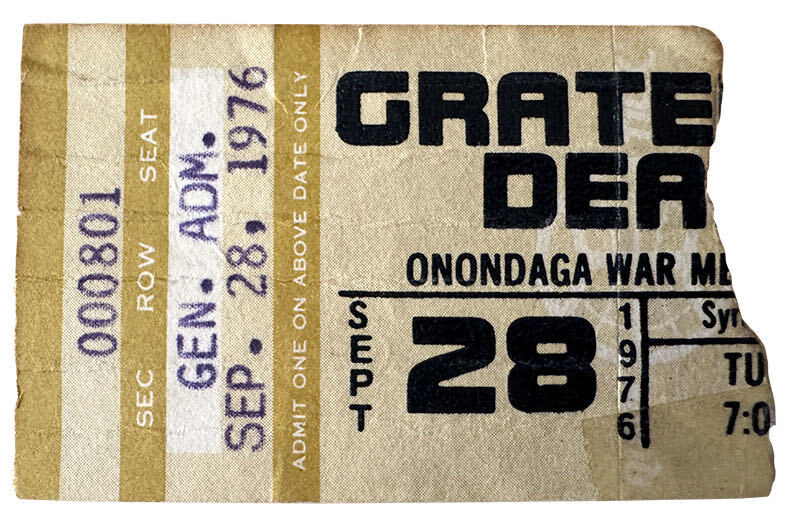
The Grateful Dead’s Sept. 28, 1976, show at the Onondaga County War Memorial was among its performances following a two-year hiatus. Deadhead Richard Ellis called the Syracuse show “electric.” Courtesy of Bob Minkin
When 19-year-old Ellis attended the Syracuse concert on Sept. 28, 1976, he was still a novice Deadhead. It was about the 12th Grateful Dead show he’d seen. But from 1970-95 (Ellis’ “formative years”), he attended at least 480 Grateful Dead concerts across the country, including seven or eight in Syracuse, he said.
For about 300 of those, Ellis was accompanied by a few of the same people, but he also bumped into many faces he’d met over the years — most of them fellow Deadheads.
“I miss it so much, too,” Ellis said. “I’ve gone to every incarnation of the Dead since ‘95, and every time I leave a show after that, I just miss what we actually had more than before.”
Even though Ellis wasn’t a fan of Dead & Company with John Mayer, he still attended those performances just to see his friends. He said seeing the Grateful Dead and the offshoot projects felt more communal than seeing other legendary groups like The Rolling Stones, Led Zeppelin or Pink Floyd. And on the East Coast — specifically in New York — Ellis said the Grateful Dead picked it up a notch.
Many New York state Grateful Dead shows, like the 1976 Syracuse and the legendary 1977 Cornell University performance, were immortalized through “Dick’s Picks,” an archival series of live albums. Dick Latvala, the band’s archivist, curated and released live Grateful Dead performances. The Syracuse show came out in 2001 as part of “Dick’s Picks Vol. 20.”
Brian Kinsler, an SU graduate student who studied English from 1977-79, saw the band about 20 times in upstate New York — including the 1976 Syracuse show — and 50 times in New York City. Like Ellis, Kinsler, who’s originally from Brooklyn and now lives in California, said the New York shows were always high energy.
“The people are crazier,” Kinsler said. “People are more laid back (in California), but people are definitely more amped up (in New York). And maybe better drugs, who knows?”
Kinsler discovered the band after listening to a live album, “Grateful Dead (Skull & Roses)vvvv,” when he was around 14. As a freshman in high school, Kinsler went to his first show on Dec. 5, 1971, at the Felt Forum (now the Infosys Theater at Madison Square Garden). Starting in 1974, he went “on tour” as a Deadhead and caught 369 Grateful Dead performances — he even skipped his Fairleigh Dickinson University graduation to see one of them.
Around the time he finished graduate school at SU, Kinsler saw the Grateful Dead perform in Pittsburgh. At 3 a.m., he stepped out of his hotel room to grab a Coke from a vending machine, and when he turned around, his hero — Garcia — stood behind him.
“You know what? I’ve been to almost 300 shows,” Kinsler said.
“I’ve been to a few myself,” Garcia responded.
“Hey, would you mind just walking into my room and saying hello?” Kinsler asked. “Maybe smoke a joint with my friends?”
“Sure,” Garcia said.
WHAT YOU SHOULD READ NEXT
Frank Malfitano nourishes steadfast music legacy with ‘reverence,’ dedication
Founder of the Syracuse Area Music Awards, Frank Malfitano, began his more than 55-year music career during his senior year at Syracuse University.
When Garcia walked into the room, Kinsler’s seven friends were stunned; they couldn’t even talk. The cherry on top: Garcia did smoke a joint with them.
Minkin also saw Garcia (sometimes smoking a joint) in intimate spaces, like backstage, often through a camera lens.
At 18, Minkin began shooting professionally. His work, like photos of Garcia playing an outdoor San Francisco show in 1977, was published in Relix magazine, where he was a senior photographer in the 1980s and 90s.
In the 1980s, Grateful Dead management provided Minkin with backstage access for many performances. His photos were used for Grateful Dead-themed calendars, CD packages and even in the background of Dead & Company’s shows at the Sphere in Las Vegas.
Over the years, Minkin developed personal relationships with members of the band. Before Weir died in January, they lived close by in Marin County, California. Minkin photographed his daughter’s 16th birthday party and family portraits for Christmas cards. Minkin also snapped photos in Lesh’s home and received holiday cards from Lesh before his 2024 death.
Minkin, who saw the Grateful Dead play “only” about 200 times, published individual photo books focusing on Garcia, Weir and Lesh. But Minkin began taking photos at concerts before he was even paid.
When the 1976 Syracuse show ended, Minkin had an idea of how to potentially meet the band. Strapped with a portable camera — he can’t remember, likely the Kodak Instamatic his aunt gifted him or a Kanika Rangefinder — he walked to the back of the Onondaga County War Memorial.
“I wanted to hopefully meet Jerry Garcia, whose voice I heard in that stairwell, because we were in this little cubicle, like we stepped in the doorway,” Minkin said. “But then, the door right in front of me opens up, and Bob Weir comes walking out.”
While the Grateful Dead’s crew was moving equipment, he snapped a shot of Weir wearing a sports jacket.
Tribute bands have also been a factor in immortalizing the Grateful Dead. In Syracuse, bands like Dark Hollow, Dark Star Orchestra and Liverpool resident Jason Fingerman’s group, Uncle Jason’s Band, continue to carry on the Grateful Dead’s legacy.
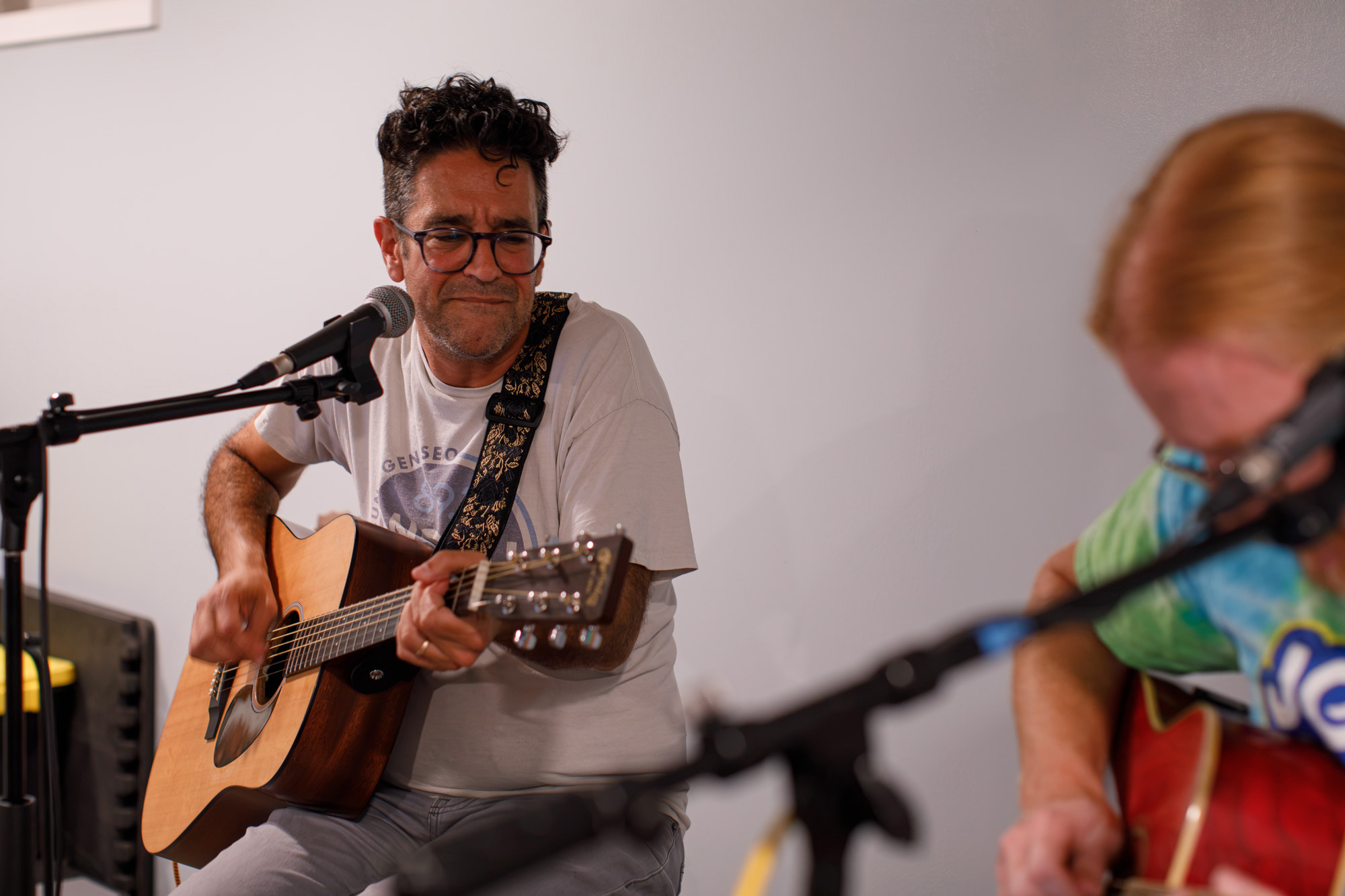
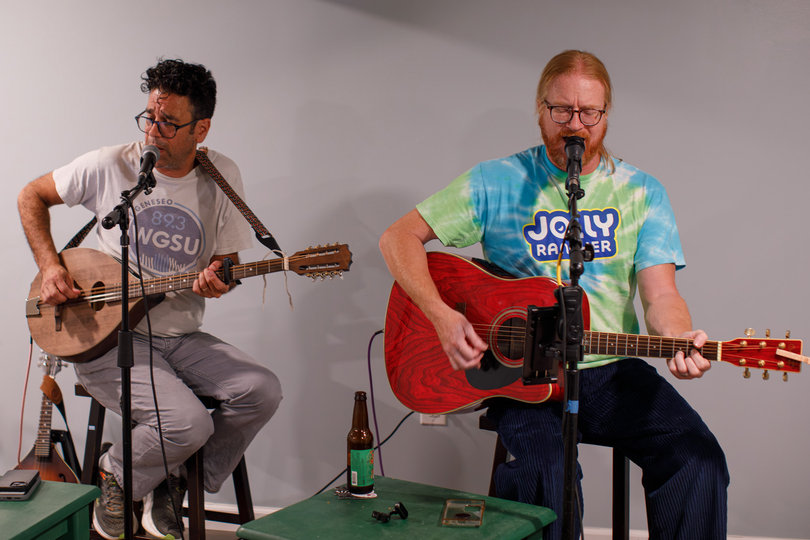
James Fingerman of the Uncle Jason’s Band passionately sings with his bandmate, Robert Searing. The band started performing in local establishments in February. Avery Magee | Development Editor
Fingerman has worked as a musician in the Syracuse area for the last five years. But since February, Fingerman and his friend, Robert Searing, have played gigs as Uncle Jason’s Band. The name is a play on the classic Grateful Dead song “Uncle John’s Band,” but Fingerman, who has a niece and several nephews, is actually an Uncle Jason, though.
The group hopes to add more members in the future, but for now, the duo is putting their own spin on the Garcia-Weir dynamic.
“Any place that advertises, ‘We have a Grateful Dead tribute coming in,’ there’s always going to be some people just to come and check it out,” Fingerman said. “It’s a built-in Deadhead audience that you can count on.”
A self-described “late-to-the-party Deadhead,” Fingerman started listening to deep cuts in the Grateful Dead’s catalogue over the past couple years. But for Tom Prowda, his love of the band began in 1969 at a record store on Marshall Street.
Prowda, a classical music fan, was looking through the Johann Sebastian Bach cantata section when he started tapping his foot to the record that was playing in the store: “Aoxomoxoa,” the Grateful Dead’s third studio album.
When one of Prowda’s friends realized he liked the Grateful Dead, he told Prowda he needed to see them live.
On May 2, 1970, Prowda saw them play at Harpur College (now Binghamton University). He said it was an evening of firsts — his first rock concert, his first Grateful Dead show and his first psychedelic trip.
Big jugs of orange juice were being passed around, and when one came near Prowda, he started guzzling it. An attendee behind him said they were supposed to share that jug with everyone, so Prowda passed it on. Then, he told Prowda the show would get better.
“I start to feel tingly all over. The walls start weaving. I start seeing sparks coming out of the speakers,” Prowda said. “And then all of a sudden, all the musicians have these bright neon halos around them. And I went, ‘Did I say just take acid? Oh my God, I did. I took acid.’”
Outside of slinging grilled cheese sandwiches and substance use, the Grateful Dead also played a pivotal role in Deadheads’ family lives. When Ellis’ second daughter, Rose, got married, their father-daughter dance song was “Ramble on Rose,” which brought a tear to Ellis’ eye.
Kinsler stopped following the band across the country when his child was born in 1981. But once Deadhead, always a Deadhead — Kinsler’s thankful for what being a Deadhead has brought him, changing his life forever.
“I wouldn’t have met my wife. I wouldn’t have had a kid,” Kinsler said. “All these things happened because of the Grateful Dead. All of my lifelong friends are basically Deadheads, almost every one.”