Haynie commits to University Senate collaboration at semester’s 1st session
Get the latest Syracuse news delivered right to your inbox.
Subscribe to our newsletter here.
The University Senate voted in favor of an amendment to bring the current status of Syracuse University’s Statement on Free Expression and Free Inquiry to a vote “as soon as possible,” at its first meeting of the semester.
The statement, located on SU’s Vision and Mission page, “expresses the institution’s commitment to academic freedom and free expression in a community welcoming to all.”
Senator and College of Arts and Sciences professor Harvey Teres’s amendment proposes that USen hold a vote on whether or not to endorse the statement, and is given the option to revise the university’s statement in the future if they choose.
This comes after the Ad Hoc Committee on Free Speech and University Policy recommended the senate maintain the current status of the statement without further deliberation or modification.
Before voting on the committee’s recommendation, Teres expressed his reservations about maintaining the statement and proposed the amendment.
“We haven’t had a chance to endorse a statement that is supposedly produced on our behalf,” Teres said. “These are supposed to be our values and we need to have a chance to vote on that statement.”
Sixty-four percent of the senate voted in favor of the amendment, with 32% opposing and 4% choosing to abstain.
Matt Mulvaney, a member of the ad hoc committee and professor in the College of Arts and Sciences, said Teres’ point was considered by the committee but that they ultimately landed on their recommendation to maintain the statement.
“(An amendment) was discussed by the committee and there was disagreement within the committee itself on that,” Mulvaney said. “I think the basic premise was that right now we have a system in place that has existed for a couple of years and that it is a strong statement.”
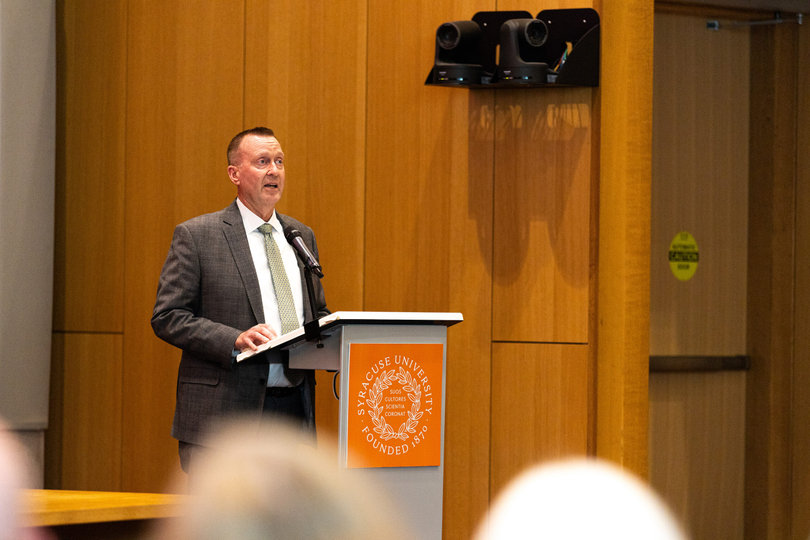
Chancellor Mike Haynie also used his first official USen remarks to “candidly” share how he hopes to work with the senate moving forward.
Haynie stressed the importance of authenticity and honesty in future collaborations with the senate, saying they’re fundamental characteristics of shared governance, which is necessary for universities to make their best decisions.
He said the best way for SU to thrive amid the challenges the university is facing, including its missed enrollment target and budget deficit, is to “elevate the rigor and competitiveness of the university’s academic enterprise.”
Haynie also said the university needs to do more to improve the value of an SU education, citing instances of students being accepted to SU, but choosing to enroll at other colleges and institutions.
“We missed our enrollment goal because too many families had higher expectations of the academic experiences their child would receive here and they felt we couldn’t deliver,” he said.
Haynie also brought up his own concerns that USen hasn’t focused enough on the student experience. Haynie said he put previous senate agendas into Claude to create a summary of its key topics.
“Claude told me based on those minutes that the issues and themes that dominated the work of the senate last year were employee rights, pay and benefits, employee workload, governance and procedural policies and speech rights,” Haynie said. “Notably missing from what Claude shared with me was a focus on our students.”
He clarified that the issues the senate had focused on during the previous year were still important, but that students need to be put at the forefront.
“I am sharing that finding to make clear that my aspiration for the year ahead is for the focus and substance of the work of this body first to be about advancing discovery, academic excellence and serving the learning and wellness needs of our students,” Haynie said.
Tom Dennison, chair of USen’s Employee Benefits Advisory Council and a professor of practice emeritus in the public administration and international affairs department, spoke about benefits issues including the university’s medical plan expiring after the 2026-27 academic year.
Dennison said the committee will review the contract because “it’s just good business and due diligence.” The committee will also send a survey asking staff about their experience with their health benefits.
Senator Laurel Morton, president of SU’s part-time faculty union Adjuncts United and instructor in SU’s School of Design, said she would appreciate some “focus” from EBAC on Adjuncts United’s negotiations.
Currently, provisions in the agreement put AU’s members at a “distinct labor disadvantage,” Morton said, citing a provision requiring part-time professors to teach at least five three-credit-hour courses all in the same college to be eligible for benefits.
Dennison said bargaining agreements aren’t part of EBAC’s current agenda, but it will look into seeing what role they can play in moving the negotiations forward.
Other Business:
- The Committee on Curriculum and Instruction report announced two new subjects: Health and Human Performance in the Falk College of Sport, and Natural Sciences and Mathematics in the College of Arts and Sciences. The senate passed a motion to approve the subjects with 90% approval.
- Jennifer Karas Montez and Amber Anand, members of Haynie’s special committee, detailed the process the 14-member committee has taken to achieve its goal, dividing its process into three steps: Data Collection and Analysis, Interpretation and Recommendations. The committee members asked for participation in the forums to hear student, faculty and staff perspectives.
- Vice Chancellor and Provost Lois Agnew spoke about challenges graduate students and international students are facing due to actions taken by President Donald Trump’s administration that limit federal aid awards to graduate students and cap international student stay to four years. Agnew said that although “much remains unclear”, SU staff remains available to talk to students and they’re “monitoring this situation closely.”