LIFE’s ‘Six Women Photographers’ exhibit spotlights power of print media

Get the latest Syracuse news delivered right to your inbox.
Subscribe to our newsletter here.
For decades, Life Magazine’s mission was to give Americans a way to see the world through photographs, from notable political affairs and wartime scenes to family life and everyday moments.
Now, “LIFE: Six Women Photographers” brings that history to the Everson Museum of Art in Syracuse, displaying photographs and issue snippets of Life Magazine, from six women who documented American life throughout the 20th century.
“It’s an interesting reminder that images have always been really powerful,” said Steffi Chappell, Everson’s Director of Curatorial Affairs and a Syracuse University alum. “Back when Life was first introduced, because of the way that it used images was so new, it blew everybody’s mind.”
The exhibition, organized by the New York Historical, is on display at the Everson until Sept. 27. It features the work of Life’s earliest female photographers: Margaret Bourke-White, Hansel Mieth, Marie Hansen, Nina Leen, Lisa Larsen and Martha Holmes, placing their photographs alongside the original Life issues where their work appeared. The black and white photos document both major historical events and ordinary American life from 1936-56. From photos of garment workers socializing and crowds surrounding a Yugoslavian president’s visit to the Soviet Union, the exhibit’s images capture a range of historical moments from the Great Depression to the Cold War.
Before the exhibit arrived at the Everson, Chappell knew Life’s role in shaping American society, but after research, she knew the magazine’s photographs would make a great addition to the museum.
For Chappell, the exhibition also provides an opportunity to consider what’s changed since Life’s popularity — and what hasn’t. It’s a reminder of the power of images and what print media “used to be,” making it suitable for the Everson, Chappell said.
When Life was established in 1936, its heavy reliance on photography distinguished it from other publications, Chappell said. The exhibition includes a prospectus that described the magazine’s mission as seeing and showing the world through images.
“It was all about the photos,” Chappell said. “And that was the first time that the American public has seen a publication like that. And so it was really, really impactful.”
WHAT YOU SHOULD READ NEXT
Local arts center exhibits watercolors from CNY-based veteran turned artist
Anderson’s watercolor paintings will be on display at the Salmon River Fine Arts Center in Pulaski as part of the inaugural Spotlight Exhibit
Nina Leen’s 1947 photo essay, “American Woman’s Dilemma,” turned to the competing expectations placed on women in postwar and depression America. The photo essay presented three options for women with children: motherhood on top of a full-time career, full-time housework or part-time work alongside housekeeping.
Nearly 80 years later, Chappell said the questions raised by Leen’s photographs remain surprisingly familiar.
“It’s 2026 and we’re still having this discussion about working parents and should someone be staying home with the kids and is it OK for kids to go to daycare?” Chappell said. “Even though that’s from the 1940s, it still is shockingly current.”
Desi Drake of Liverpool was drawn to the Everson’s exhibit particularly because of Bourke-White’s work. Of all of the images on display, Drake’s favorite was Bourke-White’s shot of the Fort Peck Dam in Montana that appeared on the cover of Life’s inaugural issue in 1936.
Drake said she found it “amazing” that the photographs were taken by female photographers in the 1930s and noted the significance of a woman’s work being featured so prominently at the beginning of the magazine’s history.
Other photographers documented women entering traditionally male-dominated spaces. Hansen’s 1942 “The WAACs,” a series of photographs that showed the Women’s Army Auxiliary Corps preparing for military support roles while also emphasizing expectations of femininity.
Similarly, Mieth’s series “Garment Workers at Play” documented women at work while capturing their relationships and social lives outside the factory, giving the series a playful and intimate quality.
“Every artist, photographer, painter, sculptor, always brings their own unique perspective, which is influenced by their background, their life experiences, where they grew up, who their family members were,” Chappell said.
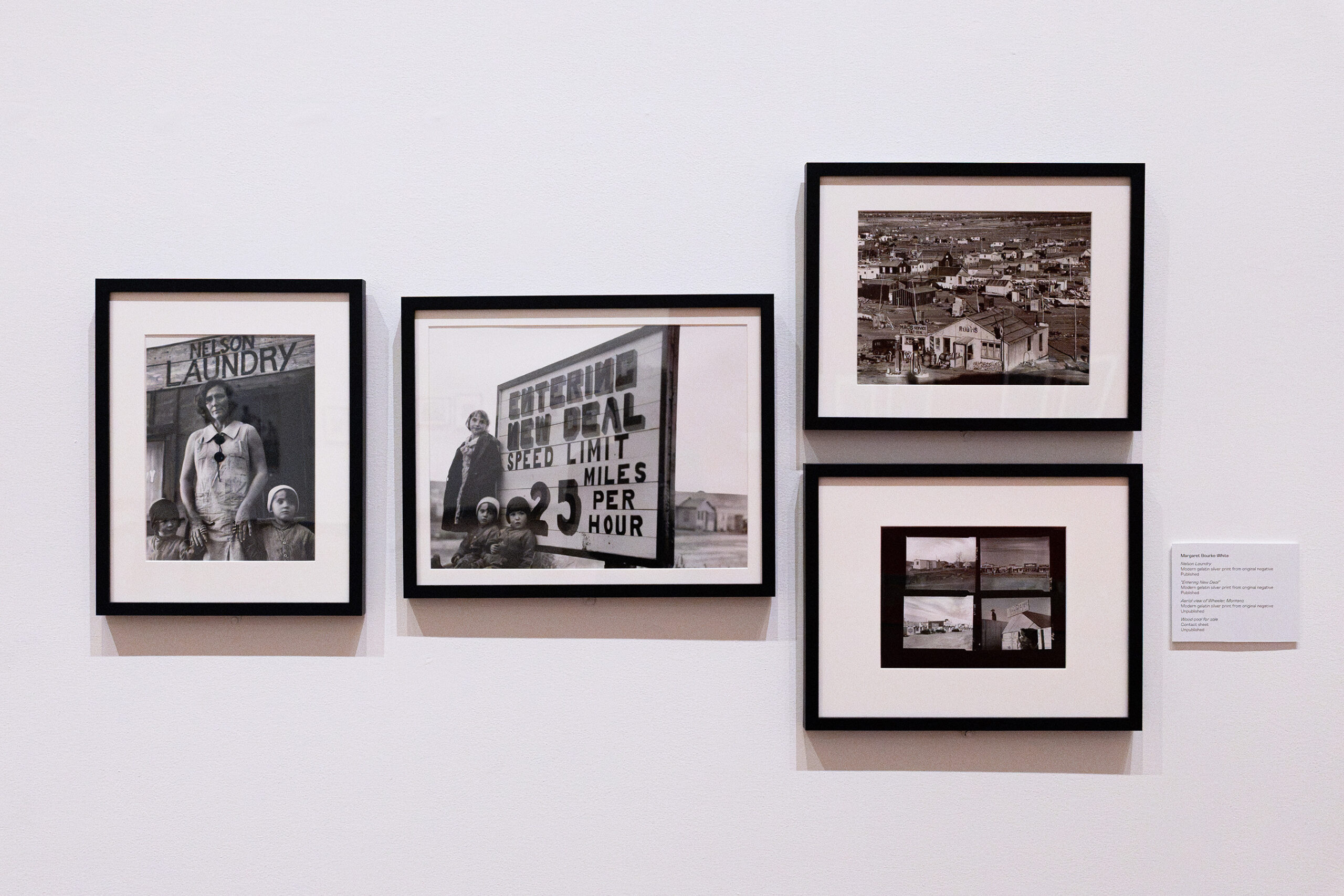
Margaret Bourke-White’s photographs from the inaugural issue of Life Magazine. Bourke-White is the first female photographer at Life. Kedar Nai | Contributing Photographer
The exhibition also draws attention to another person behind every published image: the editor.
While photographers controlled their subjects and which images they submitted, Life’s editors ultimately decided which photographs appeared in the magazine. Several photos in the exhibition didn’t actually end up in an issue of Life.
For Chappell, understanding the editorial process changes how visitors interpret the exhibition.
“If you go into the show and you don’t read any of the text and you just are looking at the images, you might not pick up on that idea that the photographers took the photos, but the editors were the ones that actually got to choose which photos were printed and which photos the public saw,” Chappell said.
The original Life issues displayed in the exhibition make that editorial process visible. Visitors can see the photographs in the context in which millions of Americans encountered them when the issues were first published.
For some visitors, the exhibition brought back memories of Life as a physical part of American society.
Loey Rotchforde, who lives in Syracuse, was reminded of the Life issues she used to see in thrift stores after attending the exhibit. She described Life as a “big cultural setter” and said the exhibit was a testament to “the power of print publications.”
Since Life’s establishment in 1936, society’s relationship with photographs has changed drastically, with images now dominating digital platforms and advertising, Chappell said.
The difference, Chappell said, is that photography was once a much newer and more concentrated form of storytelling. For Life’s first issue, founder and former Life editor-in-chief Henry Luce made the decision to put Bourke-White’s photograph on the cover. Bourke-White became not only the first female photographer at Life, but one of the first-ever photographers to capture numerous significant events.
“I don’t think he went into it thinking, ‘I’m going to put a woman photographer on the cover of Life Magazine. I’m just going to put the best photograph on the cover of Life Magazine,’” Chappell said.