Local arts center exhibits watercolors from CNY-based veteran turned artist
Get the latest Syracuse news delivered right to your inbox.
Subscribe to our newsletter here.
Painting didn’t come naturally to Craig Anderson, but it was always an interest of his. When Anderson left the military in 1991 and was skeptical about his future career, he recalled the art classes he took in high school.
Though painting wasn’t Anderson’s strong suit at the time, he was determined to sharpen his artistry. Now, over three decades later, he’s an award-winning painter.
“I wanted to be good,” Anderson, 59, said. “I told myself after I leave the military, I want to learn how to paint.”
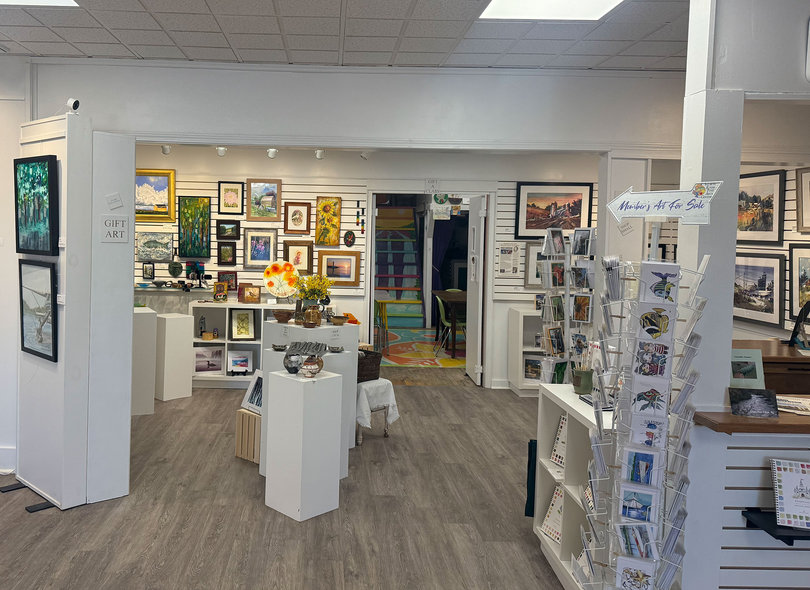
Anderson’s watercolor paintings will be on display at the Salmon River Fine Arts Center in Pulaski as part of the inaugural Spotlight Exhibit Series until Oct. 10. The series, which opened on Sept. 3, highlights members and volunteers helping to ensure the arts stay alive in the community.
This isn’t Anderson’s first exhibit at the center. In November 2024, his collection “Homelessness in America in Scene and Story” aimed to evoke empathy among viewers and help shift the stigma surrounding homeless individuals.
While Anderson was in high school, he discovered painting through art classes. But it wasn’t until after his time in the military that Anderson properly experimented with different mediums before finding his style.
Following Anderson’s high school graduation in 1985, he left his hometown in Camden, New York to join the United States Navy. Six years later, he was discharged from his last duty station in San Diego, California, but remained in the area for another 31 years to follow his passion for painting. In 2021, Anderson returned to central New York, moving to Fayetteville, where he continued his artistic career.
Anderson first attempted oil paints but quickly found they didn’t suit him. Then, while watching Bob Ross on TV, he was inspired to try acrylic. Though an improvement, it still wasn’t his forte. Anderson’s discouragement eventually made him put the brush down for six months.
Then one day while walking in downtown San Diego, he passed by the San Diego Watercolor Society art gallery. A painting in the window stood out.
“It was like a lightbulb just went off,” Anderson said. ‘‘And I go ‘That’s exactly how I want to paint.’”
Today, Anderson’s pieces are featured in both public and private collections. Most of them consist of seemingly mundane scenery that instead elicit a comforting familiarity, such as the messy surface of a diner table or three Adirondack chairs resting on a wooden dock overlooking water.
Anderson’s current collection at the Salmon River Fine Arts Center features moody farmscapes on canvas, reminiscent of central New York’s farming industry.
His style focuses heavily on value, which helps him intentionally represent each subject in his work.
“When somebody looks at my paintings, I know they see a very colorful painting,” Anderson said. “But really, the bones behind them, what makes them work, is the value. I want to make sure I hit the value for the most impact.”
WHAT YOU SHOULD READ NEXT
Winning NYS Fair painting contest honored SU administrator’s family legacy
In August, Syracuse University employee Kevin Costello won first place in the Great New York State Fair’s arts competition.
Ann Buchau, gallery committee and advisory board member of the Salmon River Fine Arts Center, met Anderson a few years ago, shortly after his return to central New York. Anderson discovered the arts center while visiting Pulaski with his wife, Kelly Bargabos, for the town’s annual Salmon Run.
Buchau expressed her enthusiasm for the center’s second collaboration with Anderson and for the paintings in this particular series.
“They’re quite beautiful,” Buchau said. “It’s just a really beautiful perspective of the area around us.”
The two became acquainted when Anderson showed her his watercolor works, leading him to teach art classes at the center for two years. However, his instructional abilities decreased when he started to experience health issues.
In October 2025, Anderson was diagnosed with ALS, a progressive neurological disease that destroys motor neurons and makes it difficult to control muscle movements. Anderson credits his wife for being his rock as the days go on.
Because of the disease’s deterioration, Anderson’s physical capacity soon declined. He now depends on mobility aids and a desk-attached device called a Saebo mini, which provides stable arm support so he can still paint.
The Spotlight Exhibit Series is Anderson’s first exhibition since receiving his diagnosis. Due to his membership status and close relationship with the Salmon River Fine Arts Center, the organization’s board of directors created the initiative with him in mind.
“Craig’s been a friend of the art gallery for a number of years,” said Judy Van Wie, President of the Salmon River Fine Arts Center board of directors. “When we heard that he was diagnosed with ALS, we wanted to do something.”
The center decided to contribute their sales commission from Anderson’s collection — on his behalf — to the Sean M. Healey and AMG Center for Integrated ALS Care and Discovery at Massachusetts General Hospital’s Brigham Neuroscience Institute. The institute has multiple clinical studies underway in hopes of better understanding ALS and advancing the development of effective therapies.
That inspired Anderson to pledge his own earnings, ensuring that 100% of sales from the exhibit would be donated, Van Wie said. Amazed by the center’s generosity, he said he felt strongly supported.
Van Wie is particularly empathetic to Anderson’s diagnosis, as her brother shares the same condition.
“It’s funny how ALS connects people. I mean, our little art gallery in Pulaski, New York, now being able to make a contribution to research,” Van Wie said.
Nearly 25 visitors attended the exhibit’s opening day, Buchau said. She recalled another attendee who had ALS came to meet Anderson, knowing firsthand what the artist was going through.
“People think that it’s just an art gallery,” Van Wie said. “My hope is to spread the word that we are so much more than that. It’s a place of community, where people can come and appreciate what art can do in their lives.”
Anderson echoes this sentiment, especially in a current societal culture that feels notably disconnected.
People nowadays are less present, always quick to move on from conversation or rushing to get home, he said. Anderson hopes others can benefit the same way he has from looking at his artwork.
“In the end, (ALS is) going to take everything from me,” Anderson said. “But I’m just keeping a great attitude, and my mantra is just to live the best life I can for as long as I can. I’m going to continue to paint for as long as I can.”